What is Signs of a Highly Sensitive Person?
Signs of a highly sensitive person are the consistent patterns of deep processing, strong empathy, and easy sensory overwhelm that show up across many situations rather than on one tiring day. In plain terms, the signs you're a highly sensitive person point to a temperament wired to notice and feel more than average. This is a trait, not a defect, and it sits at the center of the broader pillar guide to the highly sensitive person, which explains what high sensitivity means before any checklist is useful.
- Picks up subtle detail — tone, light, a shifting mood — that others tune out
- Feels emotions, both their own and other people's, with unusual depth
- Needs more downtime than most to recover after loud, busy, or intense days
Read together, these point to a nervous system that runs deep, not one that is doing something wrong.
Why It Matters for Self-Awareness
Most checklists fail the very people who need them, which is why reading the signs you're a highly sensitive person carefully matters far more than scoring high on a quiz. In my years reading aura color and energy fields — work that descends from the tradition Barbara Ann Brennan helped popularize — the same frustration surfaces again and again: a list labels everyone, so a genuinely sensitive person and a simply exhausted one walk away with the identical result. That is the exact friction this page exists to clear. The confusion usually shows up in three ways:
- Everything-fits lists. Broad prompts like "do you cry at sad films?" describe most humans, so a real marker of sensory processing sensitivity blurs into ordinary feeling and stops meaning anything at all.
- The tiredness mix-up. A hard week, thin sleep, or quiet burnout can copy the look of sensitivity, and a single snapshot can't separate a steady temperament from one rough stretch.
- The introvert overlap. Needing quiet often gets filed under shyness, yet high sensitivity and introversion are related, not identical — you can sit firmly in one camp without the other.
Self-awareness here is not about earning a label or winning an argument with yourself. It is about seeing your own pattern clearly enough to stop apologizing for needs that were never flaws, and to start arranging a life that fits how you are actually built.
Signs of a Highly Sensitive Person vs Adjacent Concepts: How It Works + Trade-offs
The signs you're a highly sensitive person look a lot like their neighbors, and telling them apart is exactly where most lists give up. Here is how each comparison works and where the trade-off lands:
- Sensitivity vs introversion. Introversion is about where your energy comes from; sensitivity is about how deeply you process what comes in. To get the introvert's clean social battery you give up nothing on depth — many highly sensitive people are extroverts who love people yet still drain fast in stimulating rooms.
- Sensitivity vs autism. The two share surface signs, especially sensory overwhelm and a love of routine, which is why the comparison of highly sensitive person and autism is worth reading slowly. Underneath, the way it works differs: autism centers on social communication and pattern, sensitivity on depth of feeling — so to gain one tidy label you sacrifice accuracy, since the two can also coexist in the same person.
- Sensitivity vs a rough week. Here the whole difference is consistency. A bad stretch lifts when the pressure does, while a temperament simply stays put. To call yourself sensitive on the strength of one bad day, you trade a real lifelong pattern for a passing mood.
The honest read is that none of these comparisons gives you a clean yes or no. They give you a way to weigh a steady pattern against a one-off, which is the only fair test a checklist can offer.
How to Read Signs of a Highly Sensitive Person in Yourself
Reading the signs you're a highly sensitive person in your own life means watching for a pattern that holds over weeks, not grading a single overwhelming afternoon. For those drawn to astrology, the inner, porous quality many people recognize in themselves is often explored through the explainer on the 12th house in astrology. Use these as observations to collect over time, not as a score to chase:
- Notice whether loud, bright, or crowded places drain you faster than they seem to drain the people standing right next to you.
- Track how long you need alone after intense days — for many, recovery is measured in hours, not minutes.
- Watch for catching a room's mood before anyone says a word, then carrying that mood home with you.
- Check whether criticism or violent media lingers in your body well after others have shrugged it off.
- See whether rich detail — a scent, a texture, a small kindness — moves you more than the moment seems to call for.
If most of these hold true across very different settings, you are likely looking at a temperament. If they only appear when you are already stretched thin, you may simply be tired.
Common Misreadings
A few misreadings about the signs you're a highly sensitive person keep people stuck, and clearing them up is half of what these observations are actually for. Each one swaps a useful pattern for a label that does not fit:
- Misread: sensitivity means weakness. High sensitivity is a neutral trait, and the same depth that makes noise costly also fuels empathy, craft, and a knack for noticing what others miss entirely.
- Misread: every emotional person is highly sensitive. The real marker is consistency across many contexts, not one teary film, one stressful month, or one season of grief.
- Misread: you can label yourself from a list. A checklist points to a pattern worth watching; it is not a clinical assessment, and it cannot tell you who you are.
- Misread: sensitive people are fragile and need to toughen up. Sensitivity is not damage to be repaired — it is a setting to understand, work with, and protect rather than override.
Naming these misreadings does more than tidy up definitions. It hands back the self-trust that vague, everyone-fits lists quietly chip away at.
Signs of a Highly Sensitive Person at a Glance
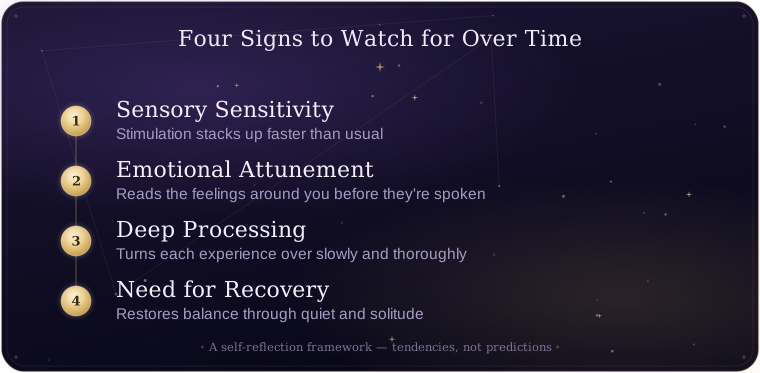
| Property | How It Works | Energy Center | How to Observe |
|---|---|---|---|
| Sensory sensitivity | Takes in more raw input before filtering it, so stimulation stacks up faster than usual | Solar plexus | You leave loud or bright places wrung out while others seem unbothered |
| Emotional attunement | Reads and absorbs the feelings around you, often before they are spoken | Heart | You catch a friend's mood shift before they say anything is wrong |
| Deep processing | Turns each experience over slowly and thoroughly instead of skimming it | Third eye | You replay conversations and decisions long after everyone else has moved on |
| Need for recovery | Restores balance through quiet, solitude, and low stimulation | Root | You crave hours alone after a packed, social, or conflict-heavy day |
The energy-center column draws on the modern chakra framework Anodea Judith systematized, matching each sign to the seat where many practitioners feel it most strongly. Read it as a reflective lens, not a measurement — it is one more way to notice a pattern, never proof of one.
Questions People Ask About Signs of a Highly Sensitive Person
Is being a highly sensitive person a flaw?
No — it is widely regarded as a normal temperament trait, not a medical label. This trait describes how a nervous system processes input, and many people live richly with it once they understand how they work.
Can you be a highly sensitive person and an extrovert?
Yes. Sensitivity is about depth of processing, not social preference, so plenty of outgoing, people-loving folks still feel flooded and need genuine recovery time afterward.
How do I know if I'm sensitive or just stressed?
Look at consistency over time. Stress eases when the pressure lifts, while a real pattern of sensitivity stays steady across many different situations and seasons.
Can high sensitivity change over time?
The core trait tends to stay stable, but how strongly it affects you can shift with your environment, your rest, and how well you manage stimulation day to day.
Reflection Prompts
- Think of a recent moment when a noisy or crowded place left you drained — how long did you need afterward to feel like yourself again?
- Recall the last time you absorbed someone else's mood; what told you the feeling was theirs and not your own?
- Look back over the past month and notice whether the signs you're a highly sensitive person held steady or appeared only on your hardest days.
Related Reading
For the research framing behind the trait, the Sensory processing sensitivity (Wikipedia) offers a neutral overview of how high sensitivity has been studied, which pairs well with the more personal lens used here.
Take Action
Want the full picture, not just the signs? Start with the complete guide to the highly sensitive person, then read it against your own life over a full week instead of a single hard day. That turns a vague, everyone-fits checklist into a pattern you can actually see — and it trades quiet self-doubt for a kinder, steadier sense of how you are wired.
Sources
This is not a clinical interpretation or mental-health advice; for assessment or support, consult a qualified professional.
- Anodea Judith — systematized the modern chakra framework this map of energy centers draws on
- Barbara Ann Brennan — helped popularize the practice of reading the body's subtle energy field