What is The North Node?
The North Node is the point where the Moon's orbit crosses the ecliptic heading north, and in a birth chart it marks the growth direction you are still developing rather than a trait you already carry. When people search for how to find north node positions, they usually want two concrete details: the zodiac sign it occupies and the house it sits in. Put simply, the North Node is the sign-and-house position you locate first, then grow toward.
- Always sits exactly opposite the South Node, with the two forming a single axis
- Located by sign, which names the quality to develop, and house, the life area to develop it in
- Read as a direction to move toward, not a personality label you wear today
This sits inside the broader pillar guide to the lunar nodes axis, which maps how both ends of the axis work together.
Why It Matters for Self-Awareness
Knowing how to find north node positions matters because the result steers your entire reading, yet most people stall at the very first step: two calculators hand them two different answers. The friction is rarely about meaning — it is about trust. You can locate a node in under a minute, then lose an afternoon to conflicting tables that disagree by a single degree or, occasionally, a whole sign. A slightly wrong sign is not a small error; it quietly redirects every interpretation that follows, because the node's sign is the thing you build the rest of the reading on top of.
Across thousands of hours of chart consultation over the past twelve years, I have watched the same snag repeat: a reader finds the placement, then second-guesses it because one site reports the true node and another reports the mean node without ever naming the difference. The psychological-astrology lineage that Liz Greene and Howard Sasportas helped shape reads this axis as a direction of growth rather than a fixed verdict, which is exactly why pinning down the correct sign matters more than collecting keywords. When the sign is solid, the node stops being trivia and starts describing where your development tends to want to go.
The North Node vs Adjacent Concepts: How It Works + Trade-offs
Working out how to find north node positions differs from reading a planet, because a node is a calculated crossing point rather than a physical body, and a few neighboring ideas are easy to mix up. Sorting them out is what keeps a quick lookup from turning into an afternoon of doubt. Three comparisons clear up most of the confusion:
- North Node vs South Node. The two points always sit exactly opposite each other, so the way it works is almost trivially simple: locate one and you immediately have the other. The North Node names the direction you are growing toward, while the South Node names the well-worn strengths you fall back on without thinking. To claim the growth the North Node points to, you accept moving away from skills that already feel effortless — which is why progress in that direction often feels like work rather than relief.
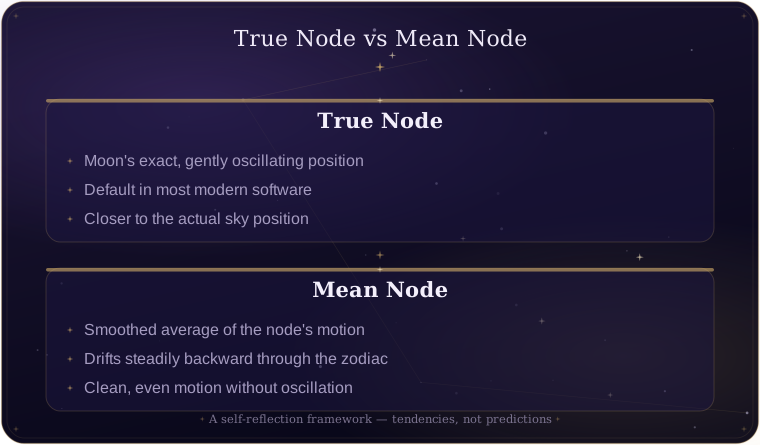
- True node vs mean node. The mean node is a smoothed average that drifts steadily backward through the zodiac, while the true node is the Moon's exact, gently oscillating position; as technical astrologers like Robert Hand have detailed, the two normally agree within a degree or two. To gain the astronomical precision of the true node, you give up the clean, even motion the mean node shows, and most modern software quietly defaults to the true setting. The trade-off only becomes visible near a sign boundary, where that small gap can place your node in one sign or the next.
- The node vs a personality placement. A Sun or Moon sign describes how you tend to operate right now, whereas the North Node describes where growth tends to pull you over time. The difference is one of tense, not category — present habit versus future direction. To read the node as a current trait, you would have to surrender the single thing it actually offers, which is a sense of direction rather than a description of who you already are.
How to Read The North Node in Your Chart
The practical answer to how to find north node placements comes down to a short, repeatable sequence rather than a single lookup, and once you have the sign you can pair it with a north node by sign meanings guide to interpret it:
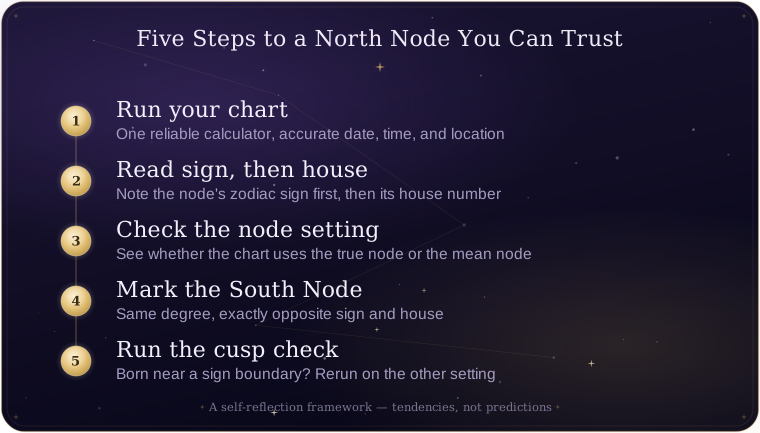
- Run your chart from one reliable calculator using an accurate birth date, time, and location.
- Read the node's zodiac sign first, then note the house number it falls in.
- Check the settings to see whether that chart uses the true node or the mean node.
- Mark the South Node at the same degree in the exactly opposite sign and house.
- If you were born near a sign cusp, rerun it on the other node setting to check whether the sign shifts.
Run through these once and the result stops feeling fragile. The order matters: you confirm the sign, settle the true-or-mean question, and only then move on to interpretation, so a calculator quirk never derails the reading before it has a chance to start. Most people who feel stuck have simply skipped the third step and never noticed which setting their chart used.
Common Misreadings of the North Node
Most trouble with how to find north node settings comes from a handful of repeatable mistakes, and each has a clean correction:
- Treating the node as a fixed trait. The node is read as a direction to grow toward, not a label you already embody, so describing someone as "a North Node in Aries person" the way you would a Sun sign misses what the point is for.
- Reading the North Node in isolation. It only makes sense paired with the South Node directly opposite it; drop one end and you lose the contrast that gives the other its meaning.
- Assuming every calculator agrees. True and mean settings can differ by a degree or more, and near a sign boundary that gap is occasionally enough to change the sign entirely.
- Expecting the node to feel like a reward. Its sign tends to name qualities that feel unfamiliar or effortful at first, which is the intended texture of growth rather than a sign you located it wrong.
Each correction points back to the same habit: slow down at the calculation stage so the meaning stage has something stable to stand on.
The North Node at a Glance
| Property | How It Works | Where It Shows in the Chart | How to Observe |
|---|---|---|---|
| North Node sign | Names the quality you are growing toward | The zodiac sign at the node's degree | Note which sign the node lands in on your chart |
| North Node house | Points to the life area for that growth | One of the twelve houses | Read the house number the node falls in |
| South Node link | Sits exactly opposite as the familiar end | Same degree, opposite sign and house | Find the point 180 degrees away |
| True vs mean setting | Shifts the exact degree slightly | A calculator option, not a chart zone | Check the software's node setting |
| Cusp sensitivity | Can move the sign when the node is near a boundary | Late or early degrees of a sign | Recompute on both settings if near a cusp |
Questions People Ask About the North Node
What is the difference between the true node and the mean node?
The mean node is an averaged position that drifts steadily backward, while the true node is the Moon's exact, slightly oscillating position. They usually sit within a degree or two of each other, so for most charts either reading lands you in the same sign.
Can my north node be in a different sign depending on the calculator?
Yes, but only when your node falls very close to a sign boundary. In that narrow case the true and mean settings can place it on either side, which is exactly why the cusp check is worth the extra minute.
Do I need an exact birth time to find my north node?
The node moves slowly, so an approximate time still gives the correct sign in almost every case. An exact time mainly sharpens the house placement, not the sign itself.
Is the north node the same as my rising sign or my moon?
No. The rising sign and Moon describe how you tend to operate now, while the node marks a direction of growth measured from the Moon's orbit rather than from the Moon itself.
Reflection Prompts
- Think of a recent moment when stress pushed you back into an old, comfortable habit — which familiar pattern was running the show?
- Recall a decision this month that felt awkward but quietly right — how did it echo your North Node's sign?
- Picture a step you keep postponing — does it ask for the very quality your North Node points toward?
Related Reading
- guide to the twelve astrological houses — to read the life area your node's house points to.
- the Persephone goddess and the descent-and-return cycle — the underworld myth and asteroid that trace the same descend-and-rise rhythm the nodal axis describes between the South and North Nodes.
- Lunar node (Wikipedia) — for the orbital background behind the calculation.
Take Action
Once you have located your node's sign and house, read both ends of the axis together: Read the North Node vs South Node guide to understand the axis you just located. That pairing shows you the familiar South Node patterns sitting directly opposite your growth direction, and seeing the two side by side is what turns a single coordinate into a usable sense of where you are being asked to stretch. The placement on its own is a fact; the axis is what makes it personal.
Sources
- Liz Greene — helped establish the psychological reading of the birth chart that frames the nodes as a growth axis rather than fate
- Howard Sasportas — developed the house-centered, growth-oriented approach to interpretation this method draws on
- Robert Hand — documented the technical distinction between the true and mean node calculations