
What is IC?
The Imum Coeli (IC) is the lowest point of a birth chart, the spot directly opposite the Midheaven at the very base of the wheel. Sitting within the wider glossary pillar of core astrology terms, ic astrology reads in modern chart work as the chart's root of home, family, and your private emotional base. The IC is calculated from your exact birth time and place, so it depends on the moment you were born rather than the day alone. Where the Midheaven at the top of the chart describes your public role and what the world sees, the IC marks what stays hidden: where you come from, what you retreat to, and the inner ground everything else is built on.
- Marks the base of the chart, the point opposite the Midheaven
- Governs home, ancestry, family of origin, and your most private self
- Read as the inner foundation you return to rather than anything on public display
Why It Matters for Self-Awareness
Understanding ic astrology matters because this is the part of the chart where many readers get quietly stuck, and the friction is precise rather than vague. People learn to read their Sun, Moon, and rising with real confidence, then treat the IC as "just the home point" and move on. The cost of that shortcut is missing the most private root of identity, the inner base that quietly shapes how every other placement behaves. The IC is easy to skip because it sits at the bottom of the chart, out of sight, in the territory of family, childhood, and the parts of yourself you rarely show anyone.
In my own work, seven years in commercial data analysis followed by five years applying pattern-recognition methods to chart structure taught me to watch the IC before reading anything flashier, because the base of a structure explains the rest of it. This way of reading the angle follows the lineage Liz Greene and Dane Rudhyar helped establish, which treats the IC less as a label for "where you live" and more as the chart's site of psychological foundation. That orientation toward the base is also why the IC works in such direct tension with the sibling explainer on the descendant and one-to-one relating, the angle that turns you outward toward others.
IC vs Adjacent Concepts: How It Works + Trade-offs
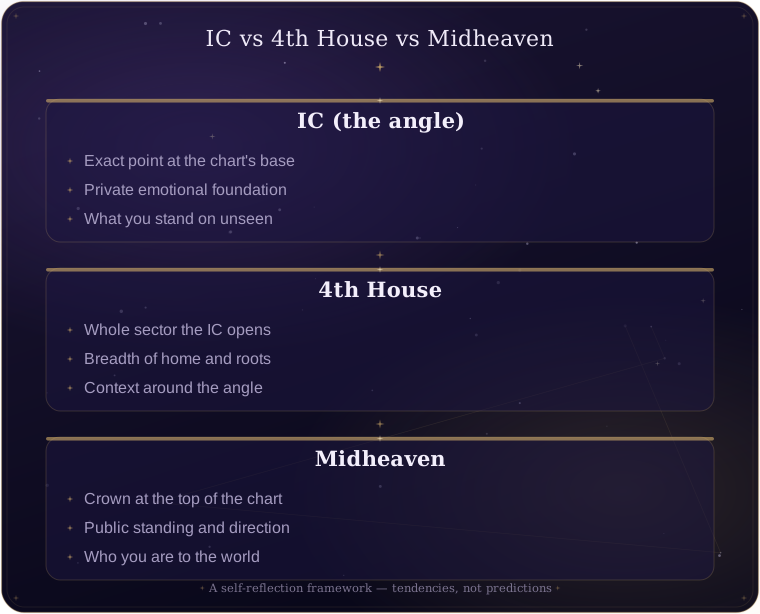
ic astrology becomes clearer when you set the IC beside the concepts it is most often confused with, because each comparison exposes a different trade-off in how the chart moves between the public and the private. The most useful contrasts are these:
- The IC versus the 4th House. The 4th house is a whole sector of experience covering home, family, and roots, while the IC is the single precise point that opens that sector at the chart's base. To gain the IC's pinpoint accuracy you give up the 4th house's breadth; the way it works, the angle names one exact degree of foundation rather than describing the full territory around it. Reading only the house, you lose the sharp focus the angle provides; reading only the angle, you lose the surrounding context the house fills in.
- The IC versus the Midheaven. The Midheaven crowns the chart with your public standing and visible direction, whereas the IC anchors the opposite end with your private base. To lean into the IC over the Midheaven is to prize inner security over outward recognition: you gain a stable foundation to operate from, but you sacrifice some of the Midheaven's drive toward being seen. In practice the Midheaven asks who you are to the world; the IC asks what you quietly stand on when no one is watching.
- The IC versus the Ascendant. The Ascendant is the mask and first impression you lead with, while the IC is the hidden interior that mask protects. Choosing to read from the IC rather than the Ascendant trades surface legibility for depth; you reach the private root, but you give up the quick, visible signal the rising sign offers. The Ascendant shows the door; the IC shows the room behind it.
How to Read IC in Your Chart
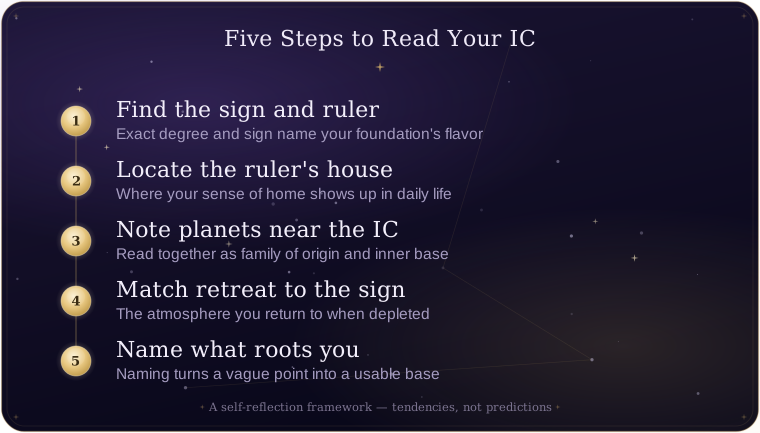
Reading ic astrology in your own chart works best as a single observe-then-apply sequence rather than a trait checklist, because the root of identity rarely announces itself as one obvious symbol. Instead of staring at the bottom of the chart and waiting for a verdict, trace the IC through parts of the chart you can already see:
- Find the exact degree and sign on your IC and note its planetary ruler, which names the flavor of your private foundation.
- Locate the house that ruler occupies, since that visible house is where your sense of home tends to show up in daily life.
- Note any planets sitting close to the IC, then read them together as a description of your family of origin and inner base.
- Recall the home or atmosphere you retreat to when you are depleted, and match its tone to the sign on your IC.
- Name out loud what actually makes you feel rooted, because that act of naming turns a vague "home point" into a foundation you can use.
Common Misreadings
Most confusion about ic astrology comes from a few popular shortcuts that flatten a foundation-rich angle into a single keyword. Each common misreading is worth correcting on its own terms:
- "The IC is just where you live." Physical address is one minor expression; the real territory is your private emotional base and where you come from, which travels with you no matter how many times you move.
- "The IC and the 4th house are the same thing." They overlap but are not identical: the IC is the precise angle, the 4th house is the whole sector it begins, so collapsing one into the other loses the angle's sharp focus.
- "The IC only matters for family questions." Family of origin is central, yet the angle also describes your need for privacy, your inner sanctuary, and the foundation any later achievement rests on.
- "The bottom of the chart is the unimportant part." The base is where structure begins; an unread IC leaves the rest of the chart standing on a foundation you never bothered to examine.
IC at a Glance
| Property | How It Works | Element / Ruler | How to Observe |
|---|---|---|---|
| Chart position | Lowest point, opposite the Midheaven | Cancer / Moon (traditional resonance) | Find the base of the wheel, directly below center |
| Life area | Home, family of origin, private base | Cancer / Moon | Notice where and to whom you retreat to recharge |
| Inner role | The foundation other placements build on | Water / Moon | Track what makes you feel rooted versus uprooted |
| Privacy | Holds the hidden, unshown self | Cancer / Moon | Watch what you protect and rarely show others |
Common Questions About IC
What does the IC mean in a birth chart?
The IC, or Imum Coeli, is the lowest point of the chart and marks home, family roots, and your private emotional foundation. Because it sits opposite the Midheaven of public life, it describes the hidden base you operate from rather than the role the world sees.
Is the IC the same as the 4th house?
Not quite. The IC is the exact angle at the base of the chart, while the 4th house is the full sector it opens, so the IC gives pinpoint focus and the house provides surrounding context. In ic astrology they are read together rather than treated as interchangeable.
Why do I need my exact birth time for the IC?
The IC is one of the four angles, and angles shift quickly as the earth rotates, so an inaccurate time moves the point into a different degree or sign. Without a precise birth time, the IC is the placement most likely to be wrong.
Does the IC have a fixed ruling sign?
No. The IC is an angle, a calculated point, not a sign, so it has no permanent ruler. The Cancer and Moon association you often see is only a "natural house" resonance: the 4th house, which the IC opens, is Cancer's natural house, which is why the angle carries themes of home, nurture, and belonging. The sign actually sitting on your IC depends entirely on your birth time and place, so it can be any of the twelve.
Reflection Prompts
- Think of a recent moment you felt truly at home; what about that place or person made it feel like your base?
- Recall where you instinctively retreat when you are depleted, and what that choice says about your roots.
- Name one thing from your family of origin you quietly carry that almost no one else gets to see.
Related Reading
- explainer on the Midheaven and your public direction — useful for reading the IC against its opposite angle, since the private base and the public role define each other.
- Midheaven (Wikipedia) — context on how the angles are calculated and positioned in a birth chart.
Take Action
Pull up your own birth chart and find the point at the very bottom of the wheel, then read its sign and ruler with the full guide to reading a birth chart to find your IC at the base of the chart. You will come away with a clear map of where your private foundation actually sits, and once you can name the base you quietly stand on, the rest of the chart stops reading as scattered traits and starts reading as a structure with a root you recognize.
Sources
- Liz Greene — helped establish the psychological reading of the chart's angles as fields of inner development rather than fixed forecasts
- Dane Rudhyar — pioneered the person-centered approach that treats the IC as the chart's foundation of identity and roots