
What Is the Jessica Pegula Birth Chart?
The Jessica Pegula birth chart is a symbolic map of the planets' zodiac positions at her February 24, 1994 birth, read as interpretive themes rather than facts about her life or results. This sits within the broader tradition of pillar guide on how to read a birth chart, which maps how every placement fits together. Astrologers treat the layout as a lens for reflection, not a verdict on who she is. The placements below are computed from that Feb 24, 1994 birth date using an ephemeris (for example Astrodienst / astro.com); because no birth time is publicly documented, an honest reading stays with the planetary signs and skips the ascendant, houses, and exact angles.
At a glance, her chart reads:
- Sun, Venus, and Saturn in Pisces — a tight water stellium of sensitivity, imagination, and quiet discipline
- Mercury (retrograde) and Mars in Aquarius — an independent, analytical, contrarian air pair
- Jupiter and Pluto in Scorpio, with the North Node there — depth, privacy, and transformation
- Moon likely in Leo — but near a sign boundary, so a best estimate rather than a fact
The single most distinctive thing here is not any one sign but the collision at the center: a feeling-led Pisces stellium bolted directly to a detached Aquarius pair — sensitivity yoked to cool distance in the same person.
Why It Matters for Self-Awareness
Understanding the Jessica Pegula birth chart matters because it models a skill anyone can borrow: reading a public figure's chart as a mirror rather than a scoreboard. When placements are held as symbols, the exercise becomes a way to reflect on your own patterns of expression, boundaries, and identity. A few concrete uses stand out:
- Separating symbol from person. Practicing on a celebrity chart trains you to hold placements as themes, not fixed truths, and that habit carries back to reading yourself with more fairness.
- Noticing a Pisces–Aquarius tension. The chart's blend of dreamy, sensitive water and cool, independent air is a familiar inner split many people recognize in their own moods and choices.
- Reflecting on what you can honestly claim. Some of a chart is solid signal and some is guesswork, and telling them apart is a discipline useful far beyond astrology.
This kind of symbolic practice, building on the person-centered reading tradition Dane Rudhyar helped shape, pairs naturally with learning your own guide to rising sign meaning, where the same interpretive care applies. Reading someone else's placements first is low-stakes rehearsal; there is no ego on the line, so it is easier to notice when a single label is doing too much work.
The Full Birth Chart vs a Sun-Sign Read: What Actually Differs
The Jessica Pegula birth chart differs from a simple sun-sign read the way a full paragraph differs from a single word. A sun-sign read takes only her Pisces Sun and spins a personality sketch from it. A full chart layers every planet's sign — Venus and Saturn joining the Sun in Pisces, Mercury and Mars in Aquarius, Jupiter and Pluto in Scorpio — so the themes qualify and complicate one another instead of resolving into one neat trait.
What makes her chart unusual is that central collision: a three-planet Pisces stellium (Sun–Venus–Saturn) sitting against an Aquarius pair (Mercury–Mars). Read symbolically, that is porous, feeling-led water fastened to detached, systemizing air — deep sensitivity paired with instinctive distance in one temperament. That specific friction, not a generic "Pisces is dreamy" line, is what a real reading of this chart has to sit with.
Where the two readings pull apart
The trade-off is real. To get the speed and shareability of a sun-sign label, you sacrifice nuance: "she's a Pisces" is easy to repeat but flattens the analytical Aquarius side and the intense Scorpio undercurrent entirely. To get the depth of the full chart, you take on ambiguity and give up the tidy one-liner. You cannot have both the headline and the whole story.
Why pop-culture astrology leans on the shortcut
Celebrity astrology reaches for the sun-sign version because it fits a caption and a quick scroll. A full-chart read holds more contradictions and says less that is catchy, which is exactly why it is more honest. The meaning is additive: each placement is a clause, and the reading lives in how the clauses argue. Treating the chart as an interpretive framework — not a fixed identity — keeps it grounded and clearly symbolic.
How to Read the Standout Placements in This Chart
Reading this chart symbolically means noticing which placements repeat a theme and which argue with each other. Modern interpreters like Robert Hand stress reading placements in combination rather than isolation, so look for the pattern before the single point:
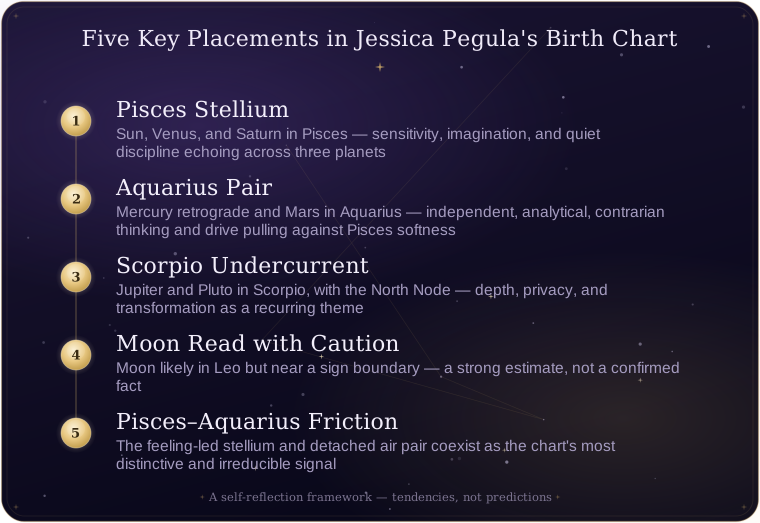
- A Pisces stellium. Sun, Venus, and Saturn all sit in Pisces, so sensitivity, imagination, and quiet discipline keep echoing.
- An Aquarius pair. Mercury (retrograde) and Mars in Aquarius suggest an independent, analytical, contrarian mental and motivational style that pulls against the Pisces softness.
- A Scorpio undercurrent. Jupiter and Pluto in Scorpio, with the North Node there too, point to depth, privacy, and transformation.
- A Moon read with caution. The Moon is likely in Leo but sits near a sign boundary, so its sign stays a best estimate, not a fact.
- The Pisces–Aquarius friction. The most distinctive signal is how the feeling-led stellium and the detached air pair coexist — hold that contradiction rather than smoothing it into one trait.
Common Misreadings
Most casual coverage of the Jessica Pegula birth chart trips on the same handful of errors. Here is each set against what a careful symbolic read actually supports:
- Misreading: the chart predicts her results. It does not — a birth chart is symbolic and says nothing measurable about matches, rankings, or outcomes.
- Misreading: she's "just a Pisces." The Aquarius and Scorpio emphasis is at least as loud, so the single-sign label erases most of the picture.
- Misreading: the ascendant is known. With no documented birth time, any stated rising sign, house, or angle is speculation dressed up as fact.
- Misreading: symbolism equals biography. Chart themes describe archetypes to reflect on, not documented events in anyone's life.
The Jessica Pegula Birth Chart at a Glance
| Placement | How It Works | Element / Emphasis | Symbolic Theme |
|---|---|---|---|
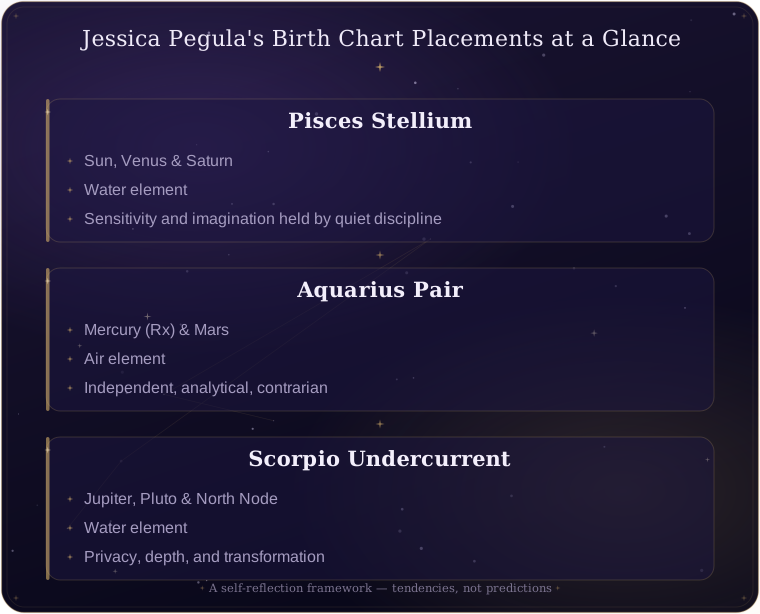
| Pisces Sun, Venus & Saturn | A tight stellium coloring core identity, values, and inner structure | Water | Sensitivity and imagination held by quiet discipline |
| Aquarius Mercury (Rx) & Mars | Shapes thinking and drive against the Pisces grain | Air | Independent, analytical, contrarian |
| Scorpio Jupiter & Pluto | Deepens themes of growth and intensity | Water | Privacy, depth, and transformation |
| North Node in Scorpio | Points to a symbolic direction of growth | Water | Leaning into depth over surface |
Questions People Ask About This Birth Chart
What can a birth chart tell you without a birth time?
It reliably shows planetary signs — like a Pisces Sun and an Aquarius Mars — and the themes those signs carry. It cannot confirm the ascendant, houses, or precise angles, which all require a documented birth time.
Is her Moon really in Leo?
The Moon is likely in Leo, but it sits close to a sign boundary, so it stays a strong estimate rather than a certainty. A neighboring sign remains possible, and an honest reading says so.
Does the chart say anything about her career?
No. A symbolic reading describes archetypal themes for reflection and makes no claim about results, ranking, or biography. Astrology here is a framework for thinking, not a forecast.
Why do different sites give different readings?
Many blend sun-sign shortcuts with full-chart interpretation and sometimes guess at unknown angles. Comparing only the confirmed planetary signs — computed from her Feb 24, 1994 birth date — keeps a reading grounded and consistent.
Reflection Prompts
- Think of a recent time you labeled someone by one trait; what did that single word make you miss about them?
- Recall a moment when your quiet, private side and your cooler, analytical side pulled in opposite directions.
- Think back to a confident claim you once accepted that later turned out to be a guess; how did you finally spot the gap?
Related Reading
- guide to the north and south lunar nodes — her Scorpio–Taurus nodal axis is a central symbolic theme worth understanding on its own.
- explainer on Mercury retrograde in a birth chart — her natal Mercury is retrograde in Aquarius, a placement people often misread.
- Jessica Pegula (Wikipedia)
- Astrology (Wikipedia)
Take Action
Ready to turn this practice inward instead of reading someone else's placements? Learn how to read your own birth chart and you can map your own planetary signs the same way — Pisces, Aquarius, Scorpio, and everything in between, laid side by side. Seeing your placements in one place makes it easier to reflect on how you express, protect, and understand yourself, and to notice which single label you may have been leaning on too hard.
This is not a clinical interpretation or mental health advice.
Sources
- Dane Rudhyar — pioneered the psychological, person-centered approach to reading a chart as symbolic narrative
- Robert Hand — advanced modern techniques for interpreting planetary placements in combination rather than isolation