
What Is John Denver's Birth Chart?
John Denver's birth chart is the full map of planetary placements for the folk singer born December 31, 1943, read here as a symbolic portrait of an earth-grounded artistic temperament rather than a fixed prediction.
- Anchored by a Capricorn Sun, pointing to disciplined, long-form craft
- Anchored in earth through its Capricorn Sun and Mercury, tying identity to land and the natural world
- Built for translation, turning private feeling into songs a wide audience recognizes
Read as a whole, a John Denver birth chart interpretation looks past a single Sun sign and treats the placements as one interconnected pattern. This approach sits alongside a broader guide on how to read a birth chart, which explains why the relationships between planets matter more than any isolated symbol. In my work reading full-chart structures instead of one placement at a time, the throughline in a chart like this is usually consistency: the same themes surface across the Sun, the elements, and the major aspects. That consistency is what makes the chart worth reading closely; when a placement seems to contradict the others, it usually points to a nuance rather than a flaw in the pattern.
Why It Matters for Self-Awareness
Understanding the John Denver birth chart matters because it models a useful question for anyone: how does a steady inner temperament turn into a recognizable public voice? Denver's chart is a case study in earth-sign persistence meeting a gift for shared emotion, and that tension is something many people carry in smaller forms. The chart gives you a language for it. That language is less about labeling yourself and more about noticing the recurring shape of how you work, root, and reach outward.
Looked at this way, the chart becomes a mirror for a few real-life patterns:
- Craft versus impulse. The Capricorn emphasis rewards showing up repeatedly, which helps you see where your own results come from patience rather than bursts of inspiration.
- Rootedness as identity. The earth weight ties selfhood to place and routine, a prompt to notice how much your sense of self depends on where and how you live.
- Private feeling made public. The chart's expressive side shows how personal emotion becomes something others relate to, useful for anyone deciding how much of themselves to share in their work.
The same interpretive lens used for the rising sign and ascendant meaning applies here: placements describe tendencies you can reflect on, not scripts you are locked into.
Full Chart Reading vs Sun-Sign Astrology: What Actually Differs
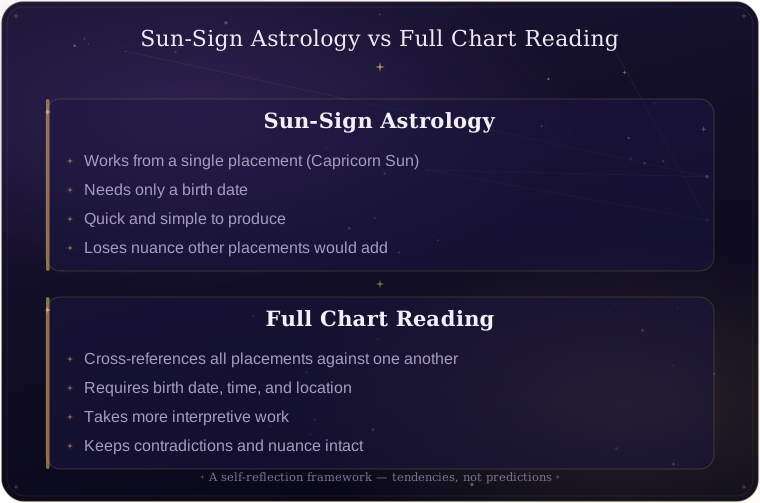
The John Denver birth chart differs from a plain Sun-sign profile mainly in scope, and the difference changes what you can honestly say about someone. Sun-sign astrology takes one placement — here, Capricorn — and builds a personality summary from it. A full chart reading treats the Sun as one voice among many, weighing elemental balance, planetary clusters, and the aspects between them.
Here is how each works. Sun-sign reading works by generalizing from a single, easy-to-find data point, which is why it needs only a birth date. A full-chart reading works by cross-referencing placements against one another, so a Capricorn Sun softened by watery, melodic aspects reads very differently from a Capricorn Sun sharpened by hard angles. Building on the person-centered approach Dane Rudhyar established, the whole chart is read as a living pattern rather than a checklist of traits.
The trade-off is concrete. To get the speed and simplicity of a Sun-sign take, you sacrifice accuracy and nuance — you lose everything the other placements would have qualified. To get the depth of a full John Denver birth chart reading, you sacrifice that easy shorthand and take on more interpretive work. Sun-sign summaries fit a quick scroll; full-chart readings fit anyone who wants the contradictions kept in.
How to Read John Denver's Birth Chart Like a Full Portrait
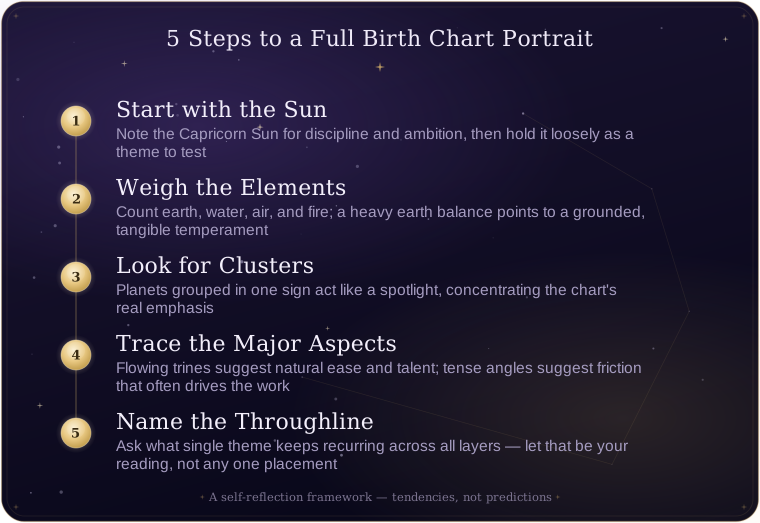
To read the John Denver birth chart as one artistic portrait rather than a list of signs, work through the structure in order and let each layer qualify the last.
- Start with the Sun, then hold it loosely. Note the Capricorn Sun for its discipline and ambition, but treat it as a theme to be tested against the rest of the chart.
- Weigh the elements. Count how much earth, water, air, and fire appear; a heavy earth balance points to a temperament grounded in the tangible and the natural.
- Look for clusters. Several planets grouped in one sign act like a spotlight, concentrating energy where the chart's emphasis really sits.
- Trace the major aspects. Flowing angles like trines suggest ease and natural talent; tense angles suggest friction that often drives the work.
- Name the throughline. Ask what single theme keeps recurring across these layers, and let that be your reading rather than any one placement.
Common Misreadings
Shallow write-ups tend to flatten the chart in predictable ways. The common misreadings of the John Denver birth chart are worth correcting one by one. Each one trades the full pattern for a shortcut, and each one loses something specific in the process.
- "He's just a Capricorn." The misread reduces the whole chart to one Sun sign; the reality is that the earth balance and the melodic, feeling-driven aspects shape his voice at least as much as the Capricorn Sun does.
- "The chart proves his biography." The misread treats placements as documented facts about his life; the reality is that a chart is a symbolic framework, not evidence of specific events or choices.
- "A birth chart predicts talent." The misread claims the chart caused his success; the reality is that astrology describes tendencies and emphases, and many people share similar placements without the same path.
The John Denver Birth Chart at a Glance
| Property | How It Works | Energy Center | How to Observe |
|---|---|---|---|
| Capricorn Sun | Grounds identity in discipline and long-form craft | Earth | Career-spanning output and steady work ethic |
| Capricorn Sun and Mercury | Anchor expression in the tangible and natural world | Earth | Recurring landscape and nature imagery in the songs |
| Melodic, feeling-driven aspects | Softens structure with warmth and directness | Water and air | Emotional plainness in ballads and love songs |
| Broad expressive reach | Turns personal feeling into shared song | Fire and air | Cross-generational, mass audience resonance |
Common Questions About John Denver's Birth Chart
Was John Denver a Capricorn?
Yes. Born December 31, 1943, his Sun sits in Capricorn, the disciplined, ambitious earth sign. That placement is the anchor most readings start from before weighing the rest of the chart.
Can you read John Denver's birth chart without a birth time?
Partly. Without a verified birth time, you can still read the Sun, elemental balance, and most planetary placements, but the rising sign and house positions stay uncertain. A responsible John Denver birth chart reading flags that gap rather than guessing.
Does the chart explain his music?
Not in a causal way. The earth emphasis and expressive aspects offer a symbolic lens for his nature-rooted, emotionally direct style, but the chart describes tendencies and never proves why the music turned out as it did. At most, it names the raw materials — earthy steadiness, emotional openness — and leaves the finished songs as their own achievement.
What does his chart say about his personality?
It suggests a temperament that blends Capricorn discipline with unusual emotional accessibility. The value is in the pattern across placements, not in any single trait pulled out on its own. Read together, those placements sketch a person who is both grounded and unusually easy to reach.
Reflection Prompts
- Think of a recent moment when your work expressed something personal that others still recognized. What made it land for them?
- Recall a time you chose steady craft over a quick shortcut. What did that discipline cost you, and what did it give back?
- Notice when a song or image tied you to a specific place or memory. What feeling did it put into words?
Related Reading
- Capricorn sun sign meaning and traits — unpacks the earth-sign anchor at the center of this chart.
- guide to major chart aspects like trines and squares — explains the angles that shape how placements interact.
- how planet clusters work in a birth chart — covers why grouped planets concentrate a chart's emphasis.
This is not a clinical interpretation or mental health advice.
Take Action
Map your own placements the way this reading maps Denver's: Generate your free birth chart to explore the John Denver birth chart approach. You will get a full-chart layout of your Sun, elements, and aspects in one view — and, more usefully, a symbolic language for seeing how your steady inner patterns become the voice other people recognize.
Sources
- Dane Rudhyar — pioneered the person-centered, whole-chart reading that treats a birth chart as a living pattern rather than a list of traits
- Liz Greene — advanced the psychological tradition of reading placements as tendencies for reflection, not fixed predictions