
What Is Jupiter in Cancer?
Jupiter in Cancer is the placement of Jupiter, the planet of growth and expansion, in Cancer, the sign of home, family, and emotional security, where a person tends to grow most through caring for others and building a felt sense of belonging. In classical astrology, Jupiter is considered exalted in Cancer, which is read as bringing out its warmer, more generous side. At its core, this placement reads as growth that expands through nurturing, protection, and emotional belonging.
- Widens its reach by giving care, comfort, and a sense of home rather than by chasing status
- Traditionally tied to the Moon and the fourth house, the chart's emotional foundation
- Easily read as soft or over-attached when it is really a deep capacity for emotional generosity
This sits inside the broader picture mapped by a pillar guide on how to read a birth chart, which shows how one placement interacts with the whole chart, not in isolation.
Why It Matters for Self-Awareness
Building on the psychological tradition Liz Greene helped establish, Jupiter in Cancer matters because it points to a precise self-awareness question rather than a personality label: when does your generosity toward the people you love begin to cost you more than it gives back? That single question tends to sit at the center of how this placement actually plays out across a real life, from the friendships you keep to the household you build to the causes you quietly take responsibility for. It reframes the placement as a pattern you can work with rather than a verdict handed down, and that shift in framing is often what makes the difference between reading your chart with curiosity and reading it with dread.
In working with psychological frameworks and evolutionary astrology, I have noticed that people with this placement often feel most themselves when they are holding space for someone else — cooking for a full table, checking in on a friend who is struggling, keeping the emotional temperature of a room comfortable. This instinct usually traces back to early family roles, and reading it consciously can support real self-awareness around them: the child who kept the peace, the sibling everyone leaned on, the person who learned that love and caretaking were the same thing.
The same warmth that makes this placement generous can quietly tip into over-giving, where your own needs get folded into everyone else's until they nearly disappear from view. Read as a growth question instead of a fixed trait, it invites you to notice the exact line between nourishing others and abandoning yourself. It connects naturally to the emotional territory of the guide to the fourth house in astrology, the part of the chart tied to home, roots, and the family patterns you carry into adulthood.
Jupiter in Cancer vs the Moon in Cancer: What Actually Differs
This placement sits inside a small cluster of emotionally sensitive positions — alongside Chiron and the twelfth house — that all speak to vulnerability, which is exactly why casual readings tend to blend them into one blurry idea of "the sensitive chart." The clearest confusion, though, is with the Moon in Cancer, because both put Cancer's caretaking themes front and center and both describe someone who leads with feeling rather than cool logic.
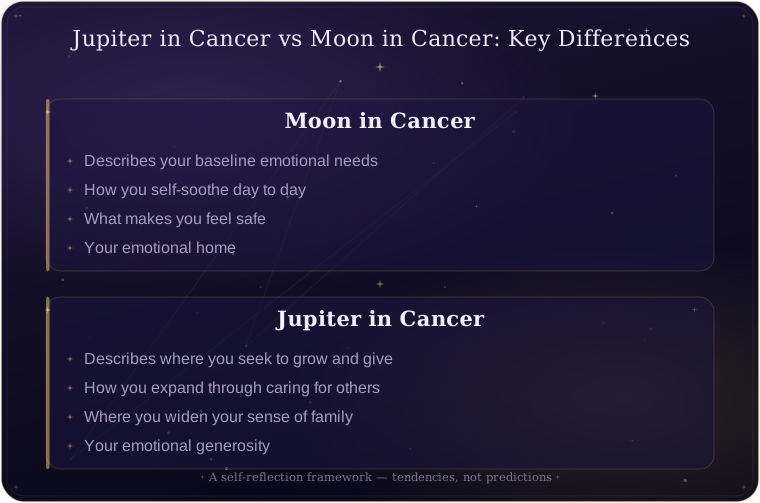
Here is how the two actually work differently. The Moon in Cancer describes your baseline emotional needs — how you self-soothe and what makes you feel safe from one day to the next. This placement describes something else: the area of life where you seek to grow, give more, and widen your sense of family. One is your emotional home; the other is your emotional generosity. The trade-off is real — to lean fully into the expansive warmth here, you give up some detachment, because the more you open your home and heart, the harder it becomes to hold a protective distance when a relationship turns costly. Someone can carry both positions at once, which is part of why they get flattened together: a Cancer Moon and this expansive placement often amplify each other, and untangling which one is really speaking in a given moment takes patience rather than a quick label.
Knowing where the reading stops is just as important as knowing what it covers. Astrologers such as Melanie Reinhart, through her work on Chiron, and Howard Sasportas, through his reading of the houses, held these as distinct territories for good reason. This placement is not the same as Chiron or the twelfth house, which deal with older, more private tender spots; blending them turns a story about generous growth into a vaguer story about pain, and the two should not be collapsed into one interpretation.
How to Read This Placement in Your Chart
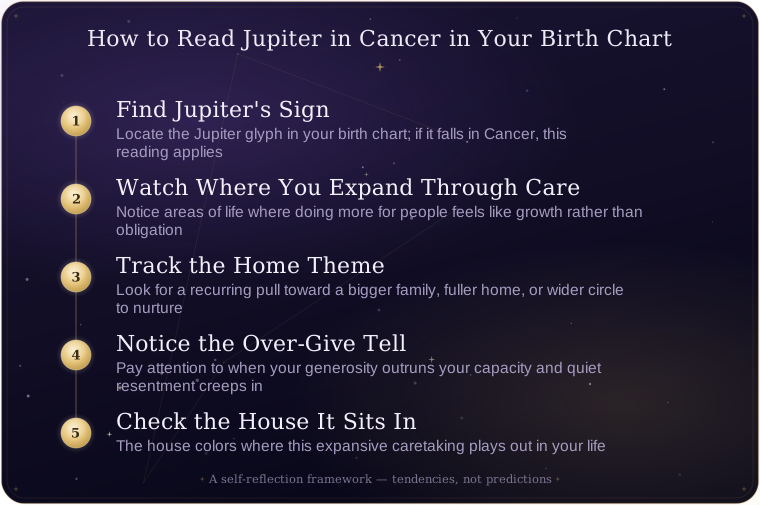
Because, according to NASA, Jupiter takes about 12 years to complete one orbit of the Sun, it spends close to a year in each sign, so many people born within the same roughly year-long window share Jupiter in Cancer. Spotting how it actually shows up in a life takes a few concrete cues rather than a broad label:
- Find Jupiter's sign. In your birth chart, locate the Jupiter glyph; if it falls in Cancer, this reading applies before you factor in house or aspects.
- Watch where you expand through care. Notice the areas of life where doing more for people feels like growth rather than obligation or pressure.
- Track the home theme. Look for a recurring pull toward a bigger family, a fuller home, or a wider circle you can quietly look after.
- Notice the over-give tell. Pay attention to moments when your generosity outruns your capacity and a low, unspoken resentment starts to creep in.
- Check the house it sits in. The house colors where this expansive caretaking plays out — money, work, partnership, or a person's sense of identity.
Common Misreadings
Popular write-ups often flatten Jupiter in Cancer into a single soft cliché, which leaves readers stuck on exactly the confusions that brought them here in the first place. Most of these misreadings share the same root: they mistake a tendency for a settled outcome, or borrow the emotional weight of nearby placements without earning it. A few corrections worth making:
- "It just means you're clingy." Misread. The placement points to expansive emotional generosity, not neediness; the caretaking is usually offered freely, not demanded from others.
- "It promises a happy family life." Misread. It describes a tendency to seek growth through home and belonging, not a fixed outcome — the theme can surface as longing just as easily as abundance.
- "It's the same as being a Cancer Sun." Misread. It is one placement among many, and a person's Sun, Moon, and rising can pull in entirely different directions.
- "It's a lucky placement, so things simply work out." Misread. Jupiter's warmth here points toward emotional abundance as a tendency, not an assurance that home and family arrive without effort or grief.
Jupiter in Cancer at a Glance
| Property | How It Works | Energy Center | How to Observe |
|---|---|---|---|
| Core drive | Expansion through care and belonging | Water element, Cardinal mode | You feel largest when nurturing others |
| Natural house | Growth tied to home and roots | Fourth house, ruled by the Moon | A steady pull toward family, home, and legacy |
| Strength | Emotional generosity and warmth | Cancer's protective instinct | People come to you for comfort |
| Shadow side | Over-giving and trouble detaching | Cardinal water's tidal pull | Your care outruns your own capacity |
Jupiter in Cancer FAQ
What does this placement mean in a birth chart?
It means the planet of growth is expressing through Cancer's themes of home, family, and emotional security. People with it tend to expand their lives by caring for others and building a strong, durable sense of belonging.
Is Jupiter strong in Cancer?
In traditional astrology, Jupiter is considered exalted in Cancer, which is read as a warm, favorable expression. That does not force any outcome; it simply describes a placement where Jupiter's generous side tends to come through clearly.
Does this placement make someone family-oriented?
It often correlates with a strong pull toward home, roots, and caretaking, though the rest of the chart shapes how that shows up. Some people express it through a literal family, while others channel it through community, mentoring, or nurturing work.
How is it different from a Cancer Moon?
A Cancer Moon describes your baseline emotional needs, while this placement describes where you seek to grow and give. They can reinforce each other or point in different directions depending on the whole chart.
Reflection Prompts
- Think of a recent moment when caring for someone left you quietly depleted — what need of your own went unspoken?
- Recall a time your home or family felt like a real source of growth. What made it feel that way?
- When did offering comfort recently feel expansive rather than draining, and what was different about that moment?
This is not a clinical interpretation or mental health advice.
Related Reading
- rising sign meaning explainer — shows how your outward style can soften or amplify this caretaking placement.
- guide to the twelfth house in astrology — the private, tender area this placement is most often confused with.
- how a trine aspect works in a birth chart — helps you read whether other planets support Jupiter's flow here.
- Cancer (astrology) (Wikipedia) — background on the sign itself.
Take Action
Open your birth chart and find which sign holds Jupiter, then note the house it sits in — that pairing shows you exactly where your instinct to nurture wants to grow. You can start with our Explore Astrology Tools to map the placement in a few minutes instead of guessing. Seeing it laid out often reframes a lifelong habit of over-giving as a strength you get to direct on purpose, rather than a pull that quietly runs you — and once you can see where your care wants to go, you can choose to send more of it toward yourself.
Sources
- Liz Greene — shaped the psychological approach to astrology this interpretation draws on
- Melanie Reinhart — developed influential modern readings of Chiron and emotional sensitivity in the chart
- Howard Sasportas — mapped the psychological meaning of the houses, including the emotional fourth and twelfth