What is libra rising houses?
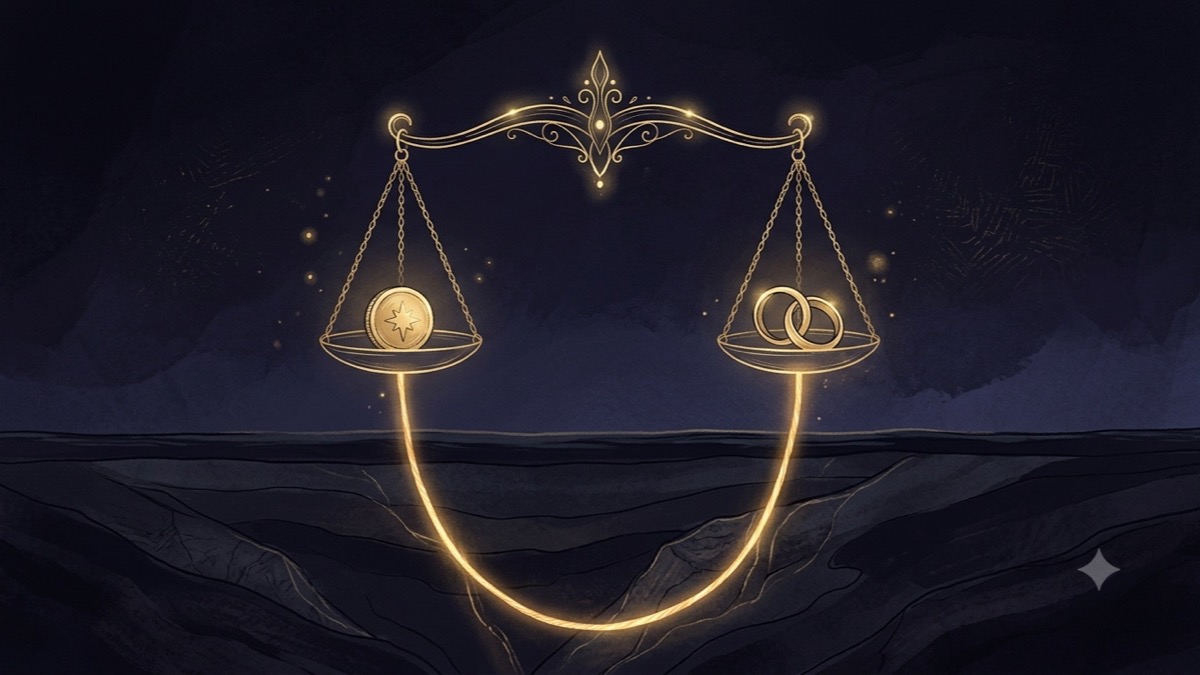
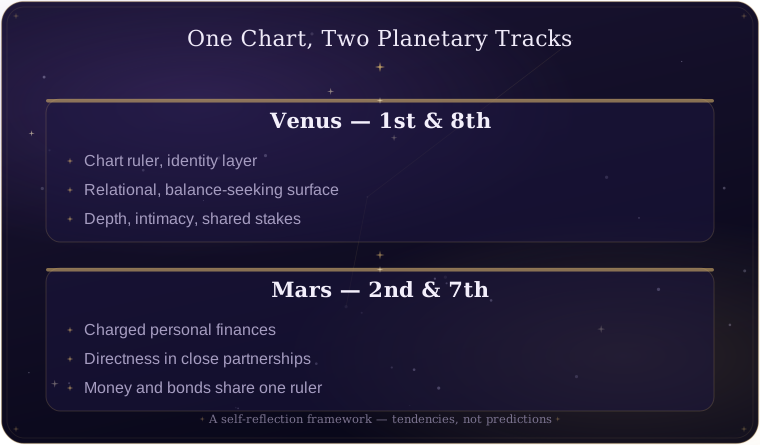
Libra rising houses describes the dual-planet ruler map activated by a Libra ascendant, in which Venus governs the 1st house of identity and the 8th house of shared transformation, while Mars governs the 2nd house of personal resources and the 7th house of close partnerships.
- Venus, as chart ruler, governs both the self-presentation domain (1st house) and the domain of depth, intimacy, and shared financial stakes (8th house).
- Mars governs both the personal resource domain (2nd house) and the one-on-one partnership domain (7th house), placing two major life areas under a single Martian influence.
- Because Mars holds both the 2nd and 7th simultaneously, personal finances and close partnerships share a planetary ruler — a structural connection most mainstream Libra resources do not address.
In Western astrology, the ascendant sign determines which planet governs each of the twelve houses. For Libra rising, Venus and Mars each govern two significant domains — a structure mapped across all twelve rising sign configurations in the pillar page on houses and life areas in astrology.
Why It Matters for Self-Awareness
The problem that libra rising houses produces in practice is concrete: nearly every popular Libra resource describes Libra as Venus-ruled and treats the entire rising sign through diplomacy, relational harmony, and balance. Those descriptions apply to the 1st house — the identity layer Venus governs. They say nothing specific about the 2nd house (personal money) or the 7th house (one-on-one partnerships), both of which run on Martian energy for this placement.
For anyone with this chart structure who has noticed that their financial decisions feel more charged than their calm outer presentation implies, or that their closest relationships carry an unexpected intensity despite the harmony-seeking identity layer, the conventional Libra material offers no explanation. The missing piece is that libra rising houses links those two domains through shared Mars rulership.
The connection surfaces in specific ways. A raise negotiation becomes unexpectedly loaded — not just about money, but about the relational dynamic with whoever is on the other side. A period of financial stress arrives alongside tension in a close partnership in a way that seems coincidental but is structurally connected. When Mars is activated by transit, progression, or natal tension, it does not touch just one domain; it touches both. Understanding this structural link does not make the patterns disappear, but it makes them readable — which is the starting point for working with them deliberately rather than reacting to them as if they arise for unrelated reasons.
libra rising houses vs Adjacent Concepts: How It Works + Trade-offs
Two comparisons clarify where confusion about libra rising houses most often enters:
- Libra rising houses vs. Libra sun sign. A Libra sun describes where the core identity and ego drive sit — in the sign's air-element themes of balance, aesthetic perception, and relational awareness. Libra rising houses is a structurally separate question: which planets govern which house domains, and how those domains behave as a result. A Libra sun with Scorpio rising has an entirely different house map. A Libra sun with Virgo rising has Mercury as chart ruler and a completely different financial and partnership structure. To get accurate house ruler information, you look at the ascendant, not the sun. The trade-off is concrete: using sun-sign Libra descriptions as a rising sign guide gives you an accurate personality flavor for the 1st house but puts you on the wrong planetary track for the money and partnership domains — where Mars, not Venus, is the operative planet.
- Libra rising houses vs. Venus-only framing. Venus is legitimately the chart ruler and governs both the 1st and 8th houses. The mistake is treating Venus as the only operative planet and reading all major domains through Venusian themes. The way it works in practice: the identity layer reads Venusian — relational, harmony-oriented, aesthetically attuned — while the resource and partnership layers carry Martian energy, which tends toward assertion, charge, and at times a directness that contrasts sharply with the surface presentation. To get the full behavioral picture, both planets are necessary. To get Venus alone, you sacrifice the explanation for why Libra rising encounters unexpected intensity in the money and relationship domains — and those are precisely the domains people most often struggle to make sense of.
For the partnership domain specifically, how Martian energy functions in the 7th house is explored in detail in Mars in the 7th house explainer. Liz Greene's reading of the seventh house as a space where unconscious relational patterns surface, and Howard Sasportas's treatment of the eighth house as a domain of shared stakes and transformation, both support this dual-planet reading.
How to Read libra rising houses in Your Chart
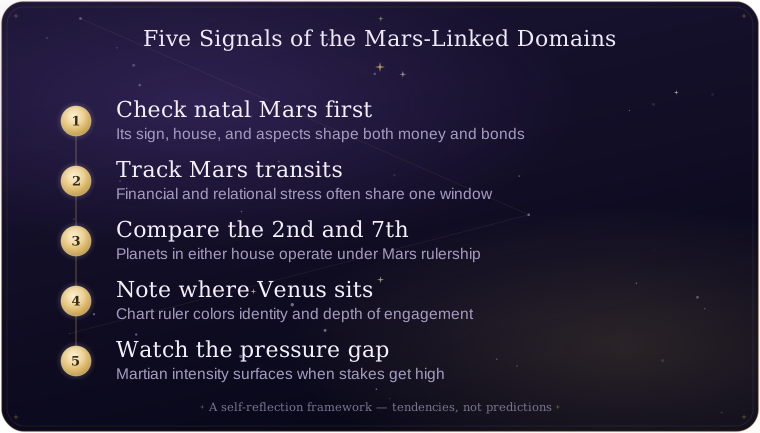
Five concrete signals help locate libra rising houses in real experience:
- Check the natal Mars condition first. Mars governs the 2nd and 7th houses for this placement, so its natal sign, house, and aspects shape both the financial domain and the partnership domain. A Mars in harmonious aspect to Venus suggests more ease across those areas; a Mars under significant natal tension tends to activate both domains with more friction when triggered.
- Track transits to Mars alongside what is happening in the money and partnership domains. Because Mars governs both simultaneously, transiting Mars crossing the 2nd or 7th house cusp tends to activate both in the same window. Keeping even a brief log — noting when financial and relational stress overlap — often reveals the shared planetary trigger.
- Compare 2nd and 7th house placements side by side. Any planet sitting in either house is operating under Mars rulership. Their themes tend to bleed across domains: a difficult transit to the 7th house cusp may surface as financial anxiety; a 2nd house progression may shift relational dynamics in ways that seem unrelated on the surface.
- Note where Venus sits natally. As chart ruler, Venus's placement describes both the identity presentation (1st house) and the depth-of-engagement style (8th house). A Venus in fire signs tends to bring more directness to both; Venus in earth signs tends toward caution and material steadiness in those same domains.
- Watch for the gap between first impression and behavior under pressure. Venus governs the 1st house, which produces a relational, ease-seeking presentation. Mars governs the 7th — the partnership house. When stakes are genuinely high in a close relationship, the Martian layer often surfaces in a way that surprises both the Libra rising person and their partner. Noticing when this gap opens is one of the clearest live signals of this house structure.
Common Misreadings
Libra rising houses generate several recurring misreadings in self-study astrology, most traceable to resources that apply sun-sign Libra material directly to the ascendant without mapping the actual house rulers:
- Assuming the whole chart runs on Venus. Venus is the chart ruler and governs the 1st and 8th — but Mars governs the 2nd and 7th. Reading financial and partnership patterns through Venus-only themes consistently misattributes those domains. The correction: when examining money behavior or close relationship dynamics for this placement, Mars's natal condition is the primary interpretive lens for those houses, not Venus.
- Reading the harmony-seeking presentation as the full relational picture. The 1st house Venus creates an identity that genuinely orients toward balance and ease. The 7th house Mars creates a different reality in how close partnerships function under pressure. For libra rising houses, these two are not the same thing — the surface presentation and the partnership domain run on different planets with genuinely different orientations. The diplomatic first impression is real; so is the Martian intensity that can emerge when relationship stakes feel high.
- Treating the 8th house as separate from identity. With Venus ruling both the 1st and 8th, self-presentation and depth of engagement are linked for this placement in a way that does not apply to other rising signs. Depth, shared resources, and transformative experiences are not departures from identity for Libra rising — they are often where the identity expresses most fully.
- Ignoring the structural 2nd–7th connection. Because Mars rules both houses, money decisions and partnership dynamics are not independent tracks. Treating them as if they are — trying to resolve financial stress in isolation from relational context, or vice versa — tends to miss the shared planetary driver that ties them together and prevents the pattern from becoming legible.
Libra Rising Houses at a Glance
| House | Ruling Planet | How It Works | How to Observe |
|---|---|---|---|
| 1st (Identity) | Venus | Governs the self-presentation layer — relational, aesthetically oriented, balance-seeking; functions as the chart ruler | How others describe you on first encounter; your default approach when entering new situations |
| 2nd (Personal Resources) | Mars | Brings assertive, charged energy into financial decisions and personal resource management | Notice when money choices carry emotional weight disproportionate to the practical stakes |
| 7th (Partnerships) | Mars | Activates Martian directness and intensity in one-on-one close relational dynamics | Watch for unexpected forcefulness or friction in partnerships despite the diplomatic identity layer |
| 8th (Shared Transformation) | Venus | Links the identity layer to depth, shared finances, intimacy, and major life transitions | How you show up when stakes are genuinely high — shared resources, significant change, close trust |
Common Questions About Libra Rising Houses
What does libra rising houses mean if I don't feel particularly harmony-seeking?
Libra rising houses describes a chart structure, not a fixed personality guarantee. If natal Mars, Saturn, or other chart factors create significant tension overlaying the 1st house, the Venusian diplomatic presentation may not feel like the dominant experience day to day. The house ruler map still operates structurally — the 2nd and 7th remain Mars-ruled — even when the surface identity layer does not feel classically Libra.
Why do some people with this placement feel most fully themselves in intense or high-stakes situations?
Venus governs the 8th house of shared transformation alongside the 1st house of identity for this placement. The 8th covers situations where depth, shared stakes, and real investment are present. With Venus ruling there, Libra rising may find those conditions genuinely feel like home — drawn to depth of engagement in a way that contradicts the light, diplomatic surface image.
Does Mars ruling the 7th house mean partnerships tend to be harder for Libra rising?
Mars in the partnership domain brings energy, directness, and assertion rather than the smooth ease Venus would bring there — which creates a different dynamic, not inherently a harder one. Many people with this placement describe their closest relationships as unusually alive and engaged. The patterns that tend to arise are more about intensity and charged exchanges than about consistent difficulty.
How does the shared Mars rulership of the 2nd and 7th actually appear in daily life?
The clearest signal is when financial stress and relationship tension arrive in the same window for no obvious external reason. Transiting Mars activating the 2nd or 7th house cusp tends to touch both domains simultaneously. People with this chart structure often describe noticing that significant financial decisions carry a relational dimension, and that their most charged relational periods tend to bring resource questions with them — the two tracks move together.
Reflection Prompts
- Think back to a time when a financial decision felt more emotionally loaded than the dollar amount explained — what was happening in your closest relationship during the same period?
- Recall a moment in a close partnership when you were more direct or forceful than your usual presentation would suggest — where did that impulse first appear, and how did the other person receive it?
- Notice a situation where engaging with something high-stakes or genuinely deep felt more natural than keeping the peace — what does that tell you about how Venus's 8th house rulership shapes what you consider identity-level belonging?
Related Reading
- pillar page on all twelve houses and life areas — the full domain map that house ruler systems like this draw from across all rising signs
- guide to Venus as chart ruler for Libra rising — how chart ruler placement shapes overall chart tone and self-presentation across the life domains
- house ruler overview for all twelve rising signs — how the house ruler map differs across each of the twelve ascendants
- what the ascendant means and how to find yours — the rising-sign foundation this whole house map is built on
- compare with Leo rising and the houses and Scorpio rising and the houses — how the same wheel shifts for a different ascendant
Take Action
Generate your free birth chart to explore libra rising houses. Your chart will show the natal condition of both Venus and Mars — the two planets that anchor the major house domains for this placement. Seeing their signs, degrees, and aspects gives you concrete starting points for understanding why financial decisions and close partnership dynamics tend to feel structurally linked, and where a more precise self-reading actually begins.
Sources
- Liz Greene — pioneered the psychological reading of the seventh house as a space where unconscious relational patterns surface in close encounter with another person
- Howard Sasportas — developed detailed psychological readings of the eighth house as a domain of shared transformation, depth, and mutual stakes