
What Is the Matheus Cunha Birth Chart?
The Matheus Cunha birth chart centers on a Gemini Sun for Matheus Santos Carneiro da Cunha, born May 27, 1999, in João Pessoa, Brazil. A birth chart — also called a natal chart — plots the positions of the Sun, Moon, and planets at the moment of birth, giving practitioners a symbolic framework for reading personality patterns, developmental themes, and timing windows. Cunha has no public birth time on record, so this read stays at the Sun-sign level: a Gemini Sun ruled by Mercury, which shapes how he processes information, reads opponents, and expresses under pressure. Without a verified birth time, his Moon, Ascendant, and house placements cannot be confirmed.
- Sun in Gemini: identity built on Mercury-ruled adaptability and tactical intelligence — the capacity to read shifting defensive contexts in real time, not produce fixed single-mode output
- João Pessoa, northeastern Brazil: a regional football culture shaped by improvisation and close-range technical play, an early formation environment that rewards exactly what Gemini Sun charts naturally describe
- 2026 World Cup timing: Jupiter transits through Cancer, the second sign from his Gemini Sun, which in a solar-chart (Sun-sign) technique touches a resource theme — a symbolic lens on his season, not a birth-time house
This article is part of the broader pillar page on World Cup 2026 player and team birth charts, which maps the astrological profiles of key figures across the tournament.
Why It Matters for Self-Awareness
The most persistent misread of the Matheus Cunha birth chart — and of Gemini Sun athletes generally — is treating adaptability as a synonym for inconsistency. Football commentary routinely conflates the two: when a Mercury-ruled forward reads the game differently match to match, adjusting to opponent shape and system, fans and analysts call it unreliability. What they are actually observing is split-second tactical switching, which is the central feature of Gemini's Mercury rulership under pressure. The friction here is real: Gemini's adaptability and actual inconsistency look nearly identical from the outside, which is why the misread persists.
In my years working with sign-based chart structures and classical planetary rulerships — as a second-generation Jyotish practitioner with a decade of independent research in the tradition descending from Parashara — I have observed this pattern with Mercury-ruled charts repeatedly. They appear inconsistent inside rigid tactical systems that demand a fixed role and a repeatable decision tree. They over-deliver the moment the system permits improvisation. Cunha scored a brace in Brazil's 3-0 win over Haiti in the 2026 World Cup group stage — a real-world result an observer can discuss alongside a symbolic Sun-sign lens, never something a chart "pointed to" or caused. That match offered exactly the permissive environment Mercury-ruled forwards tend to thrive in: a counter-pressing Brazil setup that rewarded instantaneous situational reading over choreographed runs.
The practical point, beyond football: when you see a Gemini Sun player's output described as "hot and cold," the more useful question is whether the variable is the player's form or the system's permission for improvisation. Most of the time, the answer is the system.
Gemini Sun vs Sagittarius Sun: Where Attacking Style Splits
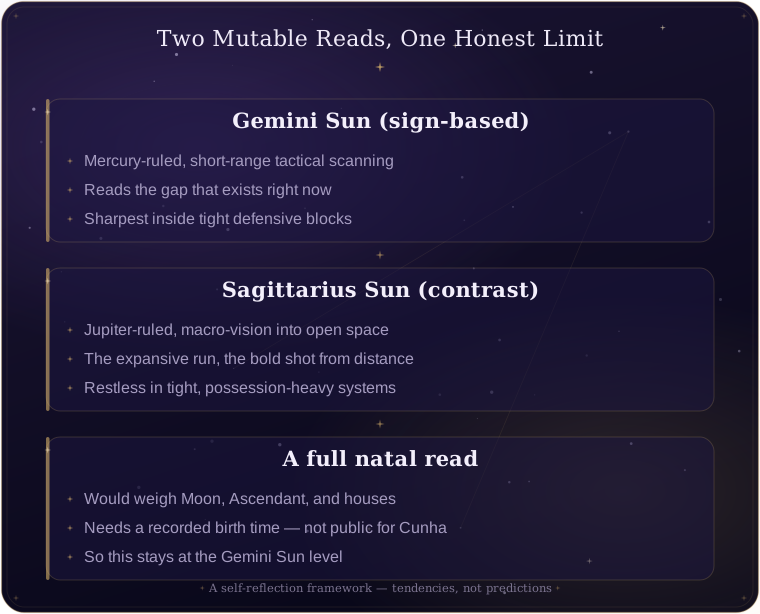
The comparison most relevant to the Matheus Cunha birth chart is with Sagittarius Sun forwards — the other mutable sign that produces adaptable, mobile attackers, but through an entirely different planetary lens.
Both signs share mutable modality, meaning both are comfortable with change and resistant to rigid, repetitive task assignments. But they diverge at the source. Gemini is Mercury-ruled and orients toward short-range scanning: reading the precise gap that exists at this exact moment, making the micro-decision that fits the defensive shape right now. Sagittarius is Jupiter-ruled and orients toward macro-vision — the expansive run into space, the bold shot from distance, the sense of the larger move before it materializes. To get Gemini's close-quarters improvisational sharpness, you give up the Sagittarian forward's natural comfort with open-space, low-pressure decisions. Conversely, choosing Sagittarian expansiveness means accepting reduced efficiency inside compact defensive blocks, where Gemini Suns tend to be at their most dangerous.
This trade-off has observable consequences on the pitch. Sagittarius Sun attackers often describe a restlessness in possession-heavy, tight-space systems where the field never fully opens — the big vision has nowhere to go. Gemini Suns are satisfied by constant micro-variation within tight structure; they find the seam inside congestion rather than waiting for territory to open. That distinction also matters for the transit events cluster covering Jupiter in Cancer 2026: in a solar-chart technique, Cancer is the second sign from a Gemini Sun, not from a Sagittarius Sun, so the resource theme this cycle highlights sits on one side of the mutable axis.
How to Read a Gemini Sun Birth Chart in Your Analysis
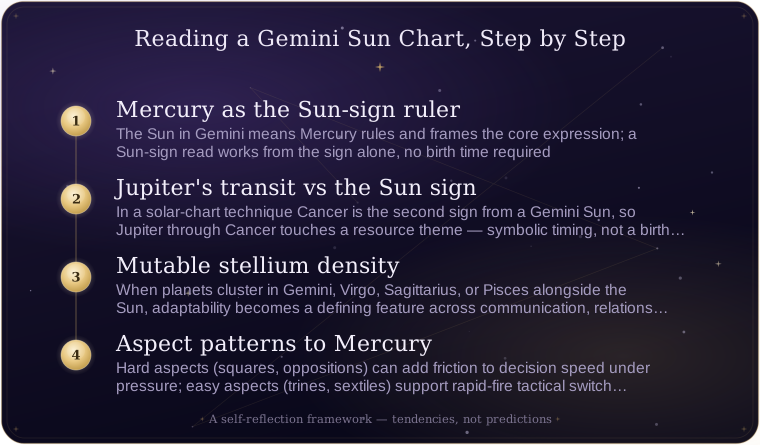
Reading the Matheus Cunha birth chart — or any Gemini Sun chart — means moving past the pop-astrology shorthand and tracking the signals that reveal how Mercury-ruled potential is structured. These items describe general chart-reading technique. For Cunha specifically, no public birth time exists, so his Moon, Ascendant, and house placements cannot be verified — only his Gemini Sun and sign-based transits can.
- Mercury as the Sun-sign ruler. Since the Sun is in Gemini, Mercury rules his Gemini Sun and frames his core expression. Where a verified birth time exists, Mercury's natal house refines this further, but a Sun-sign read works from the sign alone.
- Jupiter's transit relative to the Sun sign. In a solar-chart technique, Cancer sits as the second sign from a Gemini Sun, so Jupiter moving through Cancer touches a resource and momentum theme. Practitioners in the classical Jyotish lineage read this as a window where building potential begins outputting at higher volume — a symbolic timing theme, not a birth-time house.
- Mutable stellium density. When multiple planets cluster in Gemini, Virgo, Sagittarius, or Pisces alongside the Sun, adaptability becomes a defining feature across life domains — communication style, relationship approach, and career patterning all run through the same mutable register.
- Aspect patterns to Mercury. Hard aspects — squares and oppositions — to Mercury can create friction in the decision-speed axis under pressure. Easy aspects, trines and sextiles, tend to support the rapid-fire tactical switching that defines a Gemini Sun's best performances.
- Moon sign as the emotional pressure regulator (general technique). In any chart with a verified birth time, the Moon sign reveals how the person processes intensity. A Water Moon adds instinctive responsiveness; a Fire Moon accelerates the response. For Cunha this stays hypothetical — his birth time is unknown, so any Moon sign would be guesswork.
Common Misreadings About Cunha's Gemini Sun
Shallow astrological coverage typically lifts the Gemini stereotype and applies it without examining how Mercury-ruled athletic expression actually functions. These are the most common misreadings, with corrections:
- "Gemini means inconsistent." The actual pattern: output varies by system permission, not quality fluctuation. When a Mercury-ruled forward is channeled into a rigid positional role with a fixed decision tree, the tactical switching has nowhere to go and looks like poor form. When the system rewards improvisation, the same Matheus Cunha birth chart analysis describes a forward who reads the game in real time. The misread conflates context-dependence with unreliability.
- "His chart proves he would shine in big moments." The actual pattern: astrology describes symbolic themes, not guaranteed results — no chart proves, predicts, or causes an outcome. Gemini's duality describes range of expression, not emotional absence. A Sun-sign lens can be discussed alongside his brace against Haiti as a real event, but it never claims to have pointed to it.
- "Too versatile to be a reliable starter." The actual pattern: Mercury-ruled role flexibility gets misread as positional uncertainty or lack of a clear identity. The same intelligence that makes Cunha effective as an impact substitute makes him dangerous as a starter in open-tempo systems — the same skill set, valued differently depending on the observer's tactical framework.
- "Gemini Sun players peak early and drop off." The actual pattern: in the Jyotish framework, Mercury reaches full planetary maturation at age 32. At 27 in 2026, Cunha is mid-approach to that maturation point — the maturation the Jyotish tradition associates with Mercury-ruled charts hasn't yet arrived.
Cunha's Sun-Sign Placement at a Glance
| Property | How It Works | Ruling Element | How to Observe |
|---|---|---|---|
| Sun in Gemini | Mercury-ruled adaptability shapes the core identity; tactical switching is the primary expression mode, not fixed-rate output | Air (mutable) | Performance variation tied to system permission, not personal form dips — watch for this pattern across different tactical contexts |
| Jupiter transit (2026) | In a solar-chart technique, Jupiter in Cancer — the second sign from a Gemini Sun — touches a resource theme; this is a Sun-sign lens, not a birth-time house | Water (cardinal) | A cluster of standout games can coincide with this transit window, read as a symbolic theme rather than a forecast |
| Mutable Sun modality | Comfort in shifting contexts means quality is context-calibrated; best output in transitional and counter-attack phases rather than static possession systems | Mutable (Air) | Strongest games tend to come against organized defenses that break open in transition, not in possession-heavy, low-tempo matches |
| Mercury as Sun-sign ruler | Decision-making speed is the read's central axis; Mercury rules his Gemini Sun, framing where that speed expresses | Mercury (Air) | A verified birth time would add Mercury's house; without one, work from the Gemini Sun and sign-based transits only |
Questions About the Matheus Cunha Birth Chart
What is Matheus Cunha's zodiac sign?
Matheus Cunha's Sun is in Gemini, placed by his May 27, 1999 birth date within the Gemini season spanning May 21 to June 20. In the Matheus Cunha birth chart, this makes Mercury his Sun-sign ruler and the primary planetary lens for reading his personality patterns.
Can we know Cunha's Moon sign or rising sign?
No. Cunha has no public birth time on record, so his Moon, Ascendant, and house placements cannot be verified. A responsible read stays at the Gemini Sun and sign-based transits — anything claiming a specific Moon or rising sign for him is guesswork.
How does a solar-chart reading relate to Cunha's brace against Haiti?
Cunha scored a brace in Brazil's 3-0 win over Haiti in the group stage — a verified real-world result. A solar-chart lens notes that Jupiter transits Cancer, the second sign from his Gemini Sun, touching a resource theme; that is a symbolic discussion alongside the event, never a claim the chart pointed to or confirmed the goals.
What does Mercury maturation mean for Cunha at 27?
In the Jyotish tradition, each planet reaches a maturation point at a specific age, with Mercury maturing at 32. At 27 during the 2026 tournament, Cunha is approaching but hasn't reached Mercury's full maturation — which the tradition associates with the sharpest expression of the sign's tactical intelligence.
Reflection Prompts
- Think of a recent moment when someone read your flexibility as inconsistency — how would it look to reframe that as situational awareness rather than unreliability?
- Recall a time when conditions finally matched your strengths — what does that suggest about the role environment plays in your best output?
- Notice the next time you make a split-second read under pressure and it works — does it reflect a recognizable pattern in how you operate best?
Related Reading
- guide to Gemini Sun in natal chart readings — expands on Mercury rulership and how a Gemini Sun reads across charts beyond this Sun-sign overview
- Jupiter in Cancer 2026 transit guide — covers the resource-theme cycle referenced in this article's timing discussion in fuller detail
- World Cup 2026 astrology series pillar page — the full series mapping national team and player charts across the tournament, which this article supports as a spoke entry
Take Action
Generate your free birth chart to see your own Sun placement, ruling planet, and current planetary transits — the same framework used in this analysis. Visit how to read a birth chart for a step-by-step guide that shows you exactly what to look for in your own chart. Reading your chart's symbolic themes, like the resource theme Jupiter in Cancer touches for Gemini Suns in a solar-chart technique, turns astrology from a label into a practical lens for self-reflection rather than a forecast.
Sources
- Parashara — foundational classical Jyotish framework for planetary rulership and planetary maturation ages referenced in the misreadings section and FAQ