
What Is Messi vs Yamal Astrology?
Messi vs yamal astrology is a side-by-side symbolic reading of two footballers' natal charts, comparing archetypes instead of forecasting results. It sets Lionel Messi's birth chart next to Lamine Yamal's and asks where the two echo each other and where they part — both carry a Cancer Sun, yet they were born twenty years apart, so their generational placements color each temperament differently. Cancer is a cardinal water sign linked to instinct, memory, and a protective streak, which gives both charts an emotionally driven core. The framework, in the lineage Dane Rudhyar helped shape, treats a chart as a pattern of leanings rather than a fixed script — the same logic behind any pillar guide on how to read a birth chart.
- Compares two real natal charts as archetypes, never as a scoreboard
- Anchored in a shared Cancer Sun but split by generational placements
- Works as an interpretive lens, with its limits stated up front
Why It Matters for Self-Awareness
Understanding messi vs yamal astrology matters because it teaches a habit most chart-readers skip: treating a placement as a leaning you can work with, not a verdict handed down. When two athletes share a Sun sign and still read as completely different characters, the contrast makes the point better than any single-chart write-up could — emphasis, generation, and the balance of the whole chart matter more than the label on the Sun. That habit, close to the psychological approach Liz Greene advanced, is what turns your own chart from a horoscope soundbite into something useful. It shows up in a few concrete ways:
- It separates trait from destiny. Watching two Cancer Suns diverge is a reminder that a sign sketches tendencies, not a future you're locked into. You start noticing where you actually have room to choose.
- It sharpens how you read yourself. Once you can hold two charts side by side, comparing your own Sun against your rising sign meaning explainer feels far less abstract. The comparison hands you a method, not just a description.
- It keeps you honest about limits. The exercise keeps you asking what a chart can and can't say, which is the same discipline that stops you over-reading one placement in your own life.
None of this depends on either player. The comparison is a training ground: learn to read two well-known charts fairly, and you carry that fairness back to the one that actually belongs to you.
Chart Comparison vs Match Prediction: Where the Two Split
Messi vs yamal astrology is easy to confuse with match-prediction astrology, and that mix-up is where most bad takes begin. The two do genuinely different jobs, and keeping them apart is what protects the comparison from over-reaching.
How the two actually differ
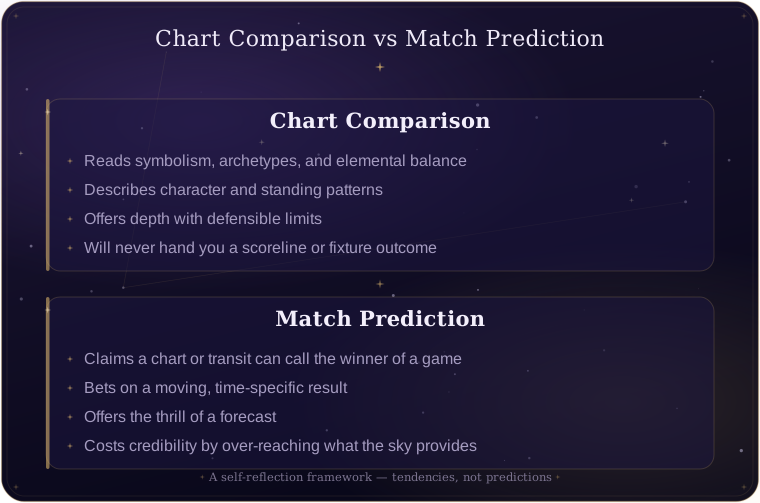
A chart comparison works by reading symbolism — shared archetypes, elemental balance, and the generational placements each person carries — and asking what standing patterns show up. It describes character. Match-prediction astrology works the other way: it claims a chart or a passing transit can call the winner of a fixture, the outcome of a transfer, or the next trophy. It bets on a moving result.
Take the shared Cancer Sun as an example. In symbolic terms, both charts describe a competitor who plays from feel and loyalty — the instinct-led, protective drive Cancer is traditionally linked to. A comparison notes that echo and then asks how twenty years of shifting outer planets rework it: the backdrop of a chart cast in 1987 is not the backdrop of one cast in 2007, so the same watery core expresses through different generational pressures. None of that predicts a goal, a rivalry, or a career arc. It sketches temperament, closer to how Robert Hand keeps symbolism grounded, and it stops there.
The trade-off you're making
Here's the honest exchange. A symbolic comparison gives you depth and defensible limits, but it will never hand you a scoreline — to get interpretive honesty, you sacrifice the thrill of a forecast. Match prediction offers that thrill, but the cost is credibility: it promises a certainty the sky doesn't provide.
Scale is part of why. According to NASA, Jupiter takes about 12 years to orbit the Sun, so a so-called lucky transit sits over an entire generation, not a single ninety-minute game. Read as fate about one match, it over-reaches by design; read as a shared backdrop, it stays proportional.
How to Read a Messi–Yamal Comparison in Your Own Chart Study
Reading a Messi–Yamal comparison for yourself is less about verdicts and more about noticing patterns you can point to. Work through it in order:
- Start with the shared Sun. Both were born under Cancer, so note the water-sign core first — instinct, memory, protectiveness — before reaching for anything more exotic. That core is the common ground the rest of the reading builds on.
- Date the generations. A chart from the late 1980s carries different slow-moving outer-planet placements than one from the late 2000s. That twenty-year gap is where the two archetypes split, not a footnote.
- Weigh the whole balance. Check which element and mode dominate each nativity overall, instead of fixating on the Sun sign alone. A chart heavy in one element reads differently from a balanced one, even under the same Sun.
- Name the limit out loud. For every observation, ask whether you're describing character or quietly smuggling in a prediction about a result.
- Keep both charts in view. Contrast is the whole point; a single chart read in isolation loses the comparison that makes the exercise worth doing.
Common Misreadings
Most quick takes on messi vs yamal astrology trip over the same handful of errors. Each misread below is paired with what the framing actually supports:
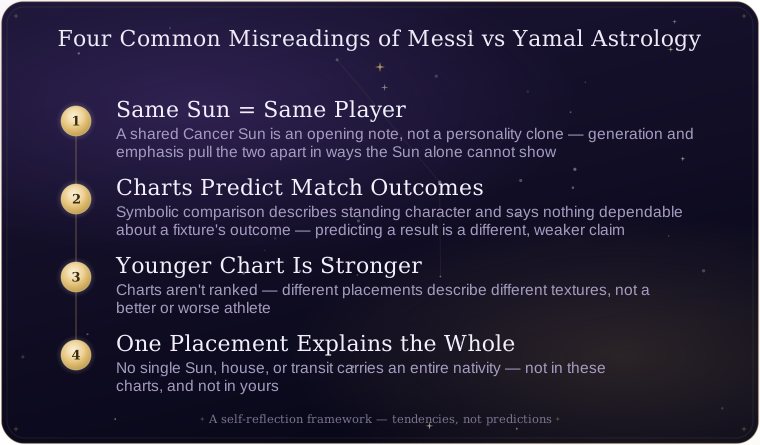
- Misread: same Sun means the same player. In reality, a shared Cancer Sun is an opening note, not a personality clone. Generation and emphasis pull the two apart in ways the Sun alone can't show.
- Misread: the charts can call the next match. In reality, a symbolic comparison describes standing character and says nothing dependable about a fixture's outcome. Predicting a result is a different, weaker claim.
- Misread: the younger chart is "stronger." In reality, charts aren't ranked. Different placements describe different textures, not a better or worse athlete.
- Misread: one placement explains the whole person. In reality, no single Sun, house, or transit carries an entire nativity — not in these charts, and not in yours.
Messi and Yamal Charts at a Glance
| Property | How It Works | Energy Center | How to Observe |
|---|---|---|---|
| Shared Cancer Sun | Both charts lead with a cardinal water core reading as instinct and protectiveness | Water element, cardinal mode | Notice emotionally driven, protective framing in how each is described |
| Generational gap | Slow outer planets shifted across the twenty years between the two births | Outer-planet natal placements | Compare the era each chart was cast in, not just the Sun |
| Elemental temperament | The full chart's element balance shades the shared Sun differently | Overall element and mode balance | Note which element dominates each nativity as a whole |
| Interpretive stance | Symbolism is read as tendency, never as a fixed outcome | Whole-chart pattern | Check whether a claim describes character or predicts a result |
Questions People Ask About the Messi–Yamal Comparison
Do Messi and Yamal share the same zodiac sign?
Yes — Lionel Messi was born on June 24, 1987 and Lamine Yamal on July 13, 2007, which places both Sun signs in Cancer, a cardinal water sign.
Can this comparison predict who will play better?
No. It reads symbolic archetypes and elemental temperament, not match results, so it makes no dependable claim about performance, transfers, or trophies.
What is the biggest astrological contrast between them?
Their generational outer-planet placements. Born two decades apart, each chart carries a different slow-planet backdrop even while sharing a Cancer Sun.
Is Lionel Messi's zodiac sign really Cancer?
Yes. A June 24 birthday falls inside Cancer's roughly June 21 to July 22 window, giving Messi a water-sign Sun.
Reflection Prompts
- Think of a recent moment when you assumed two people were alike because they shared one label — what did that assumption miss?
- Recall a time you read a single trait as your whole story; how might holding it beside your other placements change it?
- Picture a comparison you drew lately between yourself and someone you admire — where did tendency end and pressure to match begin?
Related Reading
- explainer on how astrological aspects link two charts — for the technique behind reading two nativities against each other.
- overview of the four astrological elements — to weigh the water emphasis both charts share.
- guide to the Jupiter in Gemini 2026 transit — to see how a live transit is read as a shared backdrop rather than a forecast.
Take Action
Astrology here is a reflective lens on character, not a verdict on anyone's future. This is not a clinical interpretation or mental health advice. Move from reading famous players' charts to reading your own: you get every placement mapped in minutes and a clearer sense of which tendencies are yours to work with rather than a script you're handed. Generate Your Free Birth Chart at the free birth chart calculator.
Sources
- Dane Rudhyar — shaped the person-centered reading of the chart as a pattern of tendencies rather than fixed fate
- Liz Greene — advanced the psychological approach that treats placements as character dynamics rather than predictions
- Robert Hand — known for keeping chart symbolism grounded and proportional to what the technique can support