
What Is World Cup 2026 Astrology?
World Cup 2026 astrology is a reading of the collective energy the summer's planetary transits bring to the tournament — chiefly Jupiter exalted in Cancer — rather than a forecast of who lifts the trophy. The honest version of this topic is not "astrology picks the winner." It is closer to what astrologers do with any shared moment: read the mood of the sky during the event, and then show you how to find that same transit in your own chart. The defining signature is Jupiter's exalted passage through Cancer in the opening weeks, a transit tied to belonging, home, and collective feeling — the very emotions a home tournament tends to amplify. If you want to go deeper on how transits color a whole season, the guide to reading current transits covers the wider sky behind this window.
- Reads the tournament as a window of collective energy, not a single-winner reveal
- Centers on one dated, checkable transit — Jupiter exalted in Cancer (June 11–30, 2026) — that anyone can locate in their own chart
- Treats the sky as setting conditions and mood, not as fixing any result
This is a symbolic, educational framework — not a betting forecast, and not a promise of any outcome.
Why It Matters for Self-Awareness
Most football astrology online collapses into a winner-reveal, which quietly trains readers to confuse a symbolic forecast with a gambling tip. That is the real friction: when a world cup 2026 astrology prediction is sold as a sure thing, the reader stops studying the chart and starts watching the odds. The psychologist-astrologer Liz Greene spent a career reminding her field that a symbol is not its outcome — that the chart describes a pattern of meaning, not a fixed event. Reading the tournament through transits restores that more honest question: what conditions does the sky favor, and how might a team rise to meet them?
It is the same self-aware posture serious astrology asks of any personal chart, where the goal is insight into tendencies rather than a script for the future. A nation's chart, like a person's, shows where energy gathers and where it strains, not a sealed result. Held that way, even a playful forecast becomes a small exercise in separating what is likely from what we simply want to be true — which is a more durable skill than picking a bracket. The same caution applies to a single match: a favored chart still has to be played, and the moment a forecast forgets that, it has quietly stopped being astrology and started being a wager.
Collective-Energy Reading vs Winner Prediction: Why the Difference Matters
A transit-led World Cup 2026 astrology reading sits between two neighbors, and each comparison reveals a trade-off. Against tipster-style winner reveals, this reading explains the mood the 2026 sky sets rather than naming an outcome: Jupiter exalted in Cancer strengthens collective, home-soil feeling through the group stage, so the hosts — the United States, Canada, and Mexico — share an early atmosphere of belonging and home-territory cohesion. That window is real but bounded: Jupiter leaves Cancer for Leo on June 30, so the later knockout rounds and the July 19 final read under a more individual, spotlight-seeking sky rather than the collective, homely one. To gain that honest, checkable reading, you give up the false comfort of a single name; this approach will never hand you one certain champion, and it is not meant to.
Against pure natal-player astrology, the mundane lens trades intimate detail for scale: a national chart shows how a whole squad might metabolize the same Cancer-Jupiter tone, the way an individual chart shows how one person meets a passing planet, but it cannot tell you which striker scores. The transit-as-timing approach that Robert Hand associated with modern practice helps here — read a transit as an activator of a moment, not a guarantor of an event, and the comparison stops promising more than astrology can honestly give. A spoke page can then carry the close chart detail this hub deliberately leaves out, which is why the pillar and its series are meant to be read together rather than in isolation. In my years moving between counseling work and evolutionary astrology, I have found that readers grow fastest when a forecast names its own limits rather than overselling them.
How to Read This Transit in Your Own Chart
The most useful thing World Cup 2026 astrology can give you is not a bracket — it is a live transit you can read in your own birth chart while the tournament plays out. Jupiter exalted in Cancer is touching everyone's chart, not just the host nations'. Dane Rudhyar's person-centered reading of collective cycles is the spirit to keep: the 2026 sky sets the conditions, and people supply the meaning.
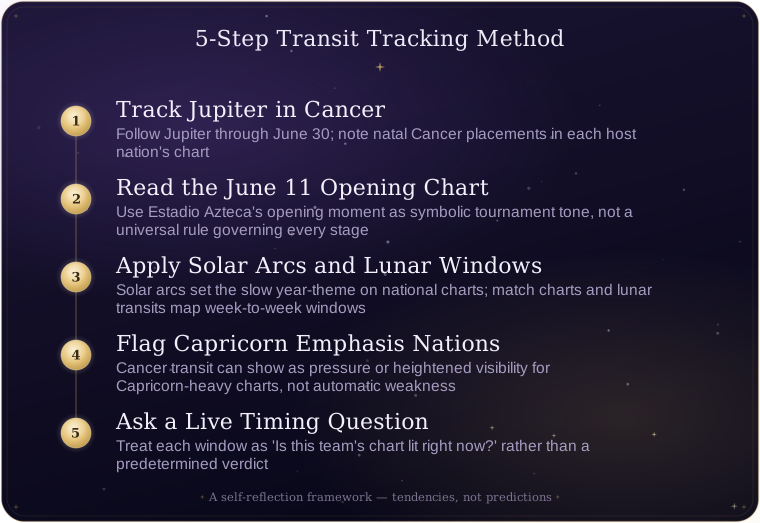
- Track Jupiter in Cancer through June 30 (it moves into Leo afterward), and note where Cancer falls in your own chart — that house is where this collective wave lands for you.
- Read the June 11 opening chart for Estadio Azteca in Mexico City as the symbolic opening tone, not a rule that governs every later stage.
- Notice the theme Cancer carries — home, belonging, family, emotional security — and watch where it shows up in your life during the same weeks.
- If you have a strong Capricorn emphasis, expect the same Cancer transit to read as pressure or exposure across the home-versus-work axis, not as weakness.
- Treat each window as a live question ("where is my chart lit right now?") rather than a settled outcome.
Jupiter in Cancer and the Theme of National Belonging
Jupiter is exalted in Cancer, meaning it is considered at its most generous and well-functioning in this sign. Cancer's territory is home, family, roots, and emotional belonging — so a home World Cup running under this transit carries an unusually strong undertone of collective togetherness. This is why the host nations' atmosphere matters more than any single result: the sky favors the feeling of home advantage, the surge of shared identity a crowd brings, regardless of which team converts it. Read this as the emotional weather of the opening weeks, not as a guarantee that the hosts go far.
How to Layer This Transit With Your Natal Chart
To make the transit personal rather than abstract, find the house Cancer rules in your own birth chart and read Jupiter as a slow, expansive guest passing through that area of life from June 11 to 30. If Cancer sits on your 4th house, the theme lands on home and family; on your 10th, on public role and belonging at work; on your 7th, on partnership and who feels like "home" to you. Layering the collective transit onto your personal chart is exactly the move serious astrology asks for — the same sky, read through your specific placements, tells you far more than the tournament headlines do.
What the Opening Ceremony Chart Shows
Astrologers treat the moment a major event begins as a kind of birth chart for the event itself. The June 11 opening at Estadio Azteca in Mexico City gives the tournament a symbolic opening tone — the houses lit at kickoff frame the mood the event starts in. Read it as the atmosphere of the first whistle, not as a master key that governs every knockout match. Later stages have their own charts and their own weather; the opening chart simply sets the opening note.
Common Misreadings
- Astrology predicts the winner. A sound world cup 2026 astrology prediction maps favored conditions and timing windows, not a fixed scoreline.
- The home advantage is just fan sentiment. Here it is framed through national chart activation by Jupiter in Cancer, not crowd noise — and only for the early rounds.
- One chart rules the tournament. The opening chart sets a tone, but each nation's birth chart filters the same transit differently.
- 2026 simply repeats 2022. The three hosts and the Cancer-to-Leo Jupiter shift make this tournament's structural picture genuinely different.
World Cup 2026 Astrology at a Glance
| Property | How It Works | Energy Center (natal placement) | How to Observe |
|---|---|---|---|
| Jupiter exalted in Cancer (Jun 11–30) | Amplifies collective, home-territory feeling | Host nations' natal Cancer placements | Hosts may read as steadier and more cohesive in the group stage |
| Jupiter in Leo (from Jun 30) | Shifts emphasis to individual spotlight and spectacle | Charts with natal Leo or 5th-house emphasis | Late-tournament stories may center standout individuals |
| Opening chart (June 11) | Frames the tournament's symbolic opening tone | Tournament natal chart, Estadio Azteca | Early momentum may echo the chart's activated houses |
| Capricorn emphasis | Receives opposition activation from the Cancer transit | Nations with natal Capricorn stelliums | Structured sides may feel pressure or visibility, not certain weakness |

Common Questions About World Cup 2026 Astrology
Can a world cup 2026 astrology prediction tell me who will win?
No. It identifies which national charts the year's transits favor and when those windows open. The outcome still rests with the players, not the planets.
Why does Jupiter in Cancer help the host nations?
Jupiter is exalted in Cancer, a sign tied to home, belonging, and collective feeling, which can amplify home-territory cohesion in the charts it touches. That signature mainly covers June 11–30, before Jupiter moves into Leo and the emphasis turns toward individual spectacle.
Is mundane astrology different from a player's birth chart reading?
Yes. Mundane astrology reads nations and events through national charts, while a natal reading interprets one person. This pillar uses the mundane lens and links out to individual player charts for the close-up.
Does the opening chart really matter?
The June 11 chart acts as the tournament's symbolic birth moment, framing the opening tone. Later stages still need their own knockout-start and match charts rather than leaning on that one figure.
Reflection Prompts
- Recall a recent contest where you assumed the favorite would win — what did that assumption cost your judgment?
- Think of a time you backed a home team; how much was chart-like cohesion versus pure sentiment?
- Notice when you want a forecast to be certain — what is that craving for certainty quietly protecting you from?
Related Reading
- player birth chart in the World Cup 2026 series — drop from the mundane view into an individual star's natal reading
- zodiac signs as World Cup 2026 teams — a lighter archetypal companion to this transit analysis
- best soccer players by zodiac sign — the data-side view of sign distribution among elite players
- transit_events cluster overview of 2026 planetary transits — the wider sky behind the tournament window
Take Action
Generate your free birth chart to explore world cup 2026 astrology prediction, then read your own Jupiter placement alongside the tournament notes across this series. You get a clear view of where Jupiter in Cancer falls in your chart and a transit principle you can carry from match to match — and, more quietly, a sharper sense of how to tell a favored condition apart from a foregone conclusion.
Sources
- Robert Hand — known for reading transits as timing activators rather than fixed character verdicts
- Dane Rudhyar — pioneered the person-centered, cyclic interpretation of mundane and collective astrology
- Liz Greene — grounded modern psychological astrology in the tension between symbol and lived outcome