What is Natal Chart Transits?
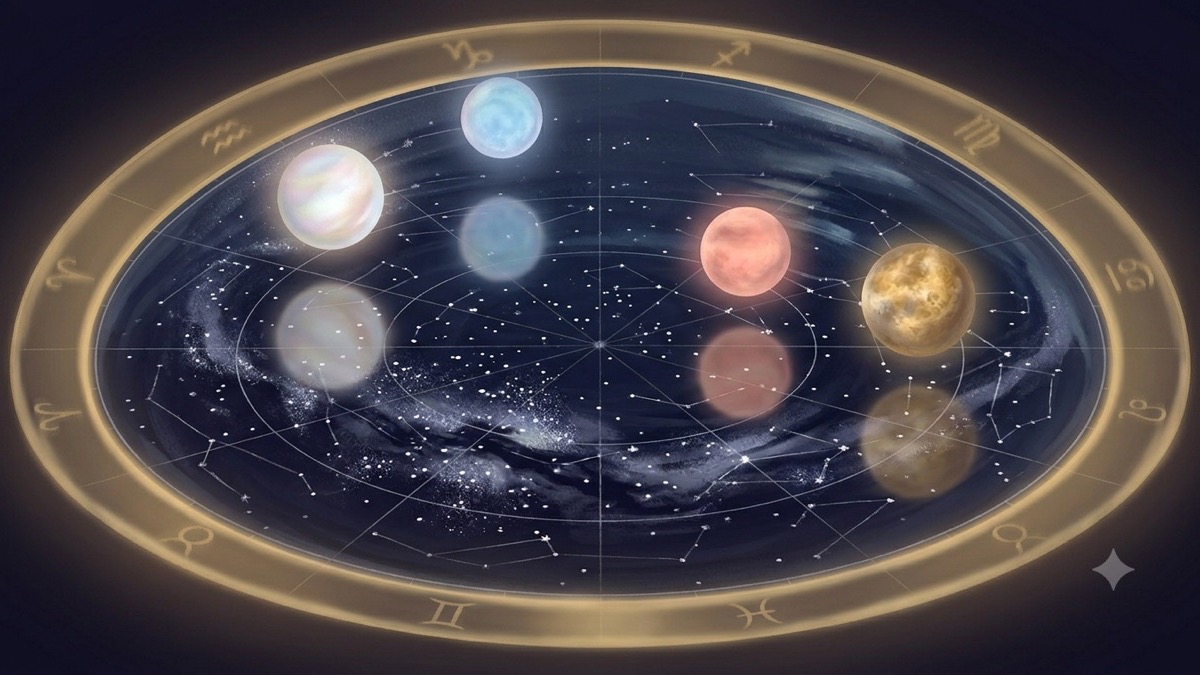
Natal chart transits are the current sky's planets forming aspects to your fixed birth chart — the live positions of the planets today, read against the placements you were born with. Your birth chart never changes. The transiting planets keep moving, and the spots where they touch your natal points mark the timing of a transit. Before reading one, it helps to understand pillar guide to astrological transits, which covers what a transit is and how astrologers track the moving sky. The idea itself is plain: lay the moving planets over the fixed map of your birth, then find where they make contact. That single overlay is the one thing a static chart can never show you on its own.
- Works from two layers: your unchanging natal chart plus the planets' positions right now
- Locates timing by which transiting planet aspects which natal point, in which house
- Treats slow outer-planet contacts as the heavy hitters and fast inner ones as background
Why It Matters for Self-Awareness
Most people hit the same wall. They can read a static birth chart — Sun here, Moon there, rising sign on the horizon — but they freeze the moment someone tells them to look at their transits. The chart they already know is fixed; transits are the part that moves, and that movement is exactly what makes them hard to grab. The questions that follow usually sound like quiet panic: which planet do I even watch, against which natal point, and how do I tell a real event apart from ordinary sky noise? That last question is the real friction. Without a way to sort signal from background, every planet looks equally important, so nothing does.
In my years applying systematic pattern-recognition frameworks to chart structure, the people who stall are rarely short on knowledge — they are short on a filter for what to ignore. Reading these contacts well is mostly about discarding the ninety percent that does not matter on a given day and keeping the one transit that does. The tradition this draws on — shaped by readers like Dane Rudhyar and Robert Hand — treats these cycles as developmental timing rather than fixed fate, which is why a transit describes a window of pressure or opportunity, not a verdict about what happens to you. Once you have a working filter, the moving chart stops feeling intimidating and starts reading like a calendar you can actually use.
Natal Chart Transits vs Adjacent Concepts: How It Works + Trade-offs
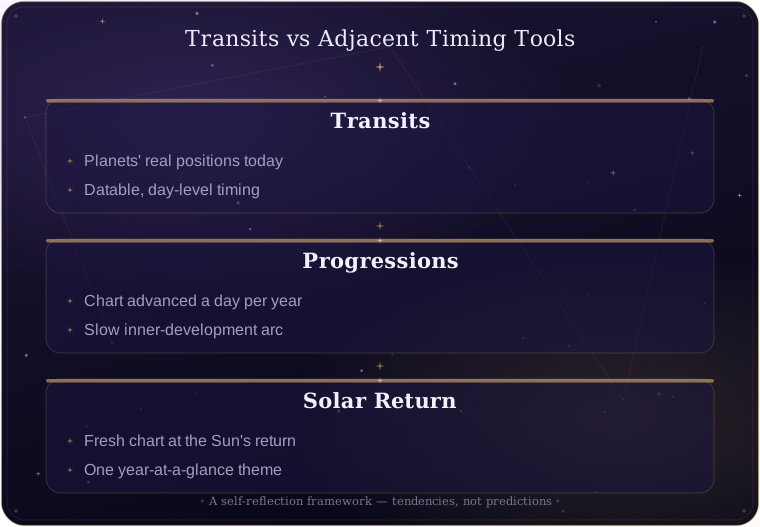
Transits to your natal chart differ from the other timing tools they get confused with mainly in how each one maps time onto the birth chart. A transit uses the planets' real positions today; the adjacent methods bend or recast the chart in different ways. Setting them side by side makes the trade-offs clear:
- Transits vs secondary progressions. Transits use where the planets actually are right now, while progressions symbolically advance the whole chart roughly a day for each year of life. To get the literal, datable timing transits give you, you sacrifice the slow inner-development arc that progressions are built to trace.
- Transits vs the solar return. A solar return casts a fresh chart for the exact moment the Sun comes back to your natal degree each year, producing one thematic portrait for the twelve months ahead. To get that single year-at-a-glance read, you sacrifice the day-level specificity that a live transit pins down.
- Transits vs synastry. Synastry compares two birth charts against each other; a transit compares one chart against the moving sky. To read the chemistry between two people you trade away the calendar — synastry tells you the dynamic, not the date.
The point is not that one tool wins. Each answers a different question, and the transits earn their place by being the only one of the three that tells you what the sky is doing to your chart this week, in real time.
How to Read Natal Chart Transits on Your Own Chart
Reading the transits on your own chart comes down to a short, repeatable sequence rather than memorizing every planetary cycle:
- Pull your birth chart and note your natal points — Sun, Moon, ascendant, and the personal planets — by exact degree.
- Get today's planetary positions from any ephemeris or chart app, listed by sign and degree.
- Look for a transiting planet sitting within a few degrees of a natal point; that tight orb is what marks a live transit.
- Prioritize the slow movers — a Saturn, Uranus, Neptune, or Pluto contact outweighs a passing Moon every time.
- Read the house the contact lands in to see which area of life the transit is touching.
Here is the sequence in action. Say transiting Saturn is sitting at a degree that matches your natal Moon: you check the orb, find it is within two degrees, note which house it falls in, and read it as a slow, serious contact to your emotional life rather than a fleeting mood. That is the whole method — observe the contact first, interpret second. For a fuller walk-through of one slow transit landing on a single natal point, see worked example of the Saturn in Pisces transit, which follows the contact from first approach to exact hit.
Common Misreadings
The friction most readers feel with transit-to-natal contacts traces back to a handful of predictable misreadings, and correcting them does most of the work:
- Treating every transit as major. The fast Moon and inner planets shift constantly. Only tight contacts from the slow planets tend to mark genuine turning points; the rest is texture.
- Tracking the wrong planet. Beginners often watch whatever planet is currently "in their sign" instead of asking which transiting planet is actually aspecting a natal point. Sign alone is not contact.
- Ignoring the orb. A transit five or six degrees away is mostly background. The contact sharpens as the orb closes toward one or two degrees, which is when you may notice something concrete.
- Reading meaning before mechanics. People reach for what a transit "means" before confirming which natal point it touches. Locate the contact first; the meaning only makes sense once you know where it lands.
Transit Contacts at a Glance
| Property | How It Works | Natal Point Touched | How to Observe |
|---|---|---|---|
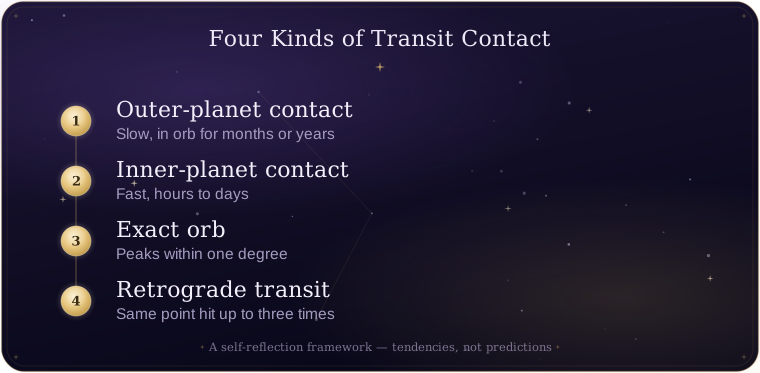
| Transiting outer planet | A slow contact that stays in orb for months or years | The natal point it aspects, read by house | The same theme keeps resurfacing over a long stretch |
| Transiting inner planet | A fast contact lasting hours to days | A personal-planet house being briefly touched | A short, passing mood or minor event |
| Exact orb | The contact peaks as degrees line up within one degree | The precise natal degree being hit | Intensity spikes, then eases as the planet moves on |
| Retrograde transit | A planet crosses the same natal point up to three times | One natal point, revisited | A theme that returns twice more before it clears |
Questions People Ask About Transits
How do I find my transits for today?
Pull up your birth chart, then overlay today's planetary positions from any ephemeris or app. A transit appears wherever a current planet sits within a few degrees of one of your natal points.
Which transits actually matter?
Contacts from the slow outer planets — Saturn, Uranus, Neptune, and Pluto — carry the most weight because they last for months. Fast Moon and inner-planet transits come and go within days and usually read as background.
How long does a transit last?
It depends on the planet's speed. A Moon transit can pass in hours, while an outer-planet contact to a natal point may stay within orb for a year or more, often returning during a retrograde.
Can I read these transits without knowing astrology?
You can locate them by matching degrees, but interpreting them takes knowing what each planet and house signifies. Start with the contact, then learn the meaning of the natal point it touches.
Reflection Prompts
- Think of a recent month that felt like a turning point — which slow-moving planet was contacting one of your natal points then?
- Recall a time you blamed a "sign" for a mood; was a fast transit simply passing rather than a lasting contact?
- Look at today's sky against your chart — which single contact would you choose to track first, and why?
Related Reading
- guide to the twelve astrological houses — once you find which house a transit lands in, this explains what that area of life governs, which is the step most beginners skip.
Take Action
New to your chart? Read the full guide to reading a birth chart first, then layer today's transits on top. Once you can confidently place the planets and houses on your own chart, overlaying today's transits becomes a quick daily habit instead of a guessing game — and timing stops feeling random, because you can finally see exactly where the moving sky is meeting the map you were born with.
Sources
- Dane Rudhyar — pioneered the psychological, person-centered reading of astrological cycles as developmental rather than predetermined
- Robert Hand — helped systematize the modern practice of reading planetary transits against the natal chart