
What are Saturn in Pisces?
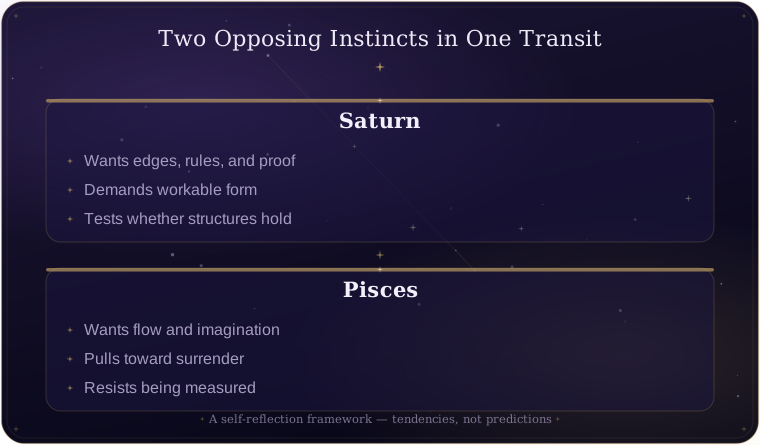
Saturn in Pisces is the multi-year transit of structure-bringing Saturn through boundary-dissolving Pisces. It is not a single event but a family of related experiences spread across the years Saturn spends in this sign, where it sits is a question of placement, so to see which arena of your own life it is reshaping, read the overview of the astrological houses alongside this guide. The pairing reads like a paradox on purpose: Saturn wants edges, rules, and proof you can lean on, while Pisces wants flow, imagination, and the kind of surrender that resists being measured at all. During this transit, that tension shows up in how you handle rest, faith, creative work, and the soft places where you usually let things blur. Think of it as a system of recurring lessons rather than one fixed verdict, each one asking you to give a workable shape to something formless.
- A repeating cyclical transit, not a one-time prediction or a permanent label
- A meeting of two opposing instincts — Saturn's demand for form and Pisces's pull toward dissolution
- A set of life areas put under review, each one tied to where the sign sits in your own chart
Why It Matters for Self-Awareness
Most people meet a Saturn transit braced for punishment. The cultural shorthand treats Saturn as the stern disciplinarian, so the news that Saturn transits your Piscean territory can read as a sentence rather than an assignment. That framing misses the actual ask. This transit does not arrive to dissolve you into your fears; it arrives to test whether you can hold a steady form around things that resist holding — your imagination, your need for rest, your sense of where you end and other people begin. Reading the whole transit as a family of related lessons, instead of bracing for one dreaded outcome, changes what you do with it.
The reason to understand the full system before zooming into any single piece is that Pisces themes are slippery by nature, and a one-trait reading tends to mislead. If you only learn that "this transit is hard on boundaries," you will treat every tired, foggy week as confirmation that you are failing the test. But the transit touches several distinct domains at once, and they do not all move on the same schedule. One person feels it most in their creative discipline; another feels it in caregiving fatigue; another in a slow, sobering shift in what they believe. Seeing them as a connected set lets you tell the difference between a real structural problem you can build around and ordinary noise you can let pass.
The wide view also protects you from two failure modes that catch most people. A reader who holds the full family of themes in view can sort the signal from the noise — noticing that the same boundary problem keeps surfacing across work, family, and friendship, which is worth acting on, versus a one-off bad mood that just needs sleep. The point of the system is a frame steady enough to make that call without spiraling in either direction. There is also a practical payoff: knowing the transit reshapes one specific area of your life rather than your whole identity lets you locate it, by looking at which part of your chart Saturn is actually crossing — a question of placement, not personality. The same transit years land very differently depending on which life domain they fall on, so the work is less about absorbing a meaning and more about narrowing the question until it becomes something you can act on. That narrowing starts with naming the two ways readers go wrong:
- Over-reading. Turning every inconvenience into a fated message and burning your attention on signs that are really just a hard week.
- Under-reading. Dismissing a genuine, repeating pattern because the doom-laden language around the transit made you tune it out entirely.
The Saturn in Pisces at a Glance
| Life Domain Under Review | Core Theme | Placement / House Link | Common Misread |
|---|---|---|---|
| Boundaries and capacity | Learning to say no without guilt | Wherever Pisces falls in your chart | Reading exhaustion as moral failure |
| Rest and surrender | Building real recovery, not collapse | Often the 12th-house territory | Treating rest as laziness to push through |
| Creative discipline | Giving form to imagination | Houses tied to work and craft | Waiting for inspiration instead of showing up |
| Faith and belief | Maturing what you trust in | Houses of meaning and worldview | Mistaking sober doubt for loss of faith |
| Compassion and care | Loving without dissolving | Relationship and service houses | Confusing self-erasure with generosity |
The Saturn in Pisces: Quick Guide
Each strand of Saturn in Pisces deserves a short orientation before you go deep on any one of them. The briefs below sketch the core of each theme plus the most common way it gets read wrong.
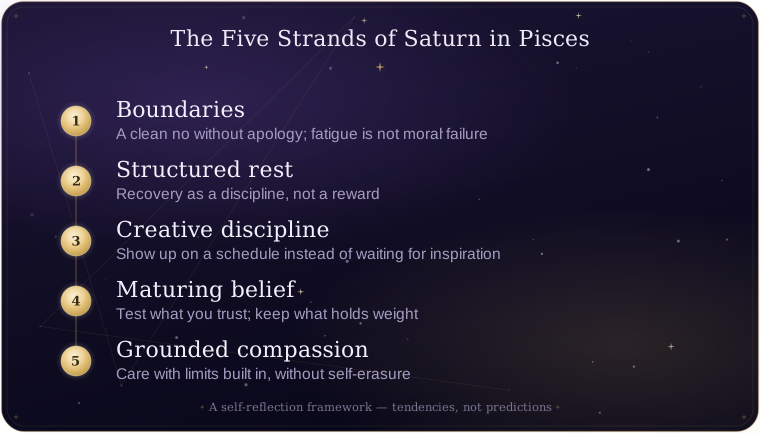
- Saturn testing your boundaries — This is the strand most people feel first. Saturn asks you to build firm, repeatable limits around your time and attention in a sign that would rather merge than separate. The work is unglamorous: noticing where you over-give, then practicing a clean no without a paragraph of apology attached to it. The misread is treating your fatigue as proof that something is wrong with you, when the transit is simply showing you a boundary that was never built in the first place. For the underlying area this often touches — the hidden, easily drained part of the chart — see deep dive on the twelfth house.
- Saturn and structured rest — The 12th house is the part of life that runs underground: sleep, retreat, the unconscious, the need to dissolve and recover, while Pisces adds imagination, compassion, and the pull toward dissolution. Saturn here asks you to give rest an actual structure instead of treating it as the thing you do once everything else is finished. The core idea is that recovery is a discipline, not a reward. The common misread is mistaking real rest for laziness and powering through until you crash.
- Saturn and creative discipline — Pisces is the imaginative, image-rich part of the zodiac, and Saturn wants that imagination to take a durable shape. This strand rewards showing up to the work on a schedule rather than waiting to feel inspired. The misread is believing that structure kills creativity, when under this transit it is usually the only thing that lets a vague vision become finished work.
- Saturn and maturing belief — Faith, meaning, and what you trust in all come under quiet review. Saturn does not delete belief; it asks you to test it, drop what was sentimental, and keep what holds weight. The misread is reading honest doubt as a crisis of faith rather than the slow maturing of it. What survives this review tends to be sturdier than what went in, precisely because it has been questioned rather than inherited.
- Saturn and grounded compassion — Pisces is the most empathic part of the zodiac, the place where you feel other people's states as if they were your own. Saturn here asks you to keep caring while staying intact, which means learning that compassion without a container quietly turns into self-erasure. The strand rewards the kind of care that has limits built into it — showing up reliably for the people who matter without dissolving into their needs. The misread is mistaking that self-erasure for generosity and calling burnout a virtue.
How Shade and Combination Shift Readings
No single strand of Saturn in Pisces acts alone, and that is the part most quick takes miss. The transit reads more like a gradient than a checklist, because the same planetary placement bends depending on which life area it touches, what angle it forms to the rest of your chart, and how long it lingers there on its retrograde passes. Two people living through the identical transit years can describe almost opposite experiences, and both can be reading it accurately. The skill is learning to combine the strands rather than score them one at a time, and a few concrete examples make the gradient clearer:
- Boundaries plus rest. When the boundary strand and the rest strand overlap, the lesson is rarely "do less" — it is "protect the recovery you do get." To get genuine restoration, you sacrifice the open-door availability that made other people comfortable, and that trade-off feels selfish long before it feels healthy.
- Creative discipline plus belief. When the creative strand meets the faith strand, finishing a piece of work starts to double as a test of what you actually trust. To gain a finished, durable body of work, you give up the romantic story that real art only arrives in bursts of inspiration.
- Hard angles intensify the strand. While Saturn moves through Pisces, it forms tense angles to other planets, and the sharpest of these is the explainer on the square aspect, which tends to force a strand to a decision point rather than let it drift. A square does not change the theme; it raises the stakes on the theme already in play.
- Belief plus compassion. When the faith strand and the care strand combine, you often find that the worldview you were defending was really a way of avoiding a hard conversation. To gain a belief you can stand behind, you give up the comfortable vagueness that let you say yes to everyone and mean it to no one.
Timing changes the reading as much as overlap does. Saturn does not cross this sign in one smooth pass; it stations and retrogrades, which means a theme you thought you had resolved can circle back for a second and sometimes third review before it finally settles. A boundary you set in the first year may get tested again on the retrograde return, and that repetition is not a failure — it is how the transit pressure-tests whether the structure you built actually holds. Reading the same strand at two different points in the passage often gives two honest but different answers, and the more accurate account is usually the later one, after the early enthusiasm has worn off and only the workable parts remain.
The practical takeaway is that you read this transit by blending, not by isolating. Ask which two or three strands are loudest right now, notice where they overlap, and treat the overlap — not any single keyword — as the real assignment. A reading that flattens the whole period into one tidy meaning has usually thrown away the information that would have made it useful.
Common Misreads + Framework Limits
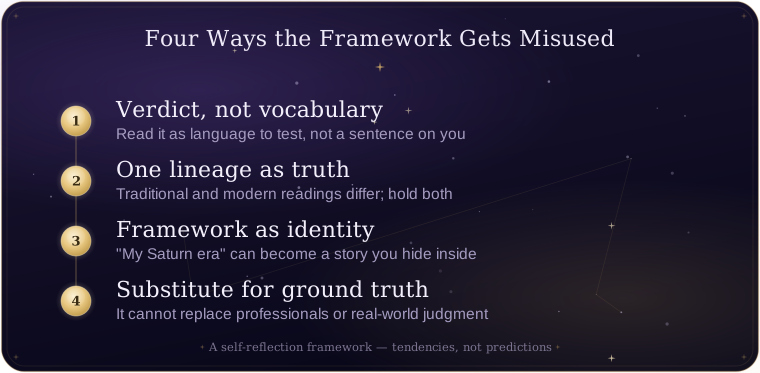
The biggest errors with Saturn in Pisces happen at the level of the whole system, not any single strand. People tend to mistake an interpretive vocabulary for a fixed verdict, and that one move generates most of the confusion. A short list of the recurring mistakes:
- Treating it as a verdict, not a vocabulary. Saturn here is a way of describing a stretch of experience, not a sentence handed down about your character. Read it as language you can test against your own week, not a label you have to accept. The cure is to phrase every claim as a question you can check: "Is my drive actually draining where this says it should?" rather than "This proves I'm drained."
- Forcing one lineage to be the single right answer. Traditional and modern astrologers describe this transit differently, and the descriptions do not always agree. The psychological reading used here leans on writers like Liz Greene, who frames Saturn as a maturing task rather than a punishment, and Dane Rudhyar, who reads transits as phases of growth; even so, when two lineages conflict, the honest move is to hold both as possibilities rather than pretending one is the settled truth.
- Upgrading the framework into an identity. "I'm in my Saturn era" can quietly become a story you hide inside, an explanation that excuses you from acting rather than a frame that helps you act. The transit is something passing through your life, not the name of who you are, and the difference shows up in whether the reading leaves you more able to do something or just more resigned.
- Expecting it to replace real ground truth. This transit can describe a season of fatigue or doubt; it cannot identify a medical or psychological condition, and it is not a substitute for the people and professionals who can. Where it overlaps the hidden, draining territory of the deep dive on the twelfth house, the temptation to over-explain difficulty through astrology alone gets strongest, and that is exactly where it helps to keep the framework in its lane.
The limit worth naming plainly is that this is interpretive language, not measurement. Astrology offers a vocabulary for noticing patterns in your own experience; it does not make scientific claims about cause and effect, and treating it as if it did is the fastest way to misuse it. The fair test is whether a reading helps you describe and act on something you already half-noticed, not whether it can predict an outcome you could not have reached any other way. Held as a set of testable observations you check against real life, this transit stays useful. Held as proof of anything, it stops being honest.
Common Questions About Saturn in Pisces
How long does Saturn in Pisces last?
Saturn spends roughly two and a half to three years moving through a single sign, so a full passage through Pisces runs on that scale rather than a few weeks. Saturn also retrogrades during that window, which can make the same themes return for a second look before they finally settle.
What is a Saturn return in Pisces?
A Saturn return is when Saturn comes back to the exact spot it occupied at your birth, an event that happens around ages 29 and 58. If you were born with this placement, that return brings these same boundary, rest, and faith themes to a personal turning point rather than a general one.
Is this Saturn transit bad luck?
No — the doom framing is the misread the whole transit pushes back on. The placement asks for specific, workable discipline around boundaries and rest, and the difficulty most people feel comes from skipping that work, not from the transit itself.
How do I know where Saturn here affects me?
Find which house Pisces occupies in your own birth chart, because that house is the life area Saturn is reshaping for you. The same transit lands on work, relationships, or private life depending entirely on that placement.
Reflection Prompts
- Think of a recent week you spent exhausted — where exactly did you keep a door open that you could have closed?
- Name one creative or caregiving commitment you have been waiting to "feel ready" for instead of giving it a schedule.
- Notice a belief you have quietly outgrown during this transit, and ask what holds up once you stop defending it.
Related Reading
To go deeper on any single strand of this transit, start with the pieces that explain the building blocks it touches. For the elemental logic behind why Pisces behaves the way it does, read the overview of the four-element framework, which places Pisces among the water signs and explains the emotional, boundary-soft quality Saturn is working against here. To explore a different long-arc lens you can set beside this one, see the explainer on the lunar nodes, north node and south node, which covers a separate growth-axis framework you can compare with Saturn's themes. For the structural map of your own chart, the overview of the astrological houses shows how to locate which domain this transit is actually reshaping, and the deep dive on the twelfth house covers the specific Pisces-ruled territory of rest, retreat, and the unconscious that this transit touches most directly.
Take Action
Open your birth chart and find which house holds Pisces, then trace where Saturn transits across it during its passage through the sign (most recently 2023-2026). Doing that gives you a single, concrete answer to "which part of my life is under review," instead of a vague dread spread across everything. Once you can name the actual domain, the transit stops being a weather warning and becomes a place you can build — which is the quieter point of Saturn anywhere: structure is not the thing that limits you, it is the thing that finally lets the formless hold a shape. Read the full guide to reading a birth chart to see where this transit lands for you.
Sources
The grounded, non-punitive reading of Saturn in Pisces in this guide draws on the modern psychological-astrology tradition, which reframes Saturn as a maturing task rather than a sentence of misfortune.
- Liz Greene — reframed Saturn through depth psychology, treating it as a developmental task that builds inner structure rather than a bringer of bad luck
- Dane Rudhyar — established the humanistic, cycle-based way of reading planetary transits as phases of growth rather than fixed predictions