
What Is Saturn Return Age 29?
Saturn return age 29 is the moment when the planet Saturn circles back to the exact zodiac position it occupied at your birth. Because the planet moves slowly, this return lands near ages 29 to 30, which is why the label points to the late twenties. According to NASA, Saturn takes about 29.5 years to complete one orbit, which is why the return recurs near ages 29 and again close to 59. Astrologers treat it as an interpretive frame for reviewing adult life, not a prediction locked into your future — a reading tradition shaped by writers such as Dane Rudhyar, who mapped planetary cycles as stages of personal development rather than fate. You can place it beside the broader pillar guide to reading a birth chart, which shows how any transit sits inside the whole chart. In plain terms, the first Saturn return reads as an adult review of structure, commitment, and responsibility.
- Recurs near age 29, then once more close to 59, following Saturn's orbit
- Read as a checkpoint on the work, boundaries, and promises you have set
- Often blurred with a vague "quarter-life crisis" instead of a bounded transit
Why It Matters for Self-Awareness
Understanding saturn return age 29 matters because the late twenties often open a quiet gap between the life you planned at 22 and the one you are actually living. In my own work applying pattern-recognition frameworks to chart structure, the clearest signal is rarely drama — it is repetition. The same friction keeps surfacing in a job, a relationship, or a habit until it asks to be dealt with directly. Read this way, the transit hands you a language for that friction instead of leaving it as a nagging sense that something is off.
Where the pressure actually lands
The value is not abstract. It tends to show up in a few concrete parts of ordinary life:
- Timing your own reviews. It offers a window to ask which commitments you chose freely and which ones you simply drifted into.
- Naming the pressure. Instead of a flat "I'm behind," you get a specific lens on work, boundaries, and self-direction.
- Separating signal from panic. It reframes late-twenties unease as a scheduled checkpoint rather than proof that you have failed.
What an honest read gives you
The point is not to predict a bad year. A grounded reading helps you notice which structures you built on purpose and which ones you inherited from a younger version of yourself. Someone at 29 might realize a job chosen at 23 no longer fits, or that a relationship they coasted through needs a real decision. The transit does not make that call for you; it simply tends to bring the question into focus, which is a very different thing from a horoscope that tells you what to do.
Saturn Return vs Saturn Square
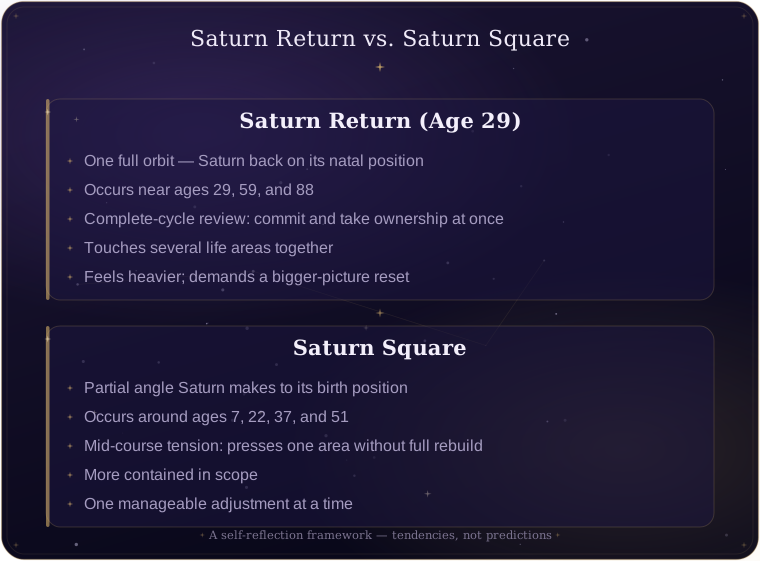
saturn return age 29 differs from a Saturn square, and mixing the two is one of the most common ways online coverage blurs its real limits. A Saturn return is one full orbit — Saturn back on your natal Saturn — and it happens near 29, 59, and again near 88. A Saturn square is a partial angle Saturn makes to its birth spot several times along the way, around ages 7, 22, 37, and 51–52 (see the explainer on the square aspect in astrology). They rhyme in theme but differ in scale.
Here is how each one works and where the trade-off sits. The return works as a complete-cycle review: it asks you to consolidate, commit, and take ownership of a whole structure at once. The square works as a mid-course tension point: it presses on one area without demanding you rebuild everything. To get the return's clarity about a full life stage, you sacrifice the smaller, more contained scope of a square — a return tends to touch several areas together, so it feels heavier. Choosing to read a late-twenties wobble as the full return rather than a passing square gets you a bigger-picture reset, but you lose the option of treating it as one manageable adjustment.
Astrologers such as Liz Greene have written at length on how Saturn's longer cycles differ from its shorter contacts, which is why folding the two together flattens both and leaves readers expecting a two-year emergency instead of a defined review.
How to Read This Transit in Your Timing
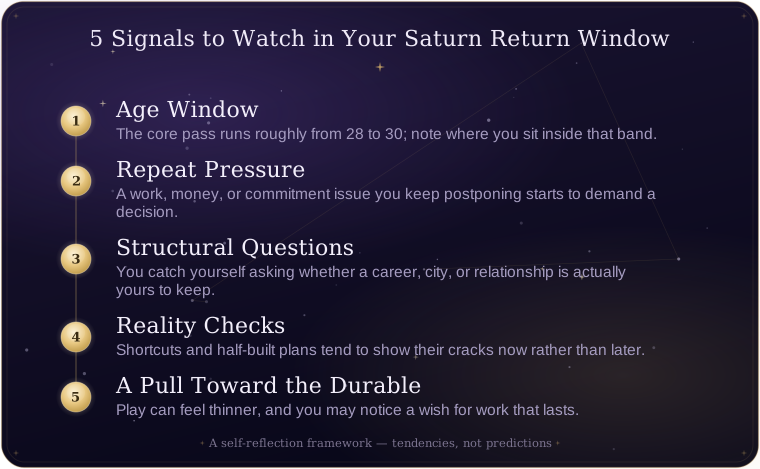
You do not need advanced technique to notice when the first Saturn return is active. Watch for a handful of observable signals rather than a single dramatic event:
- Age window. The core pass runs roughly from 28 to 30; note where you sit inside that band.
- Repeat pressure. A work, money, or commitment issue you keep postponing starts to demand a decision.
- Structural questions. You catch yourself asking whether a career, city, or relationship is actually yours to keep.
- Reality checks. Shortcuts and half-built plans tend to show their cracks now rather than later.
- A pull toward the durable. Play can feel thinner, and you may notice a wish for work that lasts.
Reading this transit in your own timing means matching these signals to the actual dates of the pass, which shift depending on your natal Saturn's sign and house. Two people born the same year can meet the exact return months apart, so the birthday number is a starting point, not the whole map.
Common Misreadings
Popular write-ups tend to stretch the first Saturn return well past its real scope, and a few misreadings come up again and again:
- "It runs your whole life for two years." In practice, saturn return age 29 points at structure and commitment — not every mood or event in your late twenties.
- "It guarantees a crisis." The transit describes a review, not a breakdown; many people describe it as steadying rather than shattering.
- "It is the same as any midlife transit." Outer-planet passes later in life work on different themes; blending them erases what makes the return specific.
- "Age 29 is a hard deadline." The window is approximate and tied to Saturn's real position in your chart, not to a single birthday.
The Saturn Return at 29: Quick Reference
| Property | How It Works | Natal Placement | How to Observe |
|---|---|---|---|
| Core cycle | Saturn completes one orbit back to its birth position | Your natal Saturn's sign and house | Falls near ages 29–30 for almost everyone |
| Main theme | Reviews commitment, structure, and responsibility | The house Saturn sits in flags the life area | Recurring pressure in one domain you keep avoiding |
| Duration | Builds and releases across roughly two years | Timing shifts with natal Saturn's exact degree | Shortcuts show cracks, then the ground settles |
| Repeat | Returns once more near age 59 | The same natal Saturn point, second pass | A later review of what you built the first time |
Common Questions About the Saturn Return at 29
What does saturn return age 29 mean in simple terms?
It is the roughly once-in-30-years point when Saturn comes back to its birth position in your chart. Astrologers read it as an adult review of commitment, work, and responsibility rather than a fixed forecast.
Does everyone go through it at the same age?
Nearly — Saturn's orbit means the first pass lands close to ages 29 to 30 for almost everyone. The exact peak shifts slightly with your natal Saturn's degree.
Is the Saturn return always difficult?
Not always. It tends to feel demanding where you have avoided a decision, but many people describe it as clarifying and grounding rather than purely hard.
How long does the first Saturn return last?
The active window runs about two years, building toward the exact return and easing afterward. The heaviest stretch usually sits closest to the exact pass.
Reflection Prompts
- Think of a recent moment when a commitment you drifted into suddenly felt heavier — what was it?
- Recall a task or promise you keep postponing; what would owning it directly ask of you?
- Name one structure — a job, a city, a bond — you would rebuild on purpose today.
Related Reading
- explainer on the astrological houses — the house holding your natal Saturn shows which life area the return reviews.
- guide to the ascendant and rising sign — helps you place Saturn against the rest of your chart's structure.
- Saturn return (Wikipedia) — a plain summary of how the cycle is defined.
Take Action
Ready to pin down your own timing? Explore your Saturn return with the Saturn return date calculator. The tool gives you the exact window when your first pass builds and eases, so instead of guessing whether you are "behind," you get a concrete map of which commitments are actually due for an honest review — and a clearer sense of which parts of your life you would choose again on purpose. This is not a clinical interpretation or mental health advice.
Sources
- Dane Rudhyar — pioneered the psychological, cycle-based reading of astrological transits this page draws on
- Liz Greene — developed the depth-psychology approach to Saturn's role in the birth chart