
What Is Saturn Return in Capricorn?
Saturn Return in Capricorn is the transit when Saturn returns to its natal Capricorn degree, a period commonly linked to authority, discipline, and the structures you build to last. Because it depends on where Saturn sat when you were born, it applies only to people who have Saturn placed in Capricorn in their natal chart. According to NASA, Saturn takes about 29.5 years to complete one orbit of the Sun, which is why this transit tends to arrive near ages 29 and 58. In interpretation, it is read as a symbolic checkpoint for commitment, responsibility, and career direction rather than a forecast of exact events. It sits within the broader Saturn return guide, which maps the timing across every sign. Treat it as a framework for reflection, not a fixed prediction.
- Applies only to charts with Saturn placed in Capricorn at birth
- Centers on authority, discipline, and durable structure
- Often misread as a guaranteed crisis instead of a period of testing
Why It Matters for Self-Awareness
Understanding saturn return in capricorn matters because it points to the exact places where your commitments get tested — work, reputation, and the standards you actually live by. In my years applying pattern-recognition frameworks to chart structure, I've found this placement tends to surface wherever someone has been running on borrowed authority instead of earned competence. It rarely reads as random bad luck; more often it looks like a bill coming due for structures built too quickly or on someone else's terms. This practical read builds on the framework Liz Greene established, which treats Saturn as a symbol of maturation rather than misfortune, and it pairs naturally with the career and public-role framework in 10th house astrology. The value is grounded self-awareness: instead of bracing for doom, you get a map of where to look. That map usually shows up in a few concrete ways:
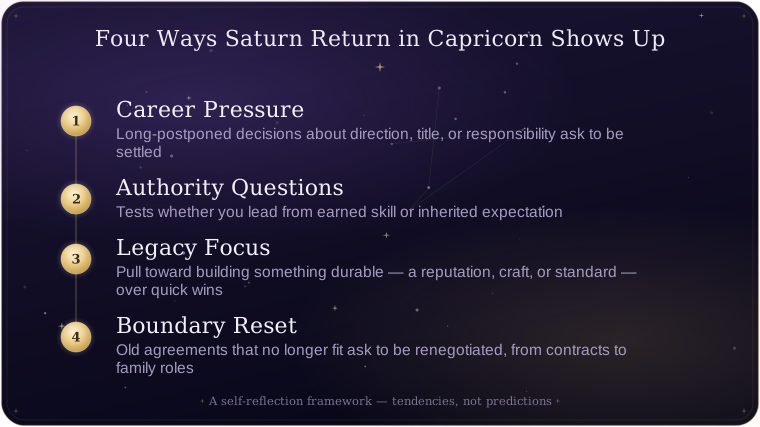
- Career pressure. You may notice long-postponed decisions about direction, title, or responsibility asking to be settled — the job you outgrew, or the promotion you keep declining. This is often where the return feels loudest.
- Authority questions. This placement tends to test whether you lead from earned skill or inherited expectation. Many people quietly restructure how they work around this age, dropping roles that were never really theirs.
- Legacy focus. Many people describe a pull toward building something durable — a reputation, a craft, a standard — rather than chasing the next quick win. The question shifts from "what looks good now" to "what still stands in ten years."
- Boundary reset. Old agreements that no longer fit often ask to be renegotiated, from contracts to family roles. Saying no becomes less about rebellion and more about accuracy.
Read this way, the placement stops being a countdown to hardship and becomes a prompt to check your foundations before you build the next floor. That reframing is the practical point — it turns vague dread into a short list of things worth looking at honestly, and it gives you a reason to act on your own timeline rather than wait for a deadline you did not choose.
Saturn Return in Capricorn vs a Saturn Square
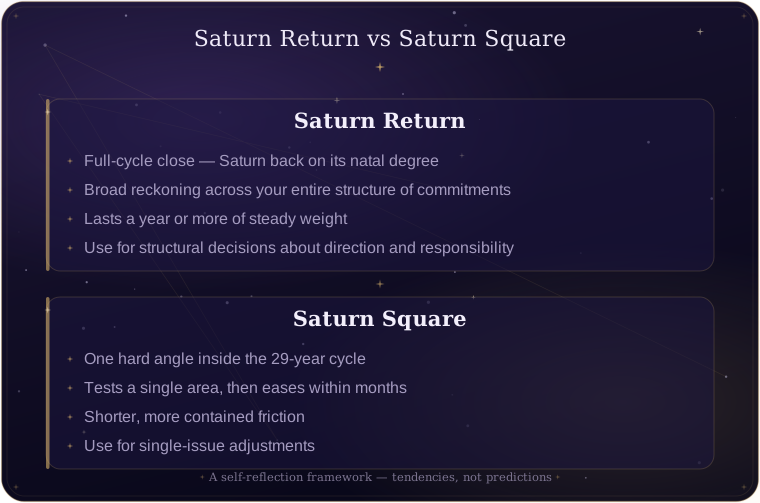
Saturn Return in Capricorn differs from a Saturn square, and the two get blended constantly in general write-ups. A Saturn square is one hard angle inside Saturn's roughly 29-year cycle; the way it works is quick and specific — a short friction point that tests a single area, applies pressure, then eases within a few months. The return, by contrast, is the full circle closing, with Saturn back on the exact position it held at your birth, so it reads as a wider reckoning across your entire structure of commitments. To get the return's depth, you give up the square's tidy containment: the return touches more of your life at once and lasts longer, often a year or more of steady weight rather than a passing squeeze.
People also confuse it with the slow transits of outer planets like Pluto or Uranus, which is the other place coverage tends to go wrong. Those reshape a whole generation and can take years to resolve, working on identity and upheaval at scale; the return stays personal, practical, and tied to your own choices. To get outer-planet scale, you lose the return's grounded, do-this-now clarity — the sense that specific decisions are within reach right now. This distinction between a full return and a passing angle follows the cyclic approach Dane Rudhyar developed for reading astrological timing as a sequence of stages rather than isolated shocks.
The practical takeaway is simple. Use the return for structural decisions about direction and responsibility, and read the square for a single-issue adjustment. Blending the two is exactly how people end up expecting a life overhaul from what is really a short test — or bracing for a quick fix when a fuller reckoning has actually begun. A useful rule of thumb: if the pressure is narrow and passing, you are probably in a square; if it touches your whole footing at once and refuses to let up, the return is the better frame.
How to Read This Return in Your Timing
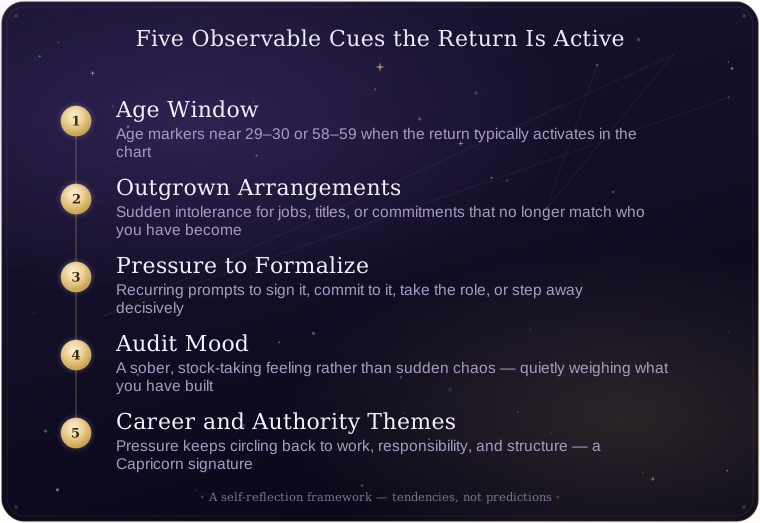
Reading saturn return in capricorn in your timing comes down to noticing where structure, not drama, starts asking for attention. The signals are usually practical and repetitive rather than cinematic, which is exactly why they are easy to miss. Watch for these observable cues:
- Age markers near 29-30 or 58-59, when the return typically activates in the chart. If you are in that window and everything feels like it wants a decision, timing is likely part of it.
- A sudden intolerance for arrangements — jobs, titles, commitments — that no longer match who you've become. The friction is usually less about the thing itself and more about how outgrown it feels.
- Recurring pressure to formalize something: sign it, commit to it, take the role, or step away. The return tends to reward decisions and penalize indefinite drift.
- A mood closer to an audit than an earthquake — quieter, weighing what you've actually built so far. People often report a sober, stock-taking feeling rather than sudden chaos.
- Themes clustering around career, authority, and responsibility rather than romance, travel, or novelty. When the pressure keeps circling back to work and structure, that's a Capricorn signature.
When several of these show up together, it is a stronger sign the return is active than any single one on its own. One cue in isolation is easy to explain away; three or four pointing at the same corner of your life is the pattern worth taking seriously.
Common Misreadings
The most common misreadings of this transit come from coverage that overstates the drama or blends it with unrelated transits. Here they are, corrected point by point:
- "It guarantees a crisis." It tends to test structures, not demolish them; many people describe it as demanding but clarifying once they name the pressure.
- "Everyone goes through it at the same time." Only charts with Saturn in Capricorn have this specific return; other people meet their own sign's version on a different schedule.
- "It predicts a fixed outcome." It maps pressures and tendencies, not a scripted future you are locked into.
- "It's identical to any Saturn transit." The return is the full-cycle close, distinct from the passing squares and oppositions that happen in between.
- "The Capricorn part doesn't change anything." The sign colors the theme heavily, steering the return toward authority, work, and structure rather than, say, relationships or belief.
Notice that each misread points the same direction: toward too much certainty. The honest read keeps the themes clear while leaving the outcome open, which is the whole point of treating this as an interpretive frame instead of a forecast.
Saturn Return in Capricorn at a Glance
| Property | How It Works | Chart Anchor | How to Observe |
|---|---|---|---|
| Timing | Recurs as Saturn completes its ~29.5-year orbit | Natal Saturn in Capricorn | Age windows near 29 and 58 |
| Core theme | Tests earned authority and discipline | Natal Saturn's house | Pressure around career and responsibility |
| Trade-off | Depth of reckoning over a quick fix | Whole-chart structure | Broad, slower shifts vs single-issue friction |
| Common misread | Framed as a guaranteed crisis | Natal chart position | Relief when read as testing, not doom |
Questions People Ask About the Capricorn Saturn Return
When does a Capricorn Saturn Return happen?
It typically arrives near ages 29 and 58, when Saturn returns to its birth degree. The exact timing depends on your natal chart, since Saturn's roughly 29.5-year orbit isn't spaced evenly across the signs.
Who actually experiences this return?
Only people born with Saturn in Capricorn have this specific return. Everyone has a Saturn return, but the Capricorn version belongs to that natal placement.
Is it always a hard time?
Not necessarily; it reads as a period of testing and consolidation rather than guaranteed hardship. Many people describe it as heavy but clarifying once the pressure has a name.
What areas does it touch most?
It tends to concentrate on authority, career, and long-term structure. The specific life area often follows the house your natal Saturn occupies.
Reflection Prompts
- Think of a recent moment when you kept a commitment that no longer fit — what made you hold on?
- Recall a time your authority came from earned skill rather than a title; how did that feel different?
- Name one structure in your life you would rebuild from scratch today, and say why.
Related Reading
- birth chart reading guide — to locate which house your natal Saturn occupies.
- explainer on Saturn square timing — to keep the return separate from passing hard angles.
- Saturn return (Wikipedia)
- Saturn (Wikipedia)
Take Action
Run your details through the Explore Your Saturn Return calculator to check whether Saturn sits in Capricorn for you and when the return lands. You'll get your exact age window and natal house, so the themes stop being abstract and start pointing at real decisions. Knowing the timing early gives you room to choose what you build next, instead of reacting once the pressure has already arrived.
This is not a clinical interpretation or mental health advice.
Sources
- Liz Greene — shaped the psychological reading of Saturn as a symbol of maturation rather than misfortune
- Dane Rudhyar — developed the cyclic, person-centered approach to reading astrological timing