
What Is Saturn Return?
Saturn Return is the moment transiting Saturn comes back to the exact ecliptic longitude it held on the day you were born, a slow orbit that repeats about every 29.5 years. Because Saturn moves slowly and turns retrograde partway through, it does not land on a single birthday; it makes three exact contacts spread across roughly two and a half years, which is why the felt window stretches from about ages 27 to 30, then 57 to 60. Astrological tradition reads this as a structural maturation checkpoint — a symbolic season for timing, boundaries, and long-term commitments — rather than a fixed event, and it is best mapped alongside the broader pillar guide to reading a birth chart. This Saturn return guide treats it as a multi-year, three-pass checkpoint that recurs near ages 29 and 58.
- Recurs about every 29.5 years as Saturn returns to its natal position
- Unfolds as three exact passes, not one birthday, because Saturn retrogrades mid-cycle
- Read as a maturation checkpoint tied to your natal Saturn's sign and house
Why It Matters for Self-Awareness
Understanding this Saturn return guide matters because the timing pressure it describes tends to attach to real decisions: whether to commit to a relationship, leave a job, move cities, or finally hold a boundary you have avoided for years. In my years applying pattern-recognition frameworks to chart structure, the detail beginners miss most is that the return is not one date but three, so the pressure builds, eases, and comes back rather than spiking once and disappearing. Knowing the shape of that window gives you something usable: a way to tell the difference between a passing bad week and a genuine checkpoint asking you to rebuild something on firmer ground. That distinction is the practical payoff — it lets you respond to the season instead of bracing for a single doomsday birthday.
The value here is not prediction. The transit describes a symbolic season, while the actual outcome stays a function of your circumstances, your choices, and the groundwork you laid in your twenties. Natal Saturn's sign and house point to where the checkpoint tends to feel most demanding — a Saturn in the seventh house often surfaces around partnership, a Saturn in the tenth around career and public standing. Reading it this way — in the lineage descending from Dane Rudhyar and Liz Greene, who framed Saturn as a symbol of maturation rather than doom — turns a vague dread of "turning 30" into a set of specific questions you can actually sit with. You may notice the same theme circling back over months; that repetition is the window doing its work, not a sign that something has gone wrong.
Saturn Return vs Saturn Square
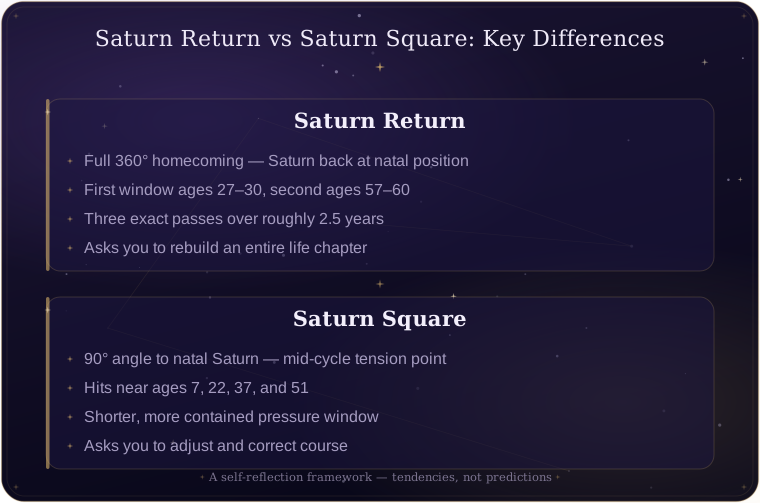
People often confuse the Saturn return with a Saturn square, because both are hard Saturn transits that show up as friction and pressure. The difference is in how each one works. A Saturn square happens when transiting Saturn forms a 90-degree angle to its natal position, hitting near the quarter points of the cycle — roughly ages 7 and 22, then 37 and 51 — and it reads as a mid-cycle tension point that nudges you back on course. The return, by contrast, is a full 360-degree homecoming: Saturn back where it started, closing and reopening an entire chapter. According to NASA, Saturn takes about 29.5 years to orbit the Sun, and the return simply marks the planet arriving back at its birth position. Compared with a square, this Saturn return guide points to a longer, heavier reset rather than a small correction along the way.
The trade-off is real, and worth naming plainly. Track the return as a three-pass window and you get an honest, roughly 2.5-year timeline; the cost is giving up the tidy one-date answer most people want. Read a Saturn square instead and you get a quicker, more contained challenge — but you lose the sense of a whole life-stage completing. To gain the precision of the three-pass framing, you sacrifice the comfort of a single birthday to circle on the calendar. Both draw on the same slow planet; they simply mark different points in its cycle, much the way a square aspect explainer lays out how hard angles work in general. If you can only remember one thing, remember that a square asks you to adjust, while a return asks you to rebuild.
How to Read This Transit in Your Timing
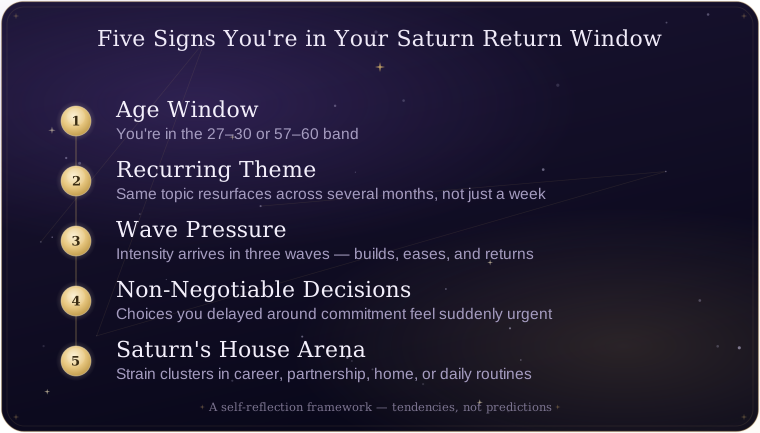
You do not need advanced technique to spot the window; a handful of markers make this a Saturn return guide worth using in real life. Watch for these signs:
- Your age lands in the 27–30 or 57–60 band, the two stretches when Saturn most often completes its return.
- The same theme keeps resurfacing across several months — a job, a relationship, a living situation — instead of passing within a week.
- Pressure comes in waves: an intense first hit, a quieter stretch, then a return of the same question months later.
- Decisions you delayed start feeling non-negotiable, especially around commitment, structure, and long-term responsibility.
- Your natal Saturn's house flags the arena — check whether the strain clusters in career, partnership, home, or daily routines.
Common Misreadings
Most Saturn return guide write-ups flatten the transit into one dramatic birthday, which leaves readers confused when the pressure starts early or drags on far past 29. Here are the misreadings worth correcting:
- "It's just my 29th birthday." The return is a roughly 2.5-year window with three exact passes, not one day — many people feel it strongest at 28 or 30, not precisely at 29.
- "Saturn will ruin my life." The transit describes a season of restructuring, not a verdict; what actually happens depends on your choices and prior groundwork, not the planet.
- "Everyone's return feels the same." Natal Saturn's sign and house shift where the checkpoint lands, so one person rebuilds a career while another reworks a relationship.
- "If nothing blew up, I skipped it." Quiet returns are common; the work is often internal recalibration rather than external drama, and it still counts.
Saturn Return at a Glance
| Pass / Element | How It Works | Focus Center (Natal Placement) | How to Observe |
|---|---|---|---|
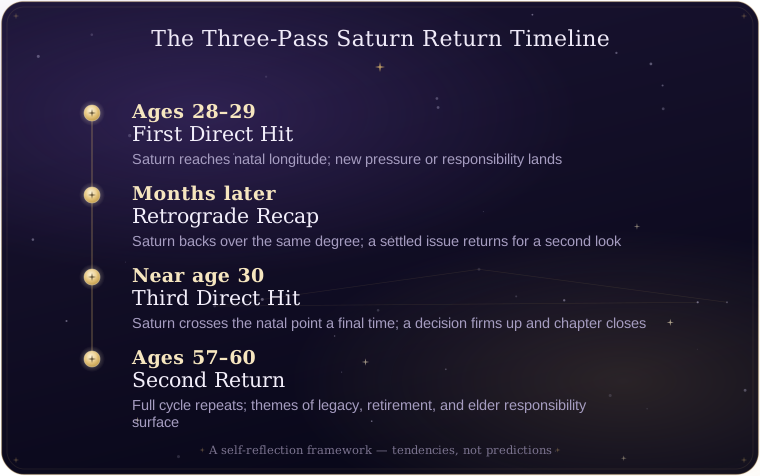
| First direct hit | Saturn reaches your natal longitude for the first time | Natal Saturn's sign and house | A new pressure or responsibility lands, often around ages 28–29 |
| Retrograde recap | Saturn backs over the same degree, revisiting the theme | Same natal degree, second contact | An issue you thought you'd settled returns for a second look |
| Third direct hit | Saturn crosses the natal point a final time | Natal Saturn's house, integration phase | A decision firms up and the chapter closes near age 30 |
| Second return | The whole cycle repeats one orbit later | Natal Saturn, ages 57–60 window | Themes of legacy, retirement, and elder responsibility surface |
Saturn Return FAQ
When exactly does a Saturn return happen?
It centers on the year Saturn completes its roughly 29.5-year orbit, so most people feel it between ages 27 and 30, then again from 57 to 60. The precise dates depend on your birth chart, which a calculator can pin down for you.
Why does my Saturn return last so long?
Saturn turns retrograde partway through, so it crosses your natal point three times over about two and a half years. That back-and-forth is why the window feels stretched rather than instant.
Does everyone get a Saturn return?
Yes — anyone who reaches about 29 has a first return, and anyone who lives into their late 50s gets a second. A rare third arrives near age 87 for very long lives.
Can I prepare for my Saturn return?
You can map the three passes ahead of time and notice which life area your natal Saturn highlights. Preparation is less about avoiding it and more about knowing which questions to sit with.
This is not a clinical interpretation or mental health advice.
Reflection Prompts
- Think of a recent commitment you keep postponing — what structure would make it feel safe enough to finally decide?
- Recall a boundary you set in the last year; where did holding it cost you, and where did it steady you?
- Name one long-term responsibility you took on before 30 — how is it shaping the choices you face now?
Related Reading
- rising sign meaning — your rising sign colors how the return's pressure shows up in daily life.
- guide to the lunar nodes in a birth chart — the nodes add a second layer of timing to major life pivots.
- Saturn (Wikipedia) — background on the planet behind the cycle.
Take Action
Run your birth details through the Saturn return calculator to see the exact dates of all three passes in your own chart. You'll get a personal timeline instead of a generic "age 29" estimate — the first hit, the retrograde recap, and the closing pass mapped to your own Saturn. Knowing that shape ahead of time turns the return from something that happens to you into a season you can meet with your eyes open. Explore Your Saturn Return.
Sources
- Dane Rudhyar — pioneered the psychological, person-centered reading of astrological cycles that frames the Saturn return as a phase of growth
- Liz Greene — developed the depth-psychology approach to Saturn as a symbol of maturation and structure rather than misfortune