
What is Sextile?
A sextile is a 60-degree angle between two planets that signals easy cooperation you have to choose to use. In sextile astrology, those two planets sit one-sixth of the way around the chart wheel, close enough to work together smoothly but far enough apart that nothing happens on its own. Most beginners learn the symbol and the number and stop there, which is why the term keeps sending people back to search. It belongs to the family of glossary of core astrology terms that name the angles between planets, and it reads best as one relationship inside that set rather than an isolated label.
- Links two planets at 60 degrees, two signs apart, typically allowed an orb of about 4-5 degrees from exact
- Reads as a standing invitation that activates only when you take a deliberate step
- Often involves planets in signs that share a compatible element, which is why the pairing feels natural
Why It Matters for Self-Awareness
Understanding sextile astrology matters because the popular write-ups stop at the word "harmonious" and leave out the part that actually trips people up. A reader sees that a sextile is a "good" angle, assumes the talent shows up by itself, then wonders why a placement everyone calls lucky has produced nothing in their life. The gap between the label and the lived result is exactly where the confusion lives, and it shows up in a few predictable ways.
- The "free gift" misread. People treat the sextile like a trine and wait for the benefit to arrive, so they skip the small action that switches it on.
- The blame loop. When the promised ease never materializes, readers decide either the chart is wrong or they are doing something wrong, when really nothing was ever automatic.
- The overlooked placement. Because a sextile makes no noise and creates no crisis, it is the first connection people ignore, even though it often points to the most usable skill in the chart.
Reading the angle accurately reframes it from a prediction into a prompt. In my years of building systematic pattern-recognition frameworks for chart structure, the sextiles are the connections clients almost always undervalue, because nothing forces their hand. This is where Dane Rudhyar's person-centered approach earns its keep: the question is not what the angle promises but what it makes available once you act.
Sextile vs Adjacent Concepts: How It Works + Trade-offs
Sextile astrology gets confused with the two angles sitting next to it on the chart wheel, so sorting out how each one works clears most of the fog. Stephen Arroyo's reading of aspects is useful here: each angle defines a specific way two planetary functions exchange, not a verdict of good or bad.
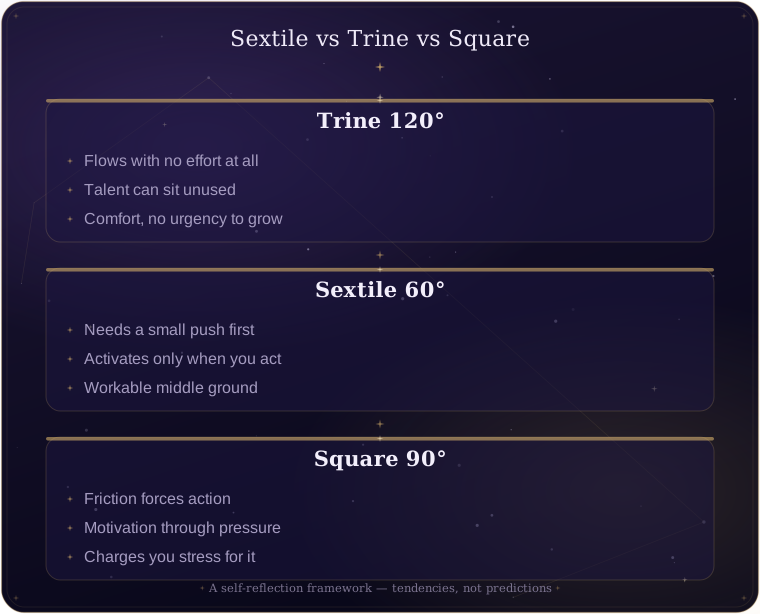
- Sextile vs trine. A trine is a 120-degree angle where two planets cooperate with no effort at all, while a sextile asks for a small push first. To get the effortless flow of the explainer on the trine aspect, you sacrifice the urgency to develop it, so the talent can sit unused; to get the sextile's growth, you sacrifice the comfort and have to make the first move.
- Sextile vs square. A square is a 90-degree angle of friction that forces action through pressure and discomfort. To get the sextile's calm opportunity you sacrifice that built-in pressure, which means no deadline arrives to make you act; the square hands you motivation but charges you stress for it.
- Sextile vs conjunction. A conjunction fuses two planets into one combined drive you cannot separate. To get the sextile's clarity, where each planet keeps its own role, you sacrifice the raw concentrated force a conjunction provides.
The practical takeaway is that the sextile occupies the middle ground: more workable than a square, less automatic than a trine. As Robert Hand's interpretive work makes clear, the same two planets read completely differently at 60, 90, and 120 degrees, so the angle, not the planets alone, sets the story.
How to Read Sextile in Your Chart
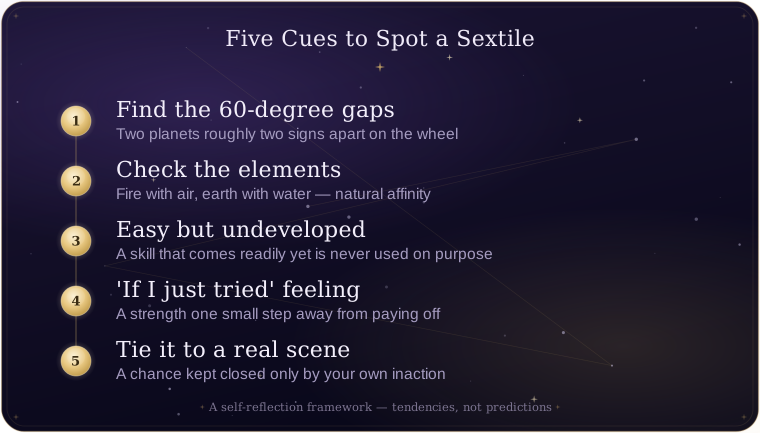
Spotting a sextile is more about scanning for a pattern than recalling a definition. With your wheel open, walk through these five cues in turn and let each one narrow the search before you move on.
- Find the 60-degree gaps. Look for two planets roughly two signs apart; that two-sign spacing is the quickest visual cue for a sextile.
- Check the elements. The two planets usually sit in compatible elements, fire with air or earth with water, which is the natural affinity you can build on.
- Notice what feels easy but undeveloped. A sextile often shows up as a skill that comes readily yet you have never bothered to use on purpose.
- Watch for the "if I just tried" feeling. When a strength feels one small step away from paying off, a sextile is frequently the connection describing it.
- Tie it to a real scene. Think of a recent moment when an opportunity was clearly there and only your inaction kept it closed; that is the sextile pattern in daily life.
Common Misreadings
The reason people stay stuck is that shallow content flattens sextile astrology into a luck label, so a few corrections clear the path.
- "A sextile is automatically lucky." It is an opening, not a guarantee; the benefit waits behind a choice you still have to make.
- "A sextile is the same as a trine." Both are cooperative, but a trine runs on its own while a sextile needs a deliberate start, and treating them as identical is the core friction that sends readers in circles.
- "A sextile is too weak to matter." Quiet does not mean minor; because it asks for participation, a worked sextile often outpaces an idle trine over time.
- "More sextiles means an easier life." Each one is only potential, so a chart full of them describes available options, not delivered outcomes.
Sextile at a Glance
| Property | How It Works | Element Pattern | How to Observe |
|---|---|---|---|
| 60-degree angle | Two planets cooperate once you act | Compatible elements (fire-air, earth-water) | Spot two planets about two signs apart |
| Opportunity, not gift | Stays dormant until a deliberate step | Shared affinity, not fusion | Notice a skill that comes easily but unused |
| Roughly 4-5 degree orb | Tightens the closer the angle is to exact | Spans two signs of complementary elements | Check the degree gap between the two planets |
| Action-activated | Rewards the first move, then flows | Air supports fire, water supports earth | Recall a chance that needed only your push |
Common Questions About Sextile
What does a sextile mean in astrology?
A sextile is a 60-degree angle between two planets that read as cooperative and supportive. It points to an opportunity that becomes useful once you take a small, intentional step rather than a result that arrives on its own.
Is a sextile a good aspect?
It is generally read as favourable, but "good" is misleading because the angle does nothing until you engage it. The accurate framing is that a sextile is workable and low-friction, which is why sextile astrology calls it opportunity rather than luck.
What is the difference between a sextile and a trine?
Both are cooperative angles, but a trine at 120 degrees flows with no effort while a sextile at 60 degrees needs a deliberate start. A trine gives you talent; a sextile gives you an opening you have to walk through.
How tight does a sextile have to be?
Most readers allow a margin of 4 to 5 degrees from the exact 60-degree angle. The closer the two planets sit to exact, the more clearly the cooperation tends to show up in how the placement plays out.
Reflection Prompts
- Think of a recent chance that was clearly available and stayed open only because you never acted on it.
- Recall a skill that has always come easily to you but that you have never deliberately put to work.
- Picture one small step this week that could switch a long-standing "I could if I tried" into something real.
Related Reading
- overview of the major chart aspects — for the full set of angles beyond the sextile covered here
- Astrological aspect (Wikipedia) — for the technical background on how aspects are measured
Take Action
Open your own chart and circle every pair of planets sitting about two signs apart, then pick the single sextile that points to a skill you have been sitting on. You will walk away with a short list of openings the chart has been holding for you, and that list usually reframes "I never got lucky" into "I never took the step." Read the full guide to reading a birth chart to spot sextiles in your own chart at the complete birth chart reading walkthrough.
Sources
- Dane Rudhyar — the case for treating a sextile as an opportunity to act on rather than a fixed outcome traces back to his person-centered work
- Stephen Arroyo — read here for the idea that each aspect names a specific exchange between two planetary functions, not a good-or-bad verdict
- Robert Hand — drawn on for how the same two planets read so differently at 60, 90, and 120 degrees