What is south node?
South Node is a chart point marking the innate skills you already arrive fluent in.
- An exact geometric point where the Moon's orbit crosses the ecliptic, not a mystical force
- Always sits directly opposite the North Node, forming the chart's growth axis
- Describes talents that feel automatic from day one, which is why readings tie it to past lives
Astronomically, the descending node is one of two places where the Moon's path meets the Sun's apparent track across the sky, and that axis is what decides where eclipses land each year. Where the North Node points toward unfamiliar territory, this point holds the competencies you were effectively born knowing — the temperament and habits that need no instruction manual. For the full picture of how the axis works, start with the broader pillar guide to the lunar nodes axis.
Why It Matters for Self-Awareness
Understanding the south node matters because most popular write-ups push readers toward one misleading conclusion — that growth means escaping this part of the chart entirely. Astrology students routinely read it as karmic baggage to leave behind, then feel stranded when "releasing" their most natural strengths leaves nothing solid to stand on. The confusion tends to show up in a few predictable ways:
- The abandon-it trap. Readers treat familiar talents as the problem and try to suppress them, instead of redeploying them on purpose.
- The all-or-nothing read. Growth gets framed as North Node or descending node, when the axis only functions as a pair — see the companion guide to the North Node and life direction.
- The guilt loop. People assume comfort equals stagnation, so they distrust the very skills that could fund their next move.
In ordinary life this plays out in recognizable ways. A natural caretaker with this placement in a nurturing sign hears she must "stop overgiving," so she withdraws completely and loses the warmth that made people trust her — when the real task was to keep the care and aim it somewhere new. A born performer told to "release ego" goes quiet and flat, missing the point that the same stage presence could serve a less self-focused cause. A gifted strategist who is always the smartest planner in the room decides thinking is the enemy and stops preparing altogether. In each case the skill was never the problem; running it on autopilot was. These are not edge cases — they are the standard result of advice that says "let it go" without ever saying where the talent should go instead.
south node vs Adjacent Concepts: How It Works + Trade-offs
The south node is easiest to understand next to the points people most often confuse it with, and each comparison carries a real trade-off.
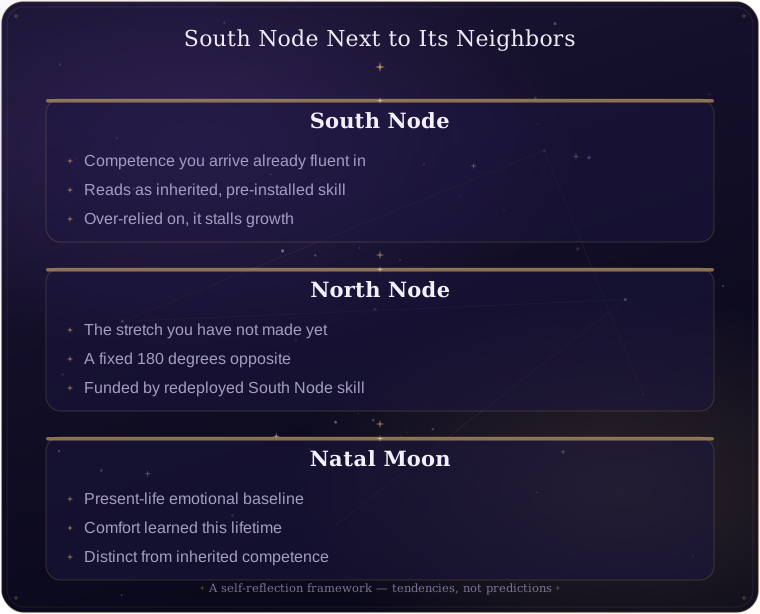
- Descending node vs North Node. This point describes what you already do well; the North Node describes the stretch you have not made yet. They sit a fixed 180 degrees apart, so the way it works is positional — energy spent over-relying on the familiar end is energy not invested in the unfamiliar one. To get the security of your default talents, you sacrifice momentum toward growth; lean too far the other way and you kick away a working foundation.
- Descending node vs the natal Moon. Both point to comfort and instinct, yet the Moon is your present-life emotional baseline while this point reads as inherited, almost pre-installed competence. Collapsing the two into one gets you a tidy story, but you lose the difference between what you learned this lifetime and what you arrived already knowing.
- An intersection vs a "karmic debt." Popular readings frame it as a bill to pay. The geometry says otherwise: it is a neutral point where the Moon's orbit crosses the ecliptic, correlating with eclipse cycles rather than handing down a sentence. Reading it as punishment buys you drama at the cost of the practical move — redeploying these competencies as the launch pad for North Node growth.
Picture a chart where this point falls in a bold fire sign in the house of career: the inherited gift might be fearless self-promotion, brilliant in a past context but exhausting now. The integration approach keeps the courage and redirects it toward listening, which is exactly what the opposing North Node asks for. Swap the fire sign for a cautious earth sign and the same logic holds — the gift of relentless reliability becomes the trap of never delegating, and the stretch is learning to trust other hands. Because the axis also marks where eclipses fall, the themes tied to this point tend to resurface on a roughly six-month rhythm, which is why the same lesson can feel like it keeps coming back around. This redeployment reading runs through the psychological-astrology lineage of Liz Greene and Howard Sasportas, building on the person-centered approach Dane Rudhyar established — each treats inherited tendencies as material to work with consciously, not a fate to obey.
How to Read south node in Your Chart
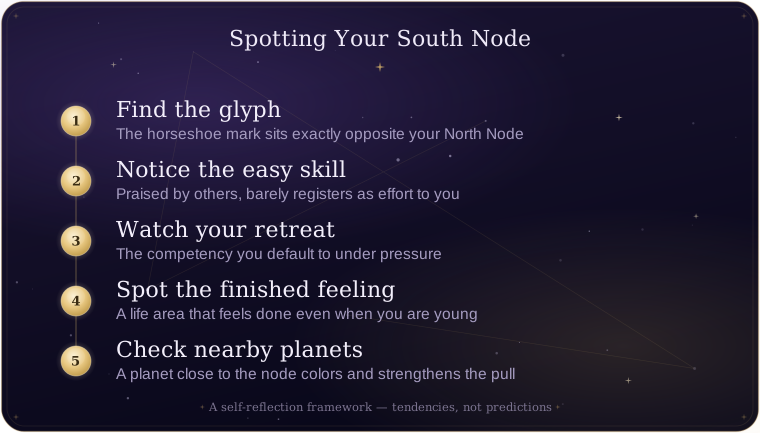
Spotting the south node in your own chart comes down to a few observable signals you can check once you know the glyph (☋).
- Find the ☋ glyph — it always sits in the sign and house directly opposite your North Node.
- Notice the skill that feels suspiciously easy, the thing others praise that you barely register as effort.
- Watch where you retreat under pressure; the competency you default to is usually this placement talking.
- Look for the area of life that feels "been there, done that," even when you are young.
- Check any planet sitting close to it — that planet colors the inherited talent and strengthens the pull backward.
Put together, these signals sketch a character. Say the glyph falls in a communicative air sign in the house of daily work: the inherited talent might be quick, fluent explaining — the person who can talk anyone through anything. Under stress they over-explain, reaching for words when action is what the moment needs. Read this way, a vague "past-life" label becomes something you can actually watch for in a Tuesday meeting. The placement is rarely exotic; it usually looks like the one thing you have always been a little too good at.
Common Misreadings
A handful of misreadings keep showing up, and each one comes straight from the "burden to escape" framing.
- "It's a weakness to fix." The descending node is not a flaw; it is an overdeveloped strength that was genuinely useful before. The work is conscious redeployment, not repair.
- "You should abandon it." Dropping your most natural skills leaves you with no platform to grow from. Integration, not abandonment, is what actually moves the North Node forward.
- "It predicts your fate." This point describes tendencies and defaults, not a fixed destiny. Two people with the same placement can express it in opposite ways.
- "It's literal proof of a past life." It is a geometric point that correlates with eclipses; the past-life language is a symbolic lens, not a measurable claim. Many people use it simply to reflect on the strengths they seem to have arrived with.
Each misread shares the same root: treating a starting line as if it were a finish line, and trying to delete the very foundation the rest of the chart is built to grow from. Once you see that pattern, the placement stops reading as a sentence and starts reading as an inventory.
The Descending Node at a Glance
| Property | How It Works | Energy Center | How to Observe |
|---|---|---|---|
| Symbol (☋) | Marks the descending crossing of the Moon's orbit and the ecliptic | Sits in one natal sign and house | Find the horseshoe-and-cross glyph opposite your North Node |
| Core meaning | Names innate, already-fluent competencies you arrive with | Anchored to its natal sign and house | Notice the skill that feels automatic and low-effort |
| Growth role | Works as a baseline to redeploy, not a flaw to delete | Paired 180 degrees with the North Node | Watch where you default under pressure |
| Motion | Moves retrograde on a roughly 18.6-year nodal cycle | Tracks the eclipse axis of the chart | Follow eclipse seasons crossing its sign |
Common Questions About the Descending Node
What does the descending node mean in astrology?
It is the chart point that marks the skills, habits, and instincts you arrive already fluent in, often described through past-life language. Most readings treat it as an overdeveloped strength to redeploy rather than a flaw to erase.
Are you supposed to get rid of these inherited talents?
No — abandoning your most natural abilities usually leaves you with no platform to grow from. The more useful move is to keep the talent and consciously aim it toward your North Node goals.
How is the North Node different from the descending node?
The North Node points to unfamiliar qualities you are growing toward, while the descending node holds what already feels automatic. They sit exactly opposite each other and only make sense when read as a single axis.
Does this point really show a past life?
It is an astronomical intersection that correlates with eclipses, so the past-life framing is a symbolic lens rather than a measurable fact. Many people use it simply to reflect on the strengths they seem to have been born with.
Reflection Prompts
- Think of a recent moment when a skill felt effortless to you but impressive to others — what was it?
- Recall a time you retreated to a familiar strength under stress; did it move you forward or keep you in place?
- Name one inherited talent you could redeploy this week as a stepping stone instead of a comfort zone.
Related Reading
- guide to the descending node in Scorpio — how this placement plays out across the Scorpio–Taurus axis.
- guide to the descending node in Aquarius — the Aquarius–Leo version of the inherited-talent pattern.
- guide to the descending node in Sagittarius — what the Sagittarius–Gemini axis carries forward.
- Lunar node (Wikipedia) — the geometry of where the Moon's orbit crosses the ecliptic.
Take Action
This is not a clinical interpretation or mental health advice. To put the integration approach to work, generate your free birth chart and locate the descending node by sign and house. The result is a concrete inventory of the talents you already carry — and a clearer read on which familiar strengths to lean on now and which to consciously stretch past as you move toward your North Node.
Sources
- Dane Rudhyar — pioneered the person-centered, cyclic approach to reading the birth chart
- Liz Greene — shaped the modern psychological interpretation of chart placements
- Howard Sasportas — developed the psychological astrology of the houses and the nodal axis