What is cancer north node?
Cancer north node is the Moon's north node sitting in the sign of Cancer, and it marks a pull away from self-reliance toward home, belonging, and emotional security. Because the nodes always sit exactly opposite, it reads as one end of a single axis — part of the broader pillar guide to the lunar nodes to how each nodal pairing describes a direction of growth, not a fixed fate.
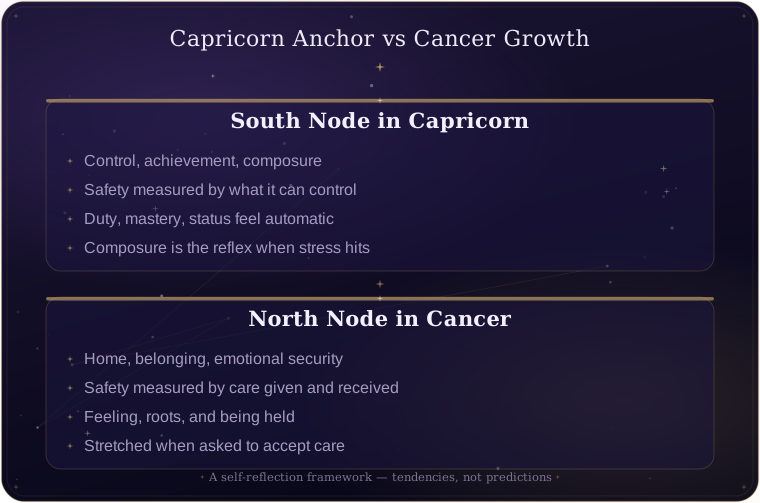
- Centers Cancer's core motifs: home, family, emotional memory, bodily safety, and the exchange of caring and being cared for
- Points toward feeling, roots, and being held instead of always being the capable one
- Pairs with a Capricorn south node fluent in control, achievement, and composure
- Often misread as a simple call to "be warmer," when the real work is unlearning the belief that needing others equals weakness
The south node marks what already comes automatically; the north node is the direction that still feels foreign and must be chosen on purpose. Where Capricorn measures safety by what it can control and achieve, Cancer measures it by care given and received — which can feel like learning a second emotional language as an adult.
Why It Matters for Self-Awareness
Understanding cancer north node matters because the standard advice — "just be more nurturing" — skips why warmth feels unsafe in the first place. Over a lifetime, a Capricorn south node tends to equate self-sufficiency with strength and emotional need with weakness. So the block isn't a missing capacity for care; it's a structural belief that voicing a need hands someone a burden, and that staying composed is the responsible, even kind, thing to do. That belief is why "open up more" bounces straight off. (This is a common reading in modern and evolutionary astrology, not a fixed diagnosis — how strongly it shows up depends on the south node's house, its aspects, and the condition of the Moon and Saturn in the chart.)
The pattern usually surfaces in a few recognizable ways:
- Need reframed as failure. Asking for support registers less as connection and more as proof you couldn't manage alone.
- Stoicism mistaken for kindness. Holding feelings back feels like protecting people, when it often just keeps you unreachable.
- Worth tied to output. Security rides on what gets done, so slowing down to feel can read as falling behind.
Picture someone who stays up fixing a problem alone at 2 a.m. rather than text a teammate, or who runs every family gathering yet never lets anyone see them wobble. The competence is real; so is the loneliness underneath it. Cancer's pull is toward the missing half — a home where you are cared for, not only the one who provides it. This reading sits in the person-centered lineage Dane Rudhyar helped establish: the nodes describe growth, not a sentence handed down at birth — which is why the pattern can move.
cancer north node vs Adjacent Concepts: How It Works + Trade-offs
The clearest way to read this placement is against the ideas it gets confused with. Start with the node versus its own opposite, the explainer on the Capricorn south node. These are one axis with two ends: the south node is the familiar, automatic setting — capable, controlled, self-contained — and the north node is the unpracticed direction. Leaning on the Capricorn end gets reliable results and the respect that comes from handling everything yourself, which is why it's so hard to leave. The trade is direct: to keep the certainty of doing it all alone, you give up rest, intimacy, and any real experience of being carried.
Next, the node versus simply having a Cancer Sun or Moon. A Cancer Sun or Moon describes personality and emotional style — how someone naturally expresses and processes feeling. The north node is a different category: not a trait you already have but a developmental direction you grow toward, against years of Capricorn conditioning. Someone can have no Cancer placements and still carry this node, so "become more like a Cancer Sun" misreads the assignment. The work is to keep Capricorn's discipline and add the capacity to receive — not to trade one personality for another.
Finally, the node versus the popular "destination" framing, where the north node is sold as a finished personality you arrive at and keep. In practice it behaves more like a muscle than a finish line. The trade here is honesty over comfort: durable growth means giving up the fantasy of being "done," because the Capricorn reflex never fully disappears — it simply stops running the show unsupervised. Naming that keeps the work realistic.
How to Read cancer north node in Yourself
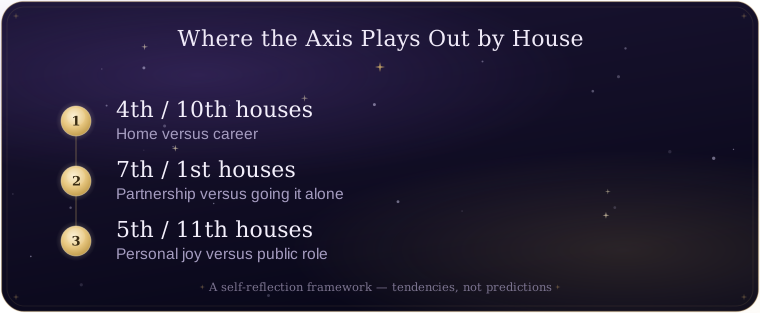
North Node in Cancer, South Node in Capricorn in the natal chart. The sign axis sets the theme, but the houses your nodes occupy decide where it plays out — a 4th/10th placement points to home versus career, 7th/1st to partnership versus going it alone, 5th/11th to personal joy versus public role. Two people can share these nodes and live the lesson in completely different arenas depending on house, aspects, and the state of the Moon and Saturn. Knowing your houses turns a general theme into a specific assignment.
Day to day, you won't notice this node as a mood; it shows up as friction around receiving rather than giving. A few honest signals:
- You say "I've got it" before anyone finishes offering, even when you're clearly underwater.
- Asking for emotional support feels like admitting failure, so you stay composed instead of honest.
- You quietly rank your worth by output, not by how connected, rested, or supported you feel.
- Home, family, and roots tug at you even when work fills every hour of the day.
Common Misreadings
Most popular write-ups get cancer north node half right, and the half they miss is the part keeping readers stuck.
- "It just means be more nurturing." The growth isn't manufacturing warmth on command; it's loosening the belief that needing people is weak, after which genuine warmth has room to surface on its own.
- "The Capricorn south node is the flawed part to delete." Its discipline and competence are hard-won gifts, not liabilities. In the depth-psychology tradition Howard Sasportas worked in, the south node is a resource to reclaim consciously, not a flaw to erase.
- "Emotional sovereignty means becoming needy or dependent." The aim is inner security steady enough to let care in — not collapsing onto others, just dropping the reflex to refuse them automatically.
- "Showing feelings burdens everyone around me." That's the conditioning talking. Measured openness tends to deepen connection far more often than it drains the people who want to be close to you.
Cancer Node at a Glance
| Property | How It Works | Related symbolic themes | How to Observe |
|---|---|---|---|
| Growth direction | Pulls you from control toward emotional openness and receiving | Cancer: home, roots, emotional memory, bodily safety — a 4th-house arena only if your nodes fall there | You feel stretched when asked to accept care, not give it |
| South node anchor | Capricorn self-reliance feels safe, earned, and automatic | Capricorn: duty, mastery, status — not the 10th house unless your nodes sit there | You reach for composure the moment stress hits |
| Core lesson | Worth and safety stop depending on achievement alone | Inner emotional foundation valued alongside external structure | Rest and closeness start to matter as much as output |
| Common friction | Vulnerability gets coded as weakness or burden | Security from within vs validation from results | Asking for help triggers a quiet flash of "I've failed" |
Cancer is a sign, not a house — its themes attach to a concrete life area only when your node actually occupies that house.
Questions People Ask About the Cancer Node
What does a cancer north node actually mean?
It points to a life direction centered on home, belonging, emotional security, and receiving care rather than control and achievement. The paired Capricorn south node makes those capacities feel unfamiliar, so they must be built on purpose.
Why does my Capricorn south node feel so much stronger?
The south node is the well-worn, automatic setting, so it feels like "just who you are." The north node feels effortful precisely because it's still under construction.
Does this placement mean I should stop being ambitious?
No — the aim is to stop letting achievement be your only source of worth. You keep the discipline that serves you and loosen its grip on your identity.
How do I start working with this node without feeling exposed?
Begin with small, low-stakes moments of letting someone help, and notice the urge to refuse. The skill grows from quiet repetition, not one dramatic act of vulnerability.
Reflection Prompts
- Think of a recent moment you said "I'm fine" while actually needing help — what made the truth feel unsafe?
- Recall the last time you carried something alone that someone would gladly have shared. What did refusing protect?
- Picture a person you trust completely. What small need could you let them meet this week?
Small practices to try this week:
- Make one small, low-stakes request out loud — and let yourself receive the help without repaying it.
- Lead with the feeling before the fix: name what you feel first, then move to solving.
- Let someone finish a household task or support you without quietly taking it back over.
- Build one steady home ritual — a recurring meal, a tidy corner, an unhurried wind-down — as felt safety, not productivity.
Related Reading
- overview of the Cancer zodiac sign — the emotional themes this node grows toward live in the sign itself.
- guide to the Capricorn zodiac sign — knowing the south node's home base makes the recalibration far clearer.
- introduction to north node meaning across the signs — see how this axis compares with the other eleven nodal placements.
- Lunar node (Wikipedia) — the sky-level astronomy underneath the symbolism.
Take Action
Ready to see where this axis actually sits in your chart? Generate your free birth chart to explore cancer north node, and the houses your Cancer–Capricorn nodes activate will be laid out in front of you. One note: house placements need an accurate birth time — without it, you can still read the Cancer–Capricorn sign axis reliably, but not the specific life areas it touches. From there the work stops being abstract: growth here was never about becoming softer — it's about letting your strength finally include the freedom to need someone.
Sources
- Dane Rudhyar, The Astrology of Personality — foundational person-centered astrology that reads the lunar nodes as a map of growth rather than fate
- Howard Sasportas, The Twelve Houses — depth-psychology approach to chart placements that treats the south node as a resource to reclaim rather than discard