
A chakra test is a short self-assessment that points you toward the energy centers asking for attention right now. There is no single official quiz: most versions ask how you have felt and behaved over the past week or two, then map your answers onto the seven named centers — root, sacral, solar plexus, heart, throat, third eye, and crown. The number it hands back matters less than the question it opens. This page shows you how to read that result honestly, how to self-assess each center without any quiz at all, and what a high, low, or balanced score is actually telling you. If you want the full map first, start with the chakra system overview, which shows how all seven centers relate.
What Is the Chakra System?
The Chakra System is a map of seven energy centers running from the base of the spine to the crown, each tied to a life domain such as safety, creativity, willpower, love, expression, insight, and connection. Most versions of the quiz ask about your mood, energy, and recent behavior, then point you toward the centers asking for attention, and this page sits inside the broader full Chakra System overview pillar page that maps how all seven relate. Put simply, a chakra test is a snapshot of which energy centers feel active or blocked right now — a reading of your present inner weather, not a permanent label.
- Reads present-tense patterns rather than fixed personality traits
- Maps your answers onto the seven named centers of the chakra framework
- Easy to misread as a diagnosis when it's really a prompt to observe
What a High Score Means
A high score on a center usually means that domain feels loud and active right now — sometimes pleasantly so, sometimes too much. A high throat score can mean you are expressing yourself freely, or it can flag a week of over-talking and over-explaining. Read a high score as "this center is busy," then ask whether the activity feels clear or strained.
What a Low Score Means
A low score points to a domain that feels quiet, depleted, or under pressure — not a broken part of you. A low root score after a stressful move says more about the move than about who you are. Treat a low center as the one most worth your attention this season, and start there rather than trying to fix everything at once.
What "Balanced" Actually Looks Like
Balanced does not mean every center scores high. It means energy moves where it is needed and settles when it is not — you can speak up or stay quiet on purpose, act or rest, give or receive, without any one center jammed open or shut. An all-high result is not the prize it looks like; steady movement across the centers is.
Why It Matters for Self-Awareness
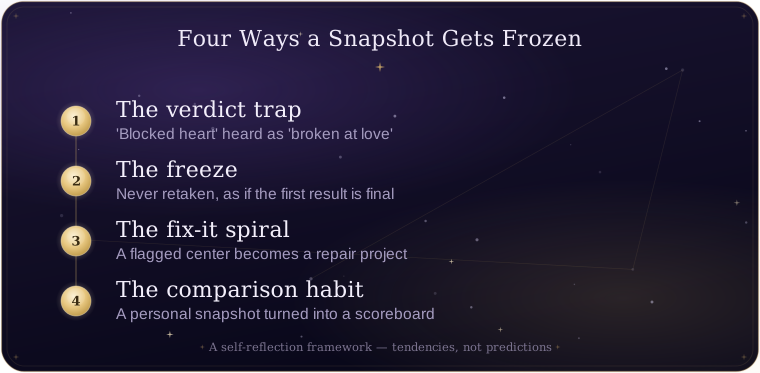
A chakra test matters less for the score it hands you and more for what people tend to do with that score: freeze it. The reading is a snapshot — a picture of which centers feel loud or quiet on the day you take it — but the moment it lands, most readers treat it as a permanent diagnosis. That single move is the friction this whole topic turns on, and it shows up in a few predictable ways:
- The verdict trap. A "blocked heart" result gets heard as "I'm broken at love," when it only flags that the heart domain feels tender at the moment. The label sticks long after the mood that produced it has passed.
- The freeze. People stop retaking it because they assume the first result is the final word. That misses how much a reading moves from one week, season, or life phase to the next.
- The fix-it spiral. A flagged center becomes a project to repair rather than a theme to sit with, which quietly turns self-reflection into one more task to get right.
- The comparison habit. Reading your result next to a friend's turns a personal snapshot into a scoreboard, even though the centers only ever describe your own current themes.
In my years reading auras and energy centers, the people who get the most from a result treat it as a question, not a sentence. A blocked reading the week after a hard breakup is information about that week, not a fault line carved into who you are. Picture two people with the same low throat-center score: one just spent a month biting their tongue at work, the other simply had a quiet, restful stretch — same number, completely different story. Read this way, the result stops being a score you pass or fail and becomes a mirror for what's genuinely loud in your life, whether that's a strained friendship, a stalled project, or the money stress humming under everything else. The point isn't the rating next to each center; it's the pause it gives you to notice what you'd otherwise move straight past.
Chakra Test vs Personality Quiz, Clinical Assessment, and Mood Tracker
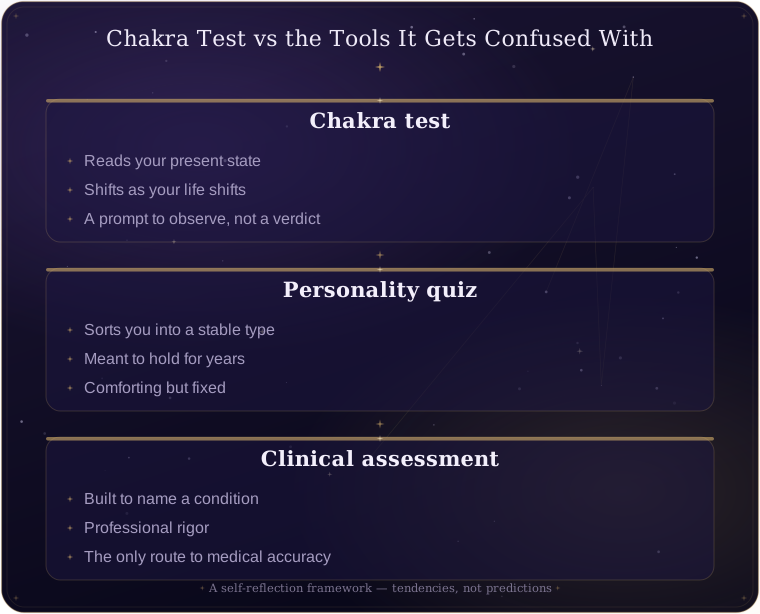
A chakra test differs from the tools it gets confused with most, and knowing how each one works keeps you from over-trusting any single result:
- Versus a personality quiz. A quiz sorts you into a stable type meant to hold for years; a chakra reading works from your present state, so it shifts as your life shifts. To get that here-and-now sensitivity, you sacrifice the comforting permanence of a fixed type.
- Versus a clinical assessment. A medical or psychological evaluation is built to assess and name a condition with professional rigor; a chakra reading only points to a theme worth noticing. Choosing the chakra lens gets you a gentle, self-directed prompt, but you lose any claim to medical accuracy — a flagged center is never a substitute for care from a qualified professional.
- Versus aura color work. Both read energy, but color speaks to the field around you while the centers speak to specific life domains. Lean on color and you get a broad mood read; lean on the centers and you trade that breadth for domain-by-domain detail.
- Versus a mood tracker. A tracker logs how you felt; a chakra reading tries to connect that feeling to a life area. You gain a sense of meaning and pattern, but you give up the tracker's plain, measurable simplicity.
These pairings aren't new, even if the online quizzes are. The color-to-center mapping most tests rely on traces back to early theosophical writers such as Charles Leadbeater, and the seven-center model was later organized for modern readers by Anodea Judith. What carries through every version is the same quiet rule: the framework describes tendencies and themes, never a fixed fate. If you want to see how a single center reads from day to day, the root chakra meaning guide walks through the everyday signs of a center under pressure.
How to Read the Chakra System in Yourself
Before or after you take a chakra test, you can read the same patterns directly in everyday life — no quiz required. Watch for signals like these:
- Notice where your energy drains fastest — money worry, a stalled project, a guarded conversation — and which center it maps to.
- Track your body: a tight throat before speaking up often points to the throat center asking for attention.
- See which life domain you keep avoiding this month, since avoidance usually marks the center that feels blocked right now.
- Catch repeating emotional loops — the same guilt, the same frustration — as clues about a center stuck in one gear.
- Ask what changed recently, because a center can read open one week and tense the next.
None of these signals needs a quiz to confirm it. When one center keeps surfacing — say a tight throat week after week — it can help to read up on that single center, such as the throat chakra meaning guide, to understand what it governs. They're the same themes a test result surfaces, just noticed in real time — and the more you track them yourself, the more any result simply echoes what you already sensed.
Starting With Your Lowest-Scoring Center
When a result hands you several numbers, resist the urge to work on all of them. Start with the lowest-scoring center, since that is the domain most under pressure right now and the one where small attention tends to do the most. If your root reads low, steady the basics first — sleep, food, money, routine — through the practices in the root chakra meaning guide, because the centers above it read more clearly once the ground feels solid.
When Multiple Centers Score Low
A cluster of low scores usually points to one upstream cause rather than several separate problems. A hard month can flatten root, sacral, and solar plexus together — safety, pleasure, and will all dim at once. Instead of treating each as its own project, look for the shared root: often steadying the lowest center, or simply resting, lifts the others with it. Retake the assessment a few weeks later and watch which scores recover on their own.
Common Misreadings
The misreadings below are usually what send people searching in the first place. Each one freezes a moving snapshot into a fixed fact:
- "A blocked center means something is wrong with me." A blocked reading flags a domain under pressure right now, not a personal flaw or a permanent condition. It tends to ease as the underlying situation changes.
- "My result is my type." The centers describe a present state that moves with mood, season, and circumstance. Retake the test next month and it can read noticeably differently.
- "The lowest-scoring center is the only one to work on." A quiet center is often just resting, while an over-active one can need as much attention as a blocked one. Balance matters more than any single low score.
- "More open chakras make you a better person." The framework points toward balance across the centers, not maximum openness everywhere. An all-green result isn't the prize it looks like.
Spot the pattern in all four: each one swaps a moving picture for a frozen one. The reading was only ever meant to describe today, and treating it as today's weather rather than tomorrow's forecast is what keeps it useful instead of discouraging.
The Chakra System at a Glance
| Property | How It Works | Energy Center | How to Observe |
|---|---|---|---|
| Safety & stability | Sets your baseline sense of being grounded and secure | Root chakra | Notice money stress, restlessness, or trouble feeling settled |
| Creativity & pleasure | Drives desire, play, and emotional flow | Sacral chakra | Watch for stalled creativity or guilt around wanting things |
| Expression & truth | Shapes how clearly you speak and listen | Throat chakra | Catch a tight throat or swallowed words before speaking up |
| Insight & perspective | Colors intuition and how you read a situation | Third eye chakra | See whether you trust your read or keep second-guessing |
Questions People Ask About the Chakra System
Can a chakra test actually be accurate?
The result reflects how you answer in the moment, so it's accurate as a picture of your current state rather than an objective, measurable reading of your body. A pattern that holds steady across several tries over a few weeks tells you far more than any single score taken on one ordinary afternoon.
How often should you retake the test?
There's no fixed schedule, though many people retake it after a meaningful change — a move, a breakup, a new job, a stretch of burnout — to see what actually shifted. Comparing two readings spaced weeks or months apart says more about your themes than one isolated reading ever could.
What does a blocked chakra in the result mean?
A blocked reading points to a life domain that feels stuck or under pressure right now, not a permanent defect in who you are. It works best as an invitation to pay closer attention to that area for a while, never as a verdict you're stuck with.
Can your results change over time?
Yes — the centers describe a present state, so the same person can read very differently across moods, seasons, relationships, and life phases. That built-in changeability is the feature that makes the reading worth repeating, not a flaw that makes it unreliable.
Reflection Prompts
- Think of a recent moment when one life area felt loud — which energy center does that map to, and what was it asking for?
- Recall the last time you swallowed something you wanted to say; what would shift if you trusted that throat-center signal?
- Notice which center your last test flagged, then ask what changed in your life that week.
Related Reading
- chakra system overview — the full map of how all seven centers relate, the place to read any result against.
- root chakra meaning — start here if your safety-and-grounding center reads low.
- heart chakra meaning — useful if your result keeps centering on connection and care.
- Chakra (Wikipedia) — helpful for where the framework originally came from
- Anahata (Wikipedia) — useful if your result keeps centering on the heart
Take Action
Take your result and read it against the whole map: See the full Chakra System overview to understand what your test result points to. You come away knowing which center your snapshot flagged, how it connects to the other six, and which life domain is quietly asking for your attention. Over time, that small habit turns a one-off score into a steady practice of noticing what your inner life is actually working through — long after the test itself is closed.
Sources
- Charles Leadbeater — early theosophical writer who linked specific colors to the chakra centers
- Anodea Judith — organized the modern seven-chakra framework that most of these tests draw on