
What Is the Root Chakra?
The Root Chakra is best understood as your base of safety, stability, and physical security.
- Governs survival basics — shelter, money, the body, and the feeling of belonging somewhere
- Sits at the base of the spine, known in Sanskrit as Muladhara, the first chakra in the system
- Reads as steadiness when it feels settled and as low-grade fear or restlessness when it feels shaky
In subtle-energy tradition — the modern chakra framework Anodea Judith helped systematize — root chakra meaning points to how grounded you feel right now rather than a fixed verdict about who you are. It sits first in the pillar overview of the seven-chakra system, the foundation every center above it is said to build on. Most people meet the idea only when a stretch of stress leaves them feeling unsafe in their own life, and they go looking for a name for it.
A note before we go further. This article is for general information and self-reflection only. It is not medical, psychological, or therapeutic advice, and the chakra and grounding practices described here are not a treatment for any condition; they are not a substitute for care from a doctor or mental-health professional. If you are dealing with persistent anxiety, low mood, pain, or problems with sleep or appetite — or any concern about your safety — please reach out to a qualified healthcare professional.
Where the Root Chakra Idea Comes From
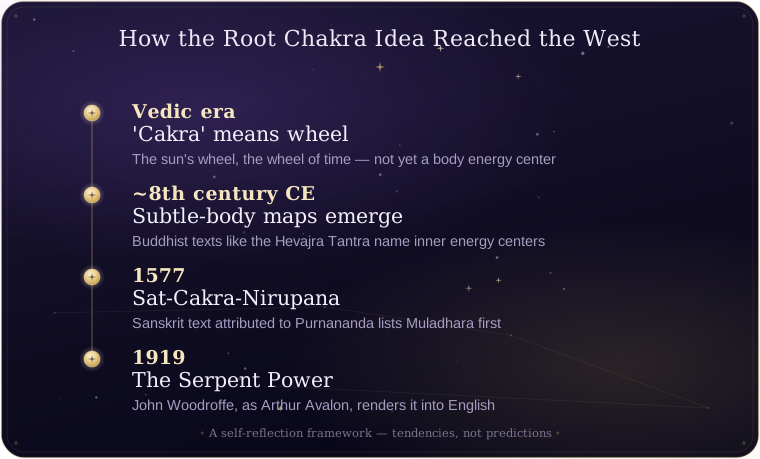
The root chakra reading is anchored in a documented history, separate from any health claim. In the Vedas the Sanskrit word "cakra" meant "wheel" — the sun's wheel, the wheel of time — and did not name a body energy center; the inner subtle-body map took shape later, with hierarchies of inner energy centers appearing about the 8th century CE in Buddhist texts such as the Hevajra Tantra and Caryagiti, per the scholar David Gordon White (Chakra, Wikipedia). The specific six-plus-one arrangement Western readers inherited is usually traced to the Sat-Cakra-Nirupana, a 16th-century Sanskrit text often dated to 1577 and attributed to Purnananda of Bengal, in whose commonly cited scheme Muladhara is listed first (Chakra, Wikipedia; Shat-cakra-nirupana, WisdomLib). That text helped draw Western attention to the system through Sir John Woodroffe, writing as Arthur Avalon, whose 1919 book The Serpent Power: Being the Sat-Cakra-Nirupana rendered it into English (Chakra, Wikipedia; The Serpent Power (1919), Open Library). The name "Muladhara" itself comes from the Sanskrit mula, "root," and the chakra is described as sitting near the base of the spine and traditionally tied to the earth element (Muladhara, Wikipedia).
The Root Chakra in Modern Wellness Practice
Root chakra language reaches most people today through the grounding practices wellness culture has folded around it — slow breathing, time outdoors, steady routine, and the body-first parts of yoga and meditation. None of these "open" a center in any provable sense; what they do is return scattered attention to the present and the physical, which is exactly the felt-safety the root is said to track. That is the practical reason this center shows up so often in modern self-reflection: the habits people already reach for when they feel unmoored map cleanly onto what the root describes.
These practices have also become genuinely mainstream, which is part of why the framework keeps spreading. Among U.S. adults, meditation use rose from 4.1% in 2012 to 14.2% in 2017, and yoga from 9.5% to 14.3% over the same years, per the 2017 National Health Interview Survey reported by the NIH's National Center for Complementary and Integrative Health (NCCIH/NIH), with the underlying figures in CDC NCHS Data Brief No. 325 (CDC NCHS). Those are population-use percentages, not measures of medical benefit — the point here is only that grounding-style practice is now common enough to be a shared vocabulary, not that it treats any condition. Used well, the root reading borrows that vocabulary to name where your steadiness is, then sends you back to ordinary habits rather than away from them.
Why It Matters for Self-Awareness
Understanding root chakra meaning matters because most people can name the root as "safety" and still can't tell a real imbalance from an ordinary rough week. That gap is the actual friction. You feel unsettled, you read that an unbalanced root causes exactly that, and you're left unsure whether something deeper is off or you simply slept badly, skipped meals, and let three deadlines pile up at once. The label "safety" is true but too broad to act on, so the search for answers usually ends in more worry rather than less.
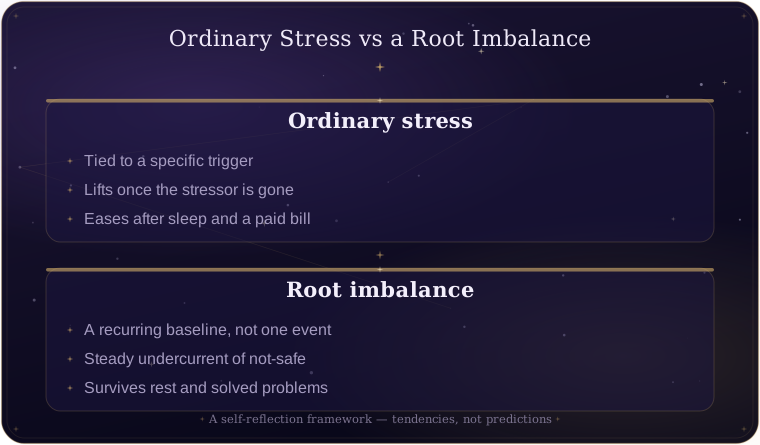
In eight years of energy-work and aura-reading practice, I've found the useful question is rarely "is my root blocked?" but "is this a passing state or a pattern I keep returning to?" A genuine root imbalance tends to show up as a recurring baseline — a steady undercurrent of not-enough or not-safe that survives a good night's sleep and a paid bill. Ordinary stress, by contrast, lifts once the trigger is gone. Reading that difference is what turns a vague sense of dread into something you can work with, and it's the whole point of paying attention to this center at all.
Self-awareness here is less about labeling yourself and more about catching the difference in real time. When you can feel the line between "today was hard" and "I haven't felt safe in months," you stop treating every bad mood as evidence of a deep block, and you stop dismissing a real pattern as just another busy stretch. That accuracy is what makes the rest of this page usable rather than only interesting — just as distinguishing the root from the solar plexus chakra and personal power keeps a confidence dip from being misread as a safety wound.
Root Chakra vs Sacral Chakra — Safety Before Desire
Root chakra meaning is easiest to grasp by contrast with the centers and states it gets confused with. The root works by anchoring your attention to survival basics — body, money, shelter, safety — so everything above it has stable ground to stand on. The center just above it, covered in the sacral chakra meaning explainer, works differently: it moves through pleasure, creativity, and emotional flow. To get the root's steadiness, you trade some of the sacral's spontaneity — a strongly root-led day feels secure but can read a little flat, while a sacral-led day feels alive but less anchored. The order matters more than it looks: desire and creativity rarely flow when the ground feels unsafe, which is why so many people who think they have a sacral problem are really running a shaky root underneath.
Root Chakra vs Plain Anxiety
The root also gets mistaken for plain anxiety, and the difference is practical. Anxiety usually fixes on a specific future threat you can point to, whereas a root imbalance reads as a body-level sense of "I am not safe here" with no obvious object attached. To gain anxiety's clarity about what is wrong, you tend to lose the quieter root signal underneath; to honor the root's vague unease, you give up the comfort of a tidy explanation. Naming which one is actually running keeps you from pouring energy into healing the wrong thing.
Root Chakra vs a Fixed "Grounded" Personality
A third confusion is treating groundedness as a fixed personality trait rather than a state that rises and falls. Someone can be deeply settled for months, then lose their footing after a move, a layoff, or a loss, and that swing is information, not a flaw. The trade-off here is comfort versus accuracy: it feels reassuring to decide you are simply "a grounded person," but you sacrifice the early warning that comes from tracking how your footing actually shifts week to week. The reading is most useful as a moving gauge, not a label you pin on once.
Root Chakra vs Red Aura — Two Ways to Read the Same Energy
The root chakra and the red aura share a color and a theme, but they look from different angles. The root reads the domain from the inside — how safe and steady you feel in your own body and basics. The red aura explainer reads the same energy from the outside — the drive, embodiment, and readiness others sense radiating from you. They often agree: a settled root tends to pair with a clear, grounded red. They can also diverge, and that gap is useful. A person can give off bold, high-energy red while privately running a shaky root, all push and no floor. Holding both readings keeps you from mistaking visible intensity for inner stability.
How to Read the Root Chakra in Yourself
You can read root chakra meaning in your own life by watching for body-level signals instead of waiting for an abstract feeling to announce itself. This is the observe-then-apply part: spend a week noticing, then decide what it's telling you.
Physical Signs of Root Chakra Tension
The root is described as the most body-anchored center, so its first signals tend to be physical rather than mental:
- Lower-body tension. Track tightness in your legs, feet, hips, or lower back, the areas this center is traditionally said to govern.
- Restless or braced. Watch for a hard-to-name urge to flee or brace, as if the ground itself feels unreliable beneath you.
- Sleep and appetite. Note whether the basics that keep a body steady feel reliable, since the root tracks physical security first.
Emotional Patterns That Point to Root Themes
Beyond the body, certain recurring feelings tend to cluster around safety rather than any other domain:
- Money and shelter worry. Notice whether unease clusters around basic security — rent, bills, a stable place to live — even when nothing is actually wrong.
- Slow recovery after a scare. See how fast you reset after a shock — a settled root returns to calm quickly, a shaky one stays on alert for hours.
- A background "not-enough" hum. Catch the quiet sense that something essential could be pulled away at any moment, even on an ordinary day.
Practices That Address Root-Level Stability
If the signals above keep showing up, the response the tradition points to is steadying the basics rather than reaching for anything dramatic:
- Anchor the routine. Regular sleep, meals, and a predictable shape to the day give the body repeated evidence that it is safe.
- Return to the physical. Time outdoors, walking, or simple weight-bearing movement brings scattered attention back into the body and the present.
- Tend the literal ground. Addressing the concrete worry underneath — a budget, a repair, a hard conversation about a living situation — often settles the root faster than any visualization. These are everyday wellness habits, not a treatment; persistent distress is a separate matter for a qualified professional.
Common Misreadings
Most surface-level content gets root chakra meaning wrong in a few predictable ways, and these misreads are usually what send people searching in the first place:
- "Any stress means a blocked root." A rough week is not a blocked chakra. A genuine imbalance is the pattern that stays after the stressor is long gone.
- "The root is purely physical." It tracks felt safety, so emotional and relational security count just as much as money, food, or a roof overhead.
- "Healing means forcing yourself to feel safe." Grounding works by noticing and steadying what is already there, not by overriding real concerns with cheerful affirmations.
- "A balanced root means nothing scares you." Even a settled root reacts to genuine threat; the marker is how quickly you return to steady, not whether you ever wobble at all.
The Root Chakra at a Glance
| Property | How It Works | Energy Center | How to Observe |
|---|---|---|---|
| Stability | Anchors attention to survival basics so higher centers have firm ground | Root (Muladhara), base of spine | You handle setbacks without feeling the floor drop out |
| Safety | Registers whether core needs feel met in the present moment | Root, lower body and legs | Calm in the body even when plans suddenly change |
| Grounding | Returns scattered energy to the present and the physical | Root, feet and pelvic floor | Quick recovery after a scare or surprise |
| Imbalance signal | Flags a recurring sense of not-enough or not-safe | Root, under strain | A baseline unease that survives a good night's sleep |
Questions People Ask About The Root Chakra
What does the root chakra govern?
The root chakra is associated with survival basics: physical safety, shelter, money, and the feeling of belonging somewhere. When it feels steady, the rest of your energy is said to have stable ground to build on.
What are the signs of a root chakra blockage?
A root chakra blockage is commonly described as ongoing worry about security, restlessness, or feeling ungrounded that lingers well past any single stressor. Body-level tension in the legs, feet, or lower back is often grouped with it in subtle-energy teachings.
How is root chakra healing usually approached?
Root chakra healing typically centers on grounding habits — steady routines, time in nature, and attention to the body — meant to restore a felt sense of safety. These are everyday wellness and self-reflection practices, not a treatment for any medical or mental-health condition; persistent anxiety, low mood, or physical symptoms are a separate matter best discussed with a qualified professional.
Is the root chakra the same as the first chakra?
Yes — the root chakra is the first chakra, sitting at the base of the spine and known in Sanskrit as Muladhara. It is the foundation the other six centers are said to build upon.
Reflection Prompts
- Think of a recent moment when your body felt genuinely safe — where were you, and what made the ground feel solid?
- Recall the last time worry about money or stability lingered long after the real problem was already solved.
- Name one daily routine that reliably settles you, and notice what changes on the days you skip it.
Related Reading
- chakra system overview — the hub that places the root at the base of all seven centers.
- sacral chakra meaning — the center directly above, where safety hands off to desire and creativity.
- solar plexus chakra affirmations — useful when a steadied root is ready to support confidence and will.
- Muladhara (Wikipedia) — useful for the Sanskrit and historical background behind the modern reading.
- Chakra (Wikipedia) — places the root inside the wider framework this page draws on.
Take Action
Start by reading your own baseline for a week: each evening, note whether the day's unease was a passing stressor or that deeper not-safe undercurrent. That gives you a simple map of when your foundation actually wobbles versus when life is just loud for a while. See the full Chakra System overview to place the root chakra at the base of the sequence — because knowing where safety lives in your body is the first step toward feeling steady enough to grow everywhere above it.
Disclaimer
Reminder: this page describes chakra and grounding ideas as cultural and self-reflection traditions, not as medical, psychological, or therapeutic treatment, and nothing here is meant to diagnose, treat, cure, or prevent any condition. If you are struggling with ongoing distress or physical symptoms, please consult a qualified healthcare professional.
Sources
- Anodea Judith — helped systematize the modern Western chakra framework this reading draws on
- Cyndi Dale — mapped contemporary energy-anatomy practices for working with the body's centers