What is Heart Chakra?
The Heart Chakra, called Anahata in the traditional system, is the fourth of the seven main energy centers and sits at the center of the chest, where the lower body's instincts meet the upper body's awareness. In plain terms, heart chakra meaning describes the balance between compassion for yourself and compassion for others. It sits within the broader Chakra System overview pillar page, which maps where every center falls in sequence — the seven-center layout early writers like Charles Leadbeater helped popularize and Anodea Judith later systematized. Most people meet this center through one narrow story, so it helps to name what it actually covers:
- Governs the give-and-take of care, not romantic love alone
- Associated with the chest, the color green, and the element of air
- Often flattened into a "love chakra" when its real theme is balanced connection
Why It Matters for Self-Awareness
Understanding heart chakra meaning matters because the popular version traps people inside one story, and that story quietly costs them. The friction is simple: people reduce this center to romantic love and miss that Anahata governs the balance between self-compassion and compassion for others, which is the part that actually keeps it open. When you believe the heart center is only about romance, a season of resentment, burnout from overgiving, or a wall you put up after being hurt all read as relationship problems rather than as the same center asking for attention.
Widening the definition gives you somewhere useful to look. Think of a stretch where you poured care into everyone around you and had nothing left for yourself, or a time you stayed guarded long after the danger passed. In the narrow framing, neither registers as a heart signal. In the wider one, both are the same imbalance wearing different clothes — care flowing outward with none returning, or care shut off entirely. That shift, from "I'm just tired of people" to "my giving and receiving are out of balance," is the practical payoff of getting heart chakra meaning right, and it's the difference between drifting and noticing.
Self-awareness here is not about forcing your heart wide open at all times. It is about catching the early tilt — toward martyrdom on one side or self-protection on the other — while the change is still small. People who only know the romantic association tend to wait until something feels like heartbreak before they look inward. People who hold the wider meaning notice the dip when it's still just a quiet week of giving too much.
Heart Chakra vs Adjacent Concepts: How It Works + Trade-offs
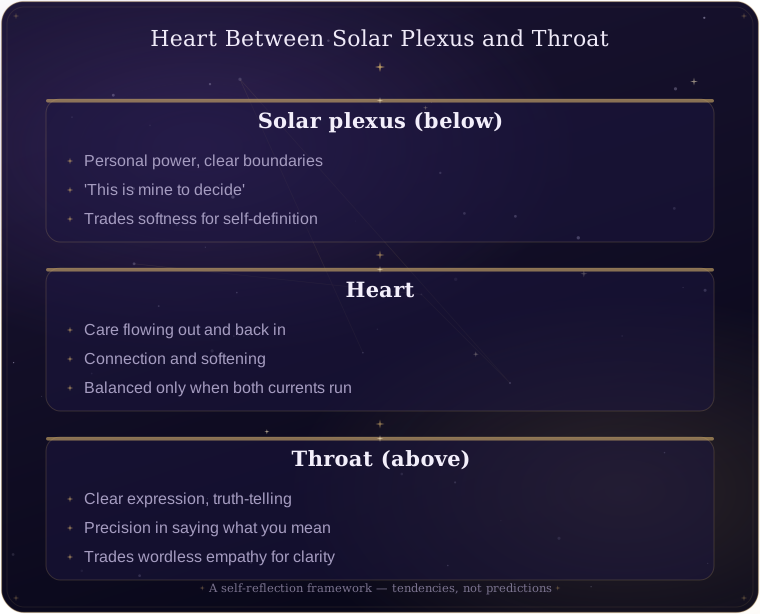
Heart chakra meaning becomes clearer when you set this center beside the ones it's most often blurred with. The Heart Chakra works by regulating flow in two directions at once — care moving out toward others and care moving back toward yourself — and it stays balanced only when both currents run. In eight years of energy-work and aura-reading practice, I've found that the center people most confuse it with is the solar plexus just below it, mapped to the Solar Plexus Chakra explainer and its themes of will and self-direction. The solar plexus runs on personal power and clear boundaries; the heart runs on connection and softening. To get the solar plexus's firm sense of "this is mine to decide," you sacrifice some of the heart's willingness to be moved by another person's need, because self-definition and self-giving pull in different directions.
The throat center just above works through clear expression and truth-telling, where the heart works through felt warmth and attunement. To get the throat's precision in saying exactly what you mean, you trade away some of the heart's wordless empathy, the part that reads a room before anyone speaks. Many people who pride themselves on being direct quietly run a guarded heart underneath, mistaking bluntness for honesty.
The most common confusion, though, isn't with another center — it's with romantic love itself. Romance is one real expression of heart energy, but the wider current is balanced compassion of every kind: for friends, for strangers, and for yourself. To reduce this center to romance, you lose sight of why chronic overgiving or a long-held grudge can each signal a heart imbalance as loudly as a breakup. That trade — one vivid image for accuracy across the whole center — is exactly the friction this page exists to clear up.
How to Read Heart Chakra in Yourself
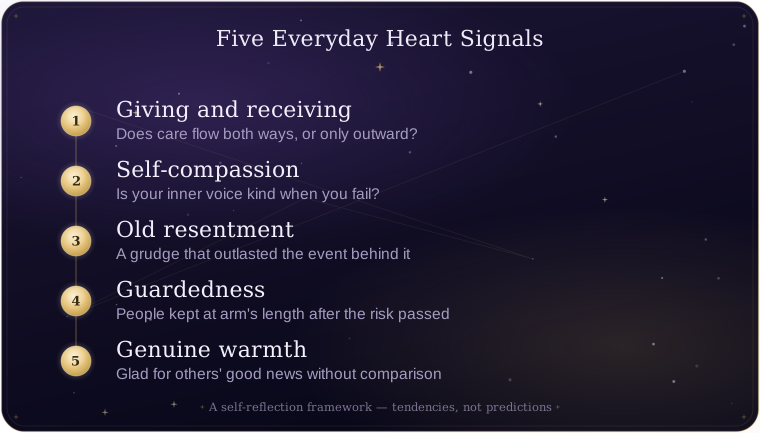
Reading heart chakra meaning in yourself doesn't take special training — the signals show up in ordinary days. A few worth noticing:
- Giving and receiving. Does care flow both ways, or do you give constantly and feel awkward accepting anything back?
- Self-compassion. When you fail at something, is your inner voice kind, or does it turn sharp and punishing?
- Old resentment. Are you holding a grudge that has quietly outlasted the event that caused it?
- Guardedness. Do you keep people at arm's length long after any real risk has passed?
- Genuine warmth. Can you feel glad for someone else's good news without comparison creeping in?
Common Misreadings
More than almost any other center, heart chakra meaning gets flattened by a handful of popular misreadings — and those misreadings are usually what sent people searching in the first place.
- "It's the love chakra, so it's only about romance." The heart center covers compassion as a whole. Romance is one channel among several, not the definition of the center.
- "An open heart means giving endlessly." Constant overgiving is an imbalance, not an open heart. Subtle-energy traditions describe balance — care that includes yourself — as the actual sign of an open center.
- "A blocked heart just means a broken relationship." A block as often shows up as self-criticism, withheld forgiveness, or numbness toward your own needs. The imbalance can land entirely inside you.
- "You either have it open or you don't." Most teaching treats this as a shifting state, not a fixed trait. The same person can read open during a generous season and guarded under stress.
Heart Chakra at a Glance
| Property | How It Works | Energy Center | How to Observe |
|---|---|---|---|
| Balanced flow | Care moves outward and back inward in steady exchange | Heart center, mid-chest | You give freely and also accept support without guilt |
| Underactive or guarded | The same flow shuts down to protect against hurt | Heart center (closed reading) | Walls stay up, forgiveness feels impossible, warmth runs thin |
| Overactive or overgiving | Care floods outward with nothing held back for yourself | Heart center (depleted reading) | Burnout, resentment, losing track of your own needs |
| Core quality | Air-like openness — connection that includes the self | Heart center, paired with the element of air | Compassion that doesn't cost you your own ground |
Common Questions About the Heart Chakra
What does the heart chakra represent beyond romantic love?
It points to balanced compassion as a whole — the wider heart chakra meaning the "love chakra" label hides. Subtle-energy traditions treat romance as one expression of this center, alongside self-kindness, forgiveness, and warmth toward people you don't know.
What are the signs of a blocked heart chakra?
Common signs described in chakra teaching include guardedness, held grudges, harsh self-criticism, and difficulty accepting care from others. The pattern is restriction — warmth that should move freely instead stays shut.
Is healing the heart chakra about opening it as much as possible?
Not quite. The aim described in most teaching is balance, not maximum openness. An endlessly open heart that gives without limit reads as depleted, so the work is restoring the give-and-take, not removing every wall.
Where is the heart chakra located?
It is mapped to the center of the chest, between the lower three centers and the upper three. In traditional systems it pairs with the element of air and the color green.
Reflection Prompts
- Think of a recent time you gave care to someone — did you let yourself receive anything in return?
- Recall the last mistake you made — was your inner voice as kind to you as you'd be to a friend?
- Notice a grudge you're still carrying — what would it cost you to set it down?
Related Reading
- chakra system overview — the hub that places the heart fourth, at the midpoint between the lower and upper centers.
- solar plexus chakra affirmations — the will center just below, useful for telling self-direction apart from self-giving.
- sacral chakra meaning — where emotional flow begins, two centers below the heart.
- chakra test — self-assess whether your heart energy is leaning toward overgiving, self-protection, or balance.
Take Action
Take the Chakra Test to see whether your heart chakra reads as open, blocked, or overactive at the astrologywiki chakra test. You'll come away with a clear read on which direction your heart energy is leaning right now — toward overgiving, toward self-protection, or somewhere in balance. Seeing that tilt named in plain language is often the first step to giving care without quietly running yourself empty.
Sources
- Anodea Judith — systematized the modern chakra framework this page draws on
- Charles Leadbeater — among the early writers who mapped the seven major chakras to the body