
What Is England vs Norway Astrology?
England vs Norway astrology is a symbolic side-by-side reading of each country's national character through astrological archetypes, framed as cultural reflection rather than a forecast of any match or event. It belongs to mundane astrology, the older branch that maps signs, planets, and houses onto places and nations instead of a single person. Read this way, it works as an interpretive comparison of two national temperaments, not a prediction of outcomes — a lens for thinking about how a reserved island culture and a northern, nature-bound one express drive, restraint, and belonging in different ways. It is less a verdict than a conversation between two archetypes. If you want the building blocks behind any chart, the pillar guide to reading a birth chart covers the same houses and placements used here.
- Treats each nation as an archetype, not a scoreboard, staying descriptive rather than deterministic
- Draws on mundane astrology's long habit of linking signs and houses to countries and cultures
- Easily confused with football-result prediction, which is a genuinely different question
Why It Matters for Self-Awareness
Understanding England vs Norway astrology matters because national archetypes hand you a low-stakes mirror for the same tensions you already carry: the pull between holding steady and taking initiative, between fitting in and standing apart, between guarding yourself and opening up. You can watch the English archetype in habits like parliamentary procedure, patient queuing, and dry understatement, and the Norwegian one in traditions such as friluftsliv — the cultural love of open-air life — and a flat, unshowy social style that prizes equality over display. In twelve years of integrating psychological frameworks with evolutionary astrology, alongside community-counseling work and thousands of hours of chart consultation, I've found that people read their own contradictions more honestly once they first see them projected onto something larger, like the temperament of a country. That distance is what makes the exercise land — it is a mode of archetypal reflection that Richard Tarnas helped bring into modern practice.
The reflection tends to settle in a few concrete places:
- Restraint versus initiative. The English archetype leans toward institutional patience and understatement, which can prompt you to ask where you hold back when a bolder move is available.
- Belonging versus independence. The Norwegian archetype leans toward egalitarian closeness with nature and community, a useful contrast for anyone weighing autonomy against connection.
- Inherited scripts. National character is partly a story a culture repeats about itself, and naming that can loosen the fixed stories you quietly tell about your own personality.
National Character Astrology vs Match-Outcome Prediction
England vs Norway astrology gets misread most often when people expect it to call a winner, so the cleanest place to start is by separating two very different questions.
Where the confusion starts
Character astrology asks what each nation's chart symbolizes — temperament, values, recurring historical themes — and it works by comparing archetypes side by side rather than betting on a result. Match-outcome prediction asks something else entirely: it tries to time a single event and name a score, which stretches astrology well past what careful practitioners in the mundane tradition, such as Robert Hand, treat as defensible. Someone typing the phrase the night before a fixture usually wants that second thing — a verdict — then finds material built for the first, a reflection on maritime, institutional England beside northern, nature-bound Norway. The two never quite meet, which is exactly the gap this page is trying to close.
What an honest comparison offers
The trade-off is real and worth naming plainly. To get the reflective depth of character comparison, you sacrifice the false certainty of a prediction; you gain a framework for understanding two cultures but lose the illusion that a chart can settle a game. Choosing archetypal reading over event forecasting gets you nuance and cultural insight, yet you give up the tidy verdict some searchers came for. Structure is where this pays off: the guide to the astrological houses shows how the same twelve-house lens organizes meaning for a nation exactly as it does for a person, sorting themes like heritage, resources, and public life without ever promising an outcome.
How to Read This Comparison as Character, Not Forecast
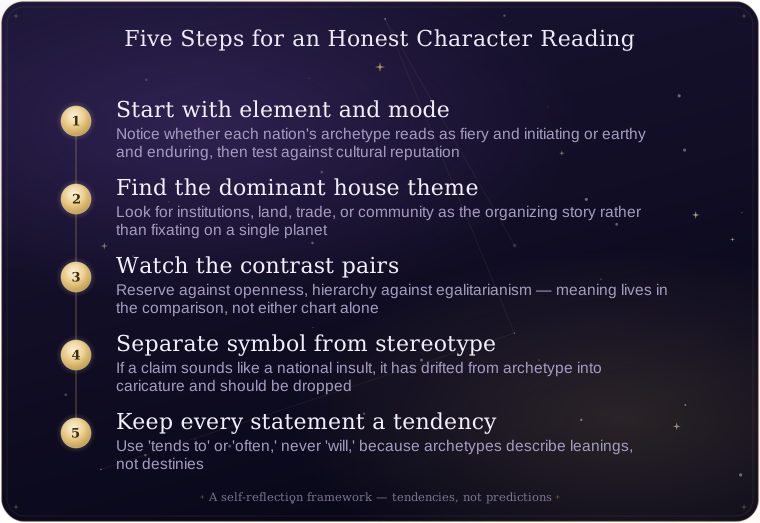
Reading England vs Norway astrology well means treating it as a character study you can actually observe in culture, history, and daily life, not as a crystal ball for the weekend's results. A handful of practical cues keep the reading grounded and honest:
- Start with element and mode. Notice whether each nation's archetype reads as fiery and initiating or earthy and enduring, then test that against its cultural reputation.
- Find the dominant house theme. Look for institutions, land, trade, or community as the organizing story rather than fixating on a single planet.
- Watch the contrast pairs. Reserve against openness, hierarchy against egalitarianism — the meaning lives in the comparison, not in either chart alone.
- Separate symbol from stereotype. If a claim starts to sound like a national insult, it has drifted from archetype into caricature and should be dropped.
- Keep every statement a tendency. Use "tends to" or "often," never "will," because archetypes describe leanings, not destinies.
Read this way, the comparison stays useful long after any single match is forgotten. You end up with a portable habit — reading temperament through element, house, and contrast — that you can turn on your own chart, your family, or any group whose character you are trying to understand more fairly. The skill transfers precisely because it never depended on the game in the first place; it depended on paying attention to pattern.
Common Misreadings
Most confusion around England vs Norway astrology comes from a handful of predictable misreadings, and each one clears up quickly once it is named directly:
- It predicts the match. The reading describes national temperament, not scores, so a chart comparison and a betting tip are simply different questions. Treating one as the other is how disappointed searchers end up feeling that astrology "failed," when it was never answering their question at all.
- One nation comes out "better." Archetypes carry no ranking, so English reserve and Norwegian openness read as different strengths rather than a hierarchy of worth. The comparison is descriptive, and reading it as a scorecard smuggles in a judgment the symbolism never makes.
- Traits are fixed and total. No country or person is only one archetype; these are dominant themes surrounded by real exceptions and countertendencies. A reserved culture still produces loud extroverts, and a communal one still produces fierce individualists.
- Symbolism equals science. This is interpretive tradition, not measurement, and it makes no empirical claim about the biology, psychology, or destiny of either nation. Holding it as reflection rather than proof keeps the reading both honest and genuinely useful.
National Temperaments at a Glance
| Property | How It Works | Astrological Signature | How to Observe |
|---|---|---|---|
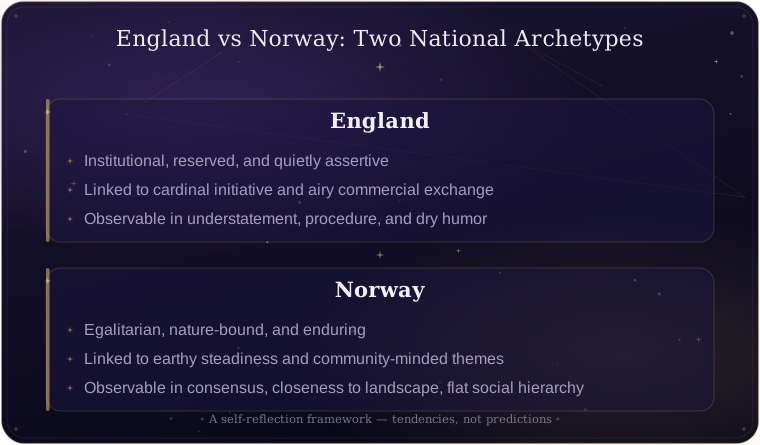
| England's temperament | Reads as institutional, reserved, and quietly assertive | Traditionally linked to cardinal initiative and airy, commercial exchange | Understatement, procedure, and dry humor in public life |
| Norway's temperament | Reads as egalitarian, nature-bound, and enduring | Traditionally linked to earthy steadiness and community-minded themes | Consensus, closeness to landscape, flat social hierarchy |
| The comparison lens | Contrasts two archetypes side by side, never merges them | The same twelve houses applied to two different nations | Meaning appears in the contrast, not either chart alone |
| The house framework | Sorts national themes into heritage, resources, and public life | Houses organize the chart the way they do for a person | Which "life area" a country's story keeps returning to |
| The boundary | Stops at symbolism and refuses to name an outcome | No placement claims a score or a winner | Any "who wins" promise signals the reading has overreached |
| Common misuse | Swaps reflection for prediction under time pressure | Archetype misread as a betting signal | Disappointment when a symbol fails to behave like a forecast |
Questions People Ask About This Comparison
Does England vs Norway astrology predict who wins a football match?
No — it reads national temperament, not results. Match forecasting is a separate and far shakier claim that careful astrologers generally avoid, because a symbolic archetype cannot settle a live event.
Which chart do you actually compare for two countries?
Mundane astrology uses charts tied to a nation's founding or defining historical moments, along with long-standing sign and house associations. The comparison then contrasts those archetypes rather than blending them into a single prediction.
Can a whole country really have one astrological personality?
Not literally; a national chart points to dominant themes, not a fixed identity shared by everyone. Think of it as a cultural center of gravity surrounded by countless individual exceptions.
Does England vs Norway astrology have any scientific backing?
No, and it makes no such claim. This is a symbolic, interpretive tradition meant to support reflection, not a measurement of either nation or a forecast of events.
Reflection Prompts
- Recall a recent moment when you held back like English reserve — what were you protecting, and did it actually serve you?
- Think of a time you chose community over independence, Norway-style; what did that closeness cost you, and what did it give?
- Name one national stereotype you quietly apply to yourself — where does it help, and where does it cage you?
Related Reading
- explainer on the ascendant and rising sign — the chart's outward "first impression," much like a nation's public reputation.
- guide to major chart aspects like trines and squares — how the angles between planets add ease or tension to any comparison.
- Mundane astrology (Wikipedia) — neutral encyclopedic context for the branch this page draws on.
Take Action
Ready to turn this national mirror inward? Generate your free birth chart to explore England vs Norway astrology, and you'll get your own houses, signs, and placements laid out the same way this comparison maps two countries. Seeing your chart beside these archetypes often makes your personal balance of reserve and openness far easier to recognize — and to work with on your own terms. This is not a clinical interpretation or mental health advice.
Sources
- Robert Hand — a leading modern voice in mundane and historical astrology, cited here for the boundary between symbolism and prediction.
- Richard Tarnas — advanced the archetypal approach that reads charts as patterns of meaning rather than fixed fate.