
What Is Jack Antonoff's Aries Sun–Scorpio Moon natal chart?
Jack Antonoff's Aries Sun–Scorpio Moon natal chart is an Aries-led natal map anchored by a deep Scorpio cluster. Built from his verified March 31, 1984 birth in Bergenfield, New Jersey, it places the Sun firmly in Aries — cardinal fire that starts fast and moves first. Around it sit Mercury and Pallas in Aries, plus a tight run of Scorpio planets in Mars, Saturn, and Pluto, which is where the fixed-water depth comes from. Because no public birth time exists, the exact Moon sign, Rising sign, and houses stay provisional, so anyone reading the Jack Antonoff birth chart is working with placements by sign, not by house — the same limit any pillar guide on how to read a birth chart flags first. In plain terms, it reads as quick ignition wired to slow, saturated emotion. That gap between what starts fast and what runs deep is the whole story of the chart.
- Leads with Aries initiative — rapid starts, first moves, restless creative momentum
- Carries a deep water undercurrent from its Scorpio planets: intensity, privacy, and slow-building depth
- Cannot be fully read for houses or Rising without a confirmed birth time
Why It Matters for Self-Awareness
Reading the Jack Antonoff birth chart this way matters because it models a tension many people live with daily: the drive to start fast and the pull to feel everything deeply at the same time. His chart makes that push-pull unusually legible, which turns it into a practical mirror rather than trivia. Its usefulness here is reflective, not predictive — and plenty of people reach for astrology that way. According to the Pew Research Center, about 29% of U.S. adults said they believed in astrology in a 2017 survey, which is a lot of people using charts as a way to think about themselves.
The chart works as a mirror in a few concrete ways:
- It names the fast-start, slow-process split. If you tend to launch quickly but need long, private stretches to actually digest things, the Aries-and-water pairing gives that pattern a shape you can point at instead of judging yourself for it.
- It separates public momentum from private intensity. The parts of you that move first in a room aren't the same parts that hold deep feeling. Seeing them as distinct can ease the pressure to be only one of them.
- It rewards holding uncertainty honestly. Because his birth time is unknown, the reading has to stay humble — which is exactly why understanding your own guide to rising sign meaning depends on an accurate birth time you may need to track down.
Aries Sun vs Scorpio Cluster: Two Engines Pulling in Different Directions
The most useful contrast inside this chart isn't his Sun versus someone else's Sun — it's the Aries Sun against the Scorpio cluster of Mars, Saturn, and Pluto sitting in the same chart. They work in almost opposite ways, and the friction between them is the interesting part.
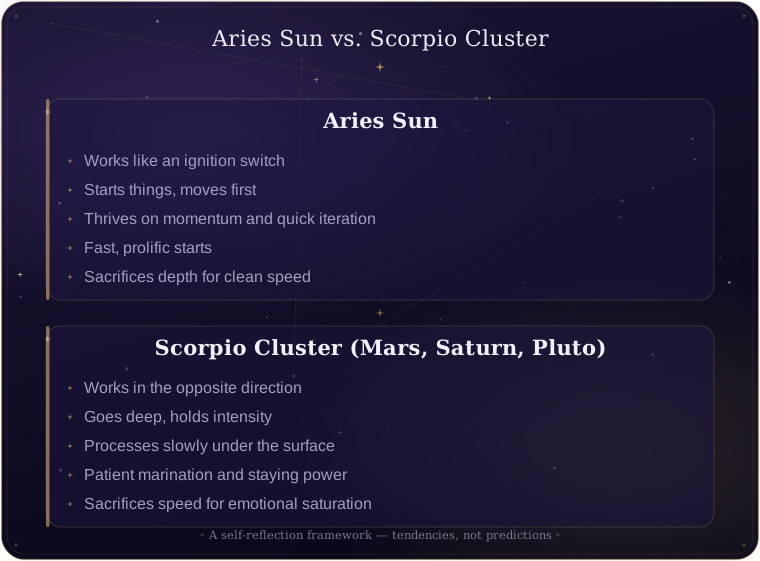
The Aries Sun works like an ignition switch: it starts things, moves first, and thrives on momentum and quick iteration. The Scorpio grouping works the other way — it goes deep, holds intensity, and processes slowly under the surface. To get the fast, prolific starts Aries is known for, you sacrifice some of the patient marination Scorpio wants; to get Scorpio's emotional saturation and staying power, you sacrifice some of Aries' clean speed. Neither setting is "better." The chart runs both at once, which is why a reading that only names the Sun sign misses half the picture. This is the person-centered approach Dane Rudhyar helped shape: you read placements as a working whole, not a stack of labels.
You can see why that framing beats a Sun-only take when you look at how fans apply it. Followers of his production streak — the steady Bleachers output and the long list of high-profile collaborations — often use the Aries-and-water read as a lens: quick, prolific starts layered over emotionally saturated, slowly built textures. That's a symbolic description, not a cause. The chart doesn't make the music; it happens to describe a rhythm people already hear in it. Venus had already ingressed into Aries by his March 31 birth, so his relating runs warm and headfirst too — reinforcing, rather than softening, all that Aries drive.
How to Read an Aries Sun–Scorpio Moon Chart
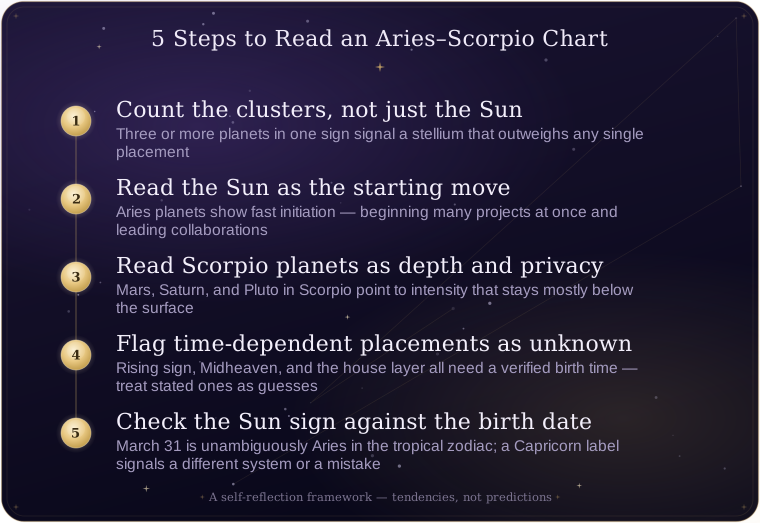
You can spot the Aries–Scorpio signature in this chart without a birth time, because the tells are about sign emphasis rather than houses. Watch for these:
- Count the clusters, not just the Sun. Three or more planets in one sign — Aries here, Scorpio here — signals a stellium that concentrates that sign's tone and outweighs any single placement.
- Read the Sun as the starting move. Aries planets show up as fast initiation: beginning many projects at once, iterating quickly, and leading collaborations rather than waiting to be asked.
- Read the Scorpio planets as depth and privacy. Mars, Saturn, and Pluto in Scorpio point to intensity that stays mostly below the surface and takes its time to fully surface.
- Flag anything time-dependent as unknown. Rising sign, Midheaven, and the house layer that astrologers like Howard Sasportas built their work around all need a verified birth time — treat any profile that states them as guessing.
- Check the Sun sign against the birth date. March 31 lands squarely in Aries; a "Capricorn" label is a red flag that a source used a different system or simply got it wrong.
Common Misreadings
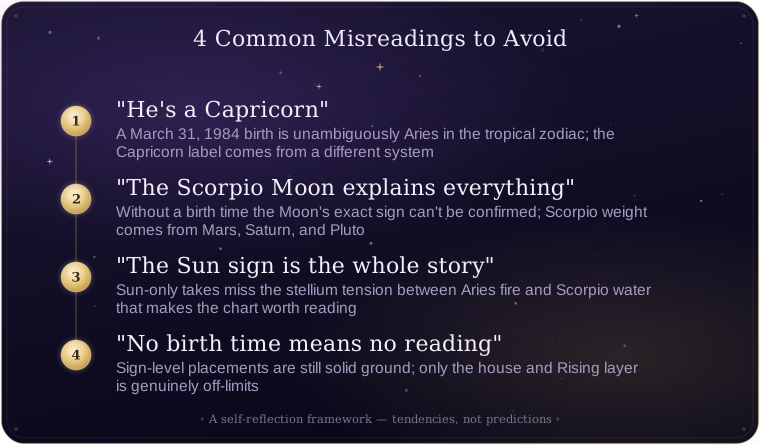
A few popular takes repeat the same avoidable errors. Here's each one set against what the chart actually supports:
- "He's a Capricorn." Some one-line profiles list a Capricorn Sun, but a March 31, 1984 birth is unambiguously an Aries Sun in the tropical zodiac most Western astrology uses. The Capricorn label usually comes from a different chart system, not new information.
- "The Scorpio Moon explains everything." Popular write-ups lean hard on a Scorpio Moon, yet without a birth time the Moon's exact sign can't be confirmed. The chart's Scorpio weight actually comes from Mars, Saturn, and Pluto — not a verified Moon.
- "The Sun sign is the whole story." Sun-only takes on the Jack Antonoff birth chart flatten it into one Aries paragraph and skip the stellium tension between fire and water that makes it worth reading at all.
- "No birth time means no reading." The opposite mistake. Sign-level placements are still solid ground; only the house and Rising layer is genuinely off-limits until an accurate time turns up.
Jack Antonoff's Aries Sun–Scorpio Moon natal chart at a Glance
| Placement | How It Works | Ruling Element / House | How to Observe |
|---|---|---|---|
| Sun in Aries | Starts fast, leads, initiates | Fire / natural 1st house | Rapid project starts, quick iteration, first moves |
| Scorpio cluster (Mars, Saturn, Pluto) | Goes deep, holds intensity privately | Water / natural 8th house | Emotional saturation kept below the surface |
| Mercury & Pallas in Aries | Thinks and strategizes in fast, direct bursts | Fire / natural 3rd house | Blunt, quick, idea-first communication |
| Venus in Aries | Relates fast, warm, and headfirst | Fire / natural 1st house | Direct affection, quick to pursue |
| Jupiter in Capricorn | Builds and expands through steady structure | Earth / natural 10th house | Ambition expressed through disciplined output |
Common Questions About the Jack Antonoff Birth Chart
Is Jack Antonoff an Aries or a Capricorn?
He is an Aries. Born March 31, 1984, his Sun sits in Aries in the tropical zodiac used by most Western astrology; Capricorn labels come from a different system or a plain mistake.
Does Jack Antonoff really have a Scorpio Moon?
It can't be confirmed. Without a public birth time the Moon's exact sign stays provisional, and the chart's clear Scorpio tone comes from Mars, Saturn, and Pluto rather than a verified Moon.
Why can't the Jack Antonoff birth chart show his Rising sign?
The Rising sign changes roughly every two hours, so it needs an accurate birth time. His time isn't publicly documented, which means any stated Ascendant is a guess.
What's the most reliable part of the chart?
The planetary signs. Sun, Mercury, Venus, Mars, and the outer planets stay stable across the whole day, so those readings hold even without a birth time.
Reflection Prompts
- Think of a recent project you started quickly — did you stay with it long enough to let it deepen?
- Recall a time you kept an intense feeling private instead of acting on it. What held it back?
- Name one collaboration where moving first helped, and one where slowing down would have served you better.
Related Reading
- explainer on the sun square moon aspect — how a fire-and-water tension between two placements tends to read.
- guide to the lunar nodes in a birth chart — his Gemini North Node adds a learning direction worth its own look.
- Jack Antonoff (Wikipedia) — the biographical background this reading's birth data is anchored to.
Take Action
Generate your free birth chart to explore jack antonoff birth chart. You'll get your own placements laid out by sign the same way his are here — Sun, Moon, and planets in plain terms — plus a clearer sense of where your own fast-start and slow-deep tendencies actually sit. Read as a whole rather than a single label, that's how a list of signs turns into real self-awareness. Start reading your birth chart
Sources
- Dane Rudhyar — pioneered the person-centered, psychological approach to reading a chart as a whole
- Howard Sasportas — developed the modern psychological treatment of houses and chart structure