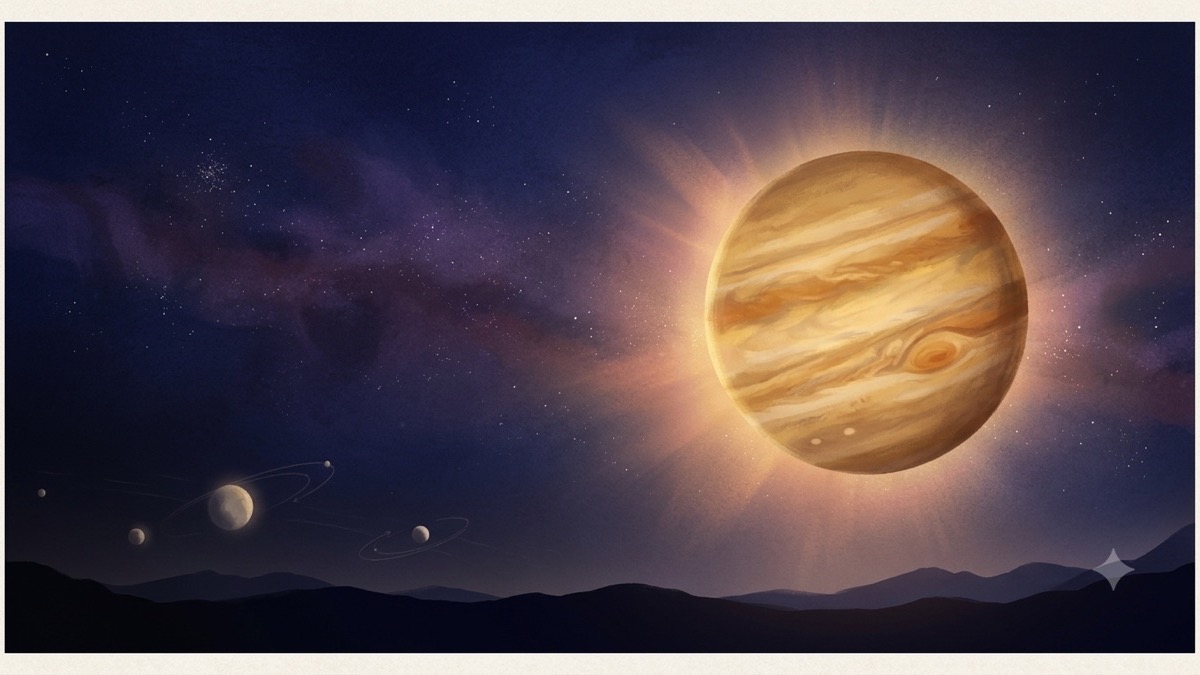
July 2026 opens with the kind of marker the sky only hands out about once a year. On July 1, Jupiter leaves the sign it has been crossing and moves into Leo. That is a once-a-year ingress, and it resets the backdrop for the months ahead. It is the headline event of the month, and everything else plays out underneath it.
The month is also bracketed by a Mercury retrograde that does not belong to July alone. Mercury turned retrograde back on June 30 and stays that way until July 24, when it stations direct at 16 degrees of Cancer. The first three weeks carry the familiar drag of a retrograde, and the relief arrives only in the final stretch. Reading the month well means not mistaking that early friction for a verdict about July as a whole.
Then, in the back half, two slow outer planets quietly change direction. Neither is dramatic the way an ingress is, but together they mark a turn in the month's center of gravity. None of this is a forecast of what will happen to you. It is a description of the sky's moving parts, offered as observations you can check against your own week.
Key Dates at a Glance
Every dated event for July 2026, drawn straight from the ephemeris. Times are in UT, so adjust for your location.
| Date | Event | Plain-language read |
|---|---|---|
| July 1 | Jupiter enters Leo | A once-a-year ingress; Jupiter begins its roughly year-long pass through Leo. |
| July 8 | Neptune stations retrograde at 4° Aries | The first of the month's two outer-planet turns. |
| July 10 | Venus enters Virgo | A shift in how Venus expresses its themes for the next few weeks. |
| July 15 | New Moon in Cancer | The month's first lunation, a fresh cycle in the sign of home and roots. |
| July 23 | Sun enters Leo | The Sun joins Jupiter in Leo as the solar season turns. |
| July 24 | Mercury stations direct at 16° Cancer | The retrograde that began June 30 finally lifts. |
| July 27 | Saturn stations retrograde at 15° Aries | The second outer-planet turn of the month. |
| July 30 | Full Moon in Aquarius | The month's closing lunation, opposite the Leo season just begun. |
To see which house each date falls into for you, lay this table beside your own chart and read it alongside the overview of astrological transits and how they move through your chart. The same date lands very differently depending on where it touches your placements. For the full year in one place, see the 2026 astrology calendar.

Jupiter Enters Leo: A Once-a-Year New Chapter
The July 1 Jupiter ingress is the event worth slowing down for, because Jupiter only changes signs about once a year. By mid-month the background chart shows Jupiter still early in the sign, at 3 degrees of Leo, so this is the opening of a long passage, not its peak. Here is how to work with it:
- Find the house. Locate which house Leo occupies in your own chart — that house is the life area getting Jupiter's expansive attention for roughly the next year.
- Watch for expansion. Jupiter tends to enlarge whatever it touches, for better and worse. In that house, themes can grow, opportunities can open, and confidence can run ahead of the facts.
- Pressure-test the optimism. Notice where you suddenly feel more willing to take up space, and ask whether that expansion is grounded in something real or just the optimism of a fresh transit.
Jupiter does not promise luck. It describes a season where one domain of your life gets louder and more generous, and your job is to put that to use deliberately rather than wait for it to happen to you.
Mercury Retrograde Closes July 24, and a Cancer New Moon Resets
For the first three weeks of July, Mercury is still retrograde. The cycle began June 30 and does not end until it stations direct on July 24 at 16 degrees of Cancer. At mid-month the chart puts Mercury at 20 degrees of Cancer, retrograde, so the slowdown sits squarely in the sign of home, memory, and family.
The observable pattern is well worn, and so is the practical response:
- Conversations circle back. Give important conversations a second read rather than treating the first pass as final.
- Agreements need re-checking. Expect to revisit and refine rather than finalize.
- Hasty decisions reopen. Treat these weeks as time for tightening what exists, not launching what does not.
Sitting inside that window is the New Moon in Cancer on July 15. A new moon starts a lunar cycle, and in Cancer it points toward home, roots, and the people you treat as family. Because it lands while Mercury is still retrograde, the cleaner read is not "launch something brand new" but "quietly begin reworking something close to home."
By July 24, when Mercury stations direct, the friction lifts and the loose threads from those three weeks become easier to tie off. To understand how a passing transit like this interacts with your own birth placements, the explainer on natal chart transits and how to read them against your birth chart is the place to start.
Two July peaks are worth marking on the chart. The Aquarius full moon at the end of July arrives just after Mercury turns direct, making it a natural point to integrate whatever the retrograde stirred up, and the 2026 World Cup reaches its final under the same summer sky — a useful lens on the collective mood carrying the month.
Neptune and Saturn Both Station Retrograde: The Outer Planets Turn Inward
The back half of July carries two slow turns that are easy to miss because nothing about them is loud:
- Neptune stations retrograde (July 8). It turns at 4 degrees of Aries; at mid-month it sits there, barely moving.
- Saturn stations retrograde (July 27). It turns at 15 degrees of Aries, already parked at that degree by mid-month.
A station is the moment a planet appears to stop before changing direction, and it concentrates that planet's themes. With both in early Aries, their stations are approximate near-neighbors in the sky — not an exact aspect with a precise date, but close enough in degree to be worth naming together. Treat it as a rough proximity and a backdrop, not a precise event.
The observable shift is one of direction. Retrograde periods for the slow planets are traditionally read as a turn from outward action toward internal review — less building in the world, more re-examining what you have already built. For Saturn especially, that means revisiting the structures and limits you set earlier; the retrograde is where you pressure-test whether they hold.
For a fuller account of how Saturn's longer cycle works, see the deep dive on Saturn transits and the structure they ask you to build. The takeaway across both stations is the same: late July rewards reviewing over launching.
Sun Enters Leo and an Aquarius Full Moon: The Two-Sign Axis
On July 23 the Sun enters Leo, joining Jupiter there and turning the solar season toward the sign of visibility and self-expression. A week later, on July 30, the Full Moon in Aquarius closes the month. A full moon always sits opposite the Sun, so this one lights up the Leo-Aquarius axis end to end:
- Leo is the individual stepping forward — visibility, self-expression, the part of you that wants to be seen.
- Aquarius is the group, the wider community, the part of you that belongs to something larger.
A full moon brings a theme to a head, and on this axis the theme is the tension between standing out and fitting in. Notice where that pull is live right now: a project where personal recognition and group contribution compete, or a gap between what you want for yourself and what your community expects.
The full moon does not resolve that tension; it makes it visible enough to name. Use it as a checkpoint, not a verdict — a moment to see which side of the axis has been carrying more weight, and whether that balance is the one you actually want.
How to Work With July's Transits
The most useful thing you can do with this month is also the most concrete: find out which house each of the eight dates falls into in your own chart. Every transit is a moving planet crossing a fixed map — your birth chart — and the meaning is decided almost entirely by where it lands.
Here is a method you can run:
- Pull up your birth chart. Have it open beside the Key Dates table above.
- Locate three signs. Find which house holds Leo (where Jupiter's ingress and the late-month Sun are working), which holds Cancer (where Mercury's retrograde and the July 15 New Moon concentrate), and which holds early Aries (where Neptune and Saturn are stationing).
- Write the three house numbers down. These are the two or three places the month actually touches your life.
- Read each date against its house, not as a headline. A Cancer New Moon means little in the abstract; landing in your fourth house versus your tenth changes the question it asks.
This narrows a month of sky-wide events down to the few places they actually touch your life. Watch those, and let the rest pass.
The discipline worth keeping is to treat all of this as a language for observing your own experience, not a forecast of what is coming. A transit is useful when it helps you name something you had already half-noticed and check it against a real week. It stops being honest the moment it becomes a prediction you stop questioning.
Questions People Ask About July 2026 Planetary Transits
What happens when Jupiter enters Leo on July 1, 2026?
On July 1, Jupiter leaves the sign it has been crossing and moves into Leo, a once-a-year ingress that resets the backdrop for the months ahead. By mid-month it sits early in the sign, at 3 degrees of Leo, so this is the opening of a roughly year-long passage rather than its peak.
When does Mercury retrograde end in July 2026?
Mercury turned retrograde back on June 30 and stays that way until July 24, when it stations direct at 16 degrees of Cancer. The first three weeks carry the familiar drag of a retrograde, and the relief arrives only in that final stretch.
What does the New Moon in Cancer on July 15 mean?
The New Moon in Cancer on July 15 starts a lunar cycle pointing toward home, roots, and the people you treat as family. Because it lands while Mercury is still retrograde, the cleaner read is not to launch something brand new but to quietly begin reworking something close to home.
Which signs does the Full Moon on July 30 affect?
On July 30 the Full Moon in Aquarius closes the month, sitting opposite the Sun that entered Leo on July 23, so it lights up the Leo-Aquarius axis end to end. The theme on this axis is the tension between standing out and fitting in, offered as a checkpoint rather than a verdict.
Take Action
The fastest way to make July 2026 useful is to stop reading these transits in the abstract and locate them on your own chart. If you have never mapped the houses against the planets, start with the basics. Read the full guide to reading a birth chart to see where July's transits land for you.
For the structural map of which life area each date touches, the overview of the astrological houses and what each one governs is the companion piece to keep open beside this one.