June 2026 has a clear shape. It opens in talkative, scattered Gemini territory, pivots hard at the solstice into the slower register of Cancer, and lands on a single loaded day — June 30 — where a Capricorn Full Moon and the start of a Mercury retrograde arrive together. If you only mark a few dates this month, mark those.
First, a quick orientation. This is a calendar of where the planets actually are, drawn from ephemeris positions, not a set of predictions about your life. None of these transits decides anything for you. They offer a shared vocabulary — a way to name the shifts in attention, pace, and priority you can already observe in your own weeks. The useful question is never "what will happen to me?" but "where in my own routine does this line up with something I can check?"
Three things are worth watching this month:
- The Summer Solstice (June 22). The Sun leaves Gemini for Cancer and the tone changes from gathering information to tending what's close to home.
- The Gemini New Moon (June 16), paired with Venus entering Leo (June 14). A mid-month reset in how you talk, connect, and show up socially.
- The June 30 double event. A Capricorn Full Moon completes something on the same day Mercury turns retrograde at 26° Cancer. Hold that date loosely — it rewards finishing more than starting.
Key Dates at a Glance
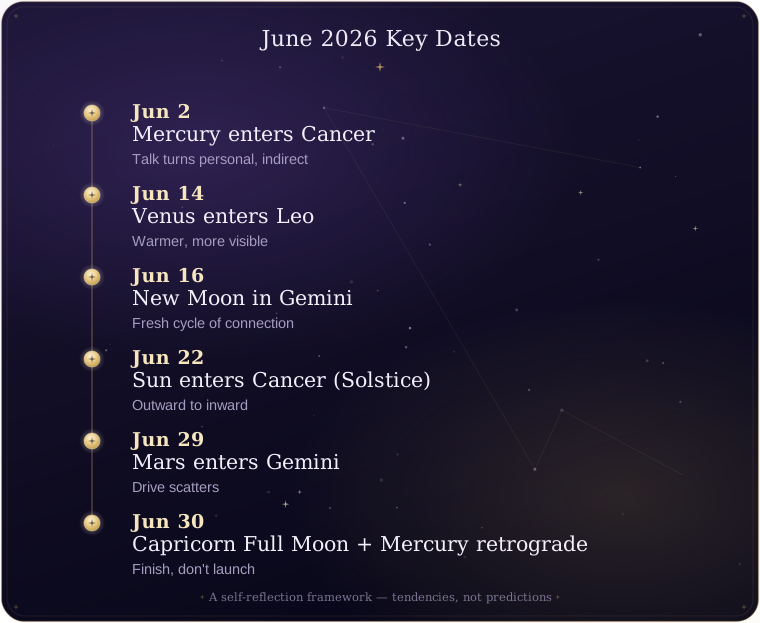
| Date | Event | Plain-language read |
|---|---|---|
| June 2 | Mercury enters Cancer | Communication turns more personal, memory-driven, indirect |
| June 14 | Venus enters Leo | Social and relational style gets warmer, more expressive, more visible |
| June 16 | New Moon in Gemini | A fresh cycle around learning, talking, and local connections |
| June 22 | Sun enters Cancer (Summer Solstice) | Seasonal pivot from outward gathering to inward tending |
| June 29 | Mars enters Gemini | Drive and effort scatter across many small tracks |
| June 30 | Full Moon in Capricorn | A structure, goal, or responsibility reaches a visible peak |
| June 30 | Mercury stations retrograde at 26° Cancer | A review window opens (through July 24); favor revisiting over launching |
All positions are based on the June 2026 ephemeris. Where this guide names an aspect or a sign relationship, treat it as an approximate read of the mid-month chart, not a timed event.
The Solstice and the Turn Into Cancer Season
The Sun spends the first three weeks of June at the tail end of Gemini and crosses into Cancer at the June 22 solstice — the most reliable shift of the month, because it's literally seasonal: the longest day in the Northern Hemisphere, after which the light starts to recede. Mercury already moved into Cancer back on June 2, so by the solstice the chart's center of gravity has clearly relocated from the airy Gemini register to the slower, home-facing register of Cancer.
What does that look like in practice? The two registers pull in opposite directions:
- Gemini season pulls attention outward and sideways — many conversations, many tabs open, a lot of input.
- The Cancer turn pulls it inward, toward what's familiar: family, household, the people and places you actually return to.
This isn't a mood the sky imposes on you; it's a pattern you can test. Over the back half of June, notice whether your attention drifts from "what's new out there" toward "what needs tending here." If it does, the transit gave you a word for something already underway.
The solstice is also a natural checkpoint — the year is half over. Rather than treating that as pressure, use it as a scheduled pause: look back at what you set in motion in January, and decide, plainly, what's worth carrying into the second half and what you can put down. To see which area of life this Cancer emphasis lands on, you'd look at which house holds Cancer in your own chart — more on that method below.
The Gemini New Moon and Venus Entering Leo
Mid-month carries two social signals close together:
- Venus enters Leo (June 14). Cancer-style connection is protective and inward; Leo-style connection is warmer, more expressive, more willing to be seen. In the mid-month chart Venus sits at the very start of Leo, around 2°, so it's just getting going — early in the sign, the effect is more a change of register than a finished mood.
- New Moon in Gemini (June 16). A New Moon is the dark point of the lunar cycle, conventionally read as a beginning. In Gemini, that loop is about the everyday machinery of connection: talking, writing, learning, errands, the short hops between people and ideas. It's a workmanlike new moon, not a grand one.
A good use of the New Moon is mundane. Try one concrete move:
- Start the email thread you've been avoiding.
- Sign up for the thing you keep meaning to learn.
- Reach back out to the contact you dropped.
Watch the Venus shift concretely too: in the second half of June, notice whether you're a little more inclined to say the warm thing out loud, to show up rather than hang back. That's the observable edge of this transit.
These two reinforce each other usefully. The Gemini New Moon hands you the channel — communication, connection, the small daily exchanges. Venus in Leo adjusts the tone traveling through it toward something more generous and visible. For a frame on how a transit like this maps onto your own placements, the method of reading how transits interact with your natal chart transits is the thing to learn once and reuse every month.
June 30: The Capricorn Full Moon and Mercury Retrograde
The month ends on a genuinely loaded day. On June 30, a Full Moon in Capricorn arrives at the same time Mercury stations retrograde at 26° Cancer. These two sit opposite each other — Cancer and Capricorn are across the zodiac from one another — so the day has a built-in tension: the home-and-care axis of Cancer pulling against the structure-and-responsibility axis of Capricorn. Treat that pairing as approximate framing, not a precise aspect with a clock attached.
Two things stack on this single date:
- Full Moon in Capricorn. A Full Moon is the peak of the lunar cycle, read as culmination — something reaches a visible high point. In Capricorn the themes are concrete: work, goals, structure, the responsibilities you carry in public. The practical read is that some project, commitment, or obligation hits a point where you can actually see where it stands. Good for assessment, completion, and honest accounting; less good for pretending an overdue thing is fine.
- Mercury stations retrograde at 26° Cancer. This opens a review window — here running June 30 through July 24 — where the conventional advice favors the "re-" verbs: revisit, revise, reconnect, reconsider. It's not a forecast of disaster; it's a scheduling heuristic.
Layer them together and the day's instruction clarifies itself: lean toward finishing and reviewing at month's end rather than launching something new on June 30. For the longer mechanics of this cycle, see what Mercury retrograde actually means.
Mars Enters Gemini
One more shift closes the month: Mars enters Gemini on June 29. Mars is the planet of drive and effort, and Gemini is the sign of many channels at once, so the straightforward read is that your drive to get things done starts to spread across multiple small tracks rather than driving one big push. In the back half of June this can show up two ways:
- Productive multitasking — a few tracks moved forward deliberately.
- Scattered, half-finished starts — a long list you touched and dropped.
Same transit, two outcomes depending on how you handle it. The test is honest: at the end of a late-June day, can you point to two or three things you actually moved forward, or just a list you grazed?
Note too that this lands right beside the June 30 Mercury retrograde and Capricorn Full Moon, so month's end asks you to manage scattered effort and a review window at once. The plain move: narrow your focus precisely when the sky is tempting you to widen it.
How to Work With June's Transits
Here's the one practical method that turns this calendar into something personal. Every transit above is a planet moving through a sign — but the part that matters for you is which house that sign occupies in your own birth chart. The house is the life area; the transit is the timing.
Run the same check for each of June's signs:
- Cancer — the Sun, Mercury, and (by June 30) Mercury-retrograde activity concentrate here. If Cancer is on your career house, the season pivot and the June 30 events read as a work story; if it's on your home or family house, the same transits read as a domestic one.
- Gemini — find the house holding Gemini for the June 16 New Moon and the June 29 Mars ingress.
- Capricorn — find the house holding Capricorn for the June 30 Full Moon.
Three placements, and most of the month's meaning resolves into specifics you can observe. Same sky, different life area — and the only way to know which is to look at your own chart, not a generic forecast. If you've never mapped your houses, start with the basics in a guide to the astrology houses, and keep the broader overview of astrological transits handy for how moving planets interact with a fixed natal chart.
Two June dates deserve a closer read on their own. The Capricorn full moon that closes June caps a six-month arc that began at the start of the year, and as the 2026 World Cup opens under Jupiter in Cancer, the same theme of belonging, home, and collective feeling runs quietly underneath the tournament's noise.
None of this is a prediction, and none of it decides your month for you. It's a way of paying attention — a vocabulary for noticing shifts in pace and priority that you can check against your own experience and keep or discard. To build the one skill that makes every monthly forecast like this one legible, learn to read your own chart: start with how to read a birth chart and you'll have the map you need for June and every month after. For the whole year at a glance — every ingress, retrograde, eclipse, and moon phase — see the 2026 astrology calendar.
Questions People Ask About June 2026 Planetary Transits
What happens on June 30, 2026?
June 30 is the month's single loaded day: a Full Moon in Capricorn arrives at the same time Mercury stations retrograde at 26° Cancer. Cancer and Capricorn sit opposite each other, so the day carries a built-in tension between home-and-care and structure-and-responsibility. The article reads it as a day that rewards finishing and reviewing rather than launching something new.
When does the June 2026 Mercury retrograde end?
Mercury stations retrograde at 26° Cancer on June 30 and the review window the article describes runs through July 24. During that stretch the conventional advice favors the "re-" verbs — revisit, revise, reconnect, reconsider — treated as a scheduling heuristic, not a forecast of disaster.
When is the Cancer season solstice in June 2026?
The Sun leaves Gemini and enters Cancer at the June 22 solstice, the longest day in the Northern Hemisphere. The article calls it the most reliable shift of the month because it's literally seasonal, marking a pivot from outward gathering to tending what's close to home.
What does the Gemini New Moon on June 16 mean?
The article frames the June 16 New Moon in Gemini as a workmanlike fresh cycle around the everyday machinery of connection — talking, writing, learning, and short hops between people and ideas. Paired with Venus entering Leo on June 14, it's read as a mid-month reset in how you talk, connect, and show up socially, with a warmer and more visible tone.