
What is Ketu Mahadasha?
Ketu Mahadasha is the seven-year Vimshottari period assigned to the south lunar node. In Vedic astrology's timing framework, a birth chart runs through a fixed sequence of planetary periods called mahadashas, and Ketu's is the shortest of the major ones at seven years. Before reading Ketu's chapter on its own, it helps to understand the pillar guide to the mahadasha system and its planetary periods that frames it. The classical Vimshottari scheme, traditionally traced to the sage Parashara, treats this stretch as a season of detachment, completion, and turning inward rather than a verdict of loss.
- Lasts exactly seven years within the larger Vimshottari sequence
- Associated with endings, release, and a pull toward the inner life
- Read as a tendency toward letting go, not a sentence of deprivation
Why It Matters for Self-Awareness
This period matters for self-awareness because the fear attached to it usually outruns the facts. Many people reach this period braced for seven years of loss — a relationship that ends, work that dissolves, a creeping sense of drift — and miss that the same tradition frames those events as release rather than punishment. In a decade of independent research into the classical Sanskrit sources, working as a second-generation Jyotish practitioner, I have watched this single reframe change how people meet the period: the outer events may look similar, but read as completion they stop feeling like things being done to you.
The practical value is that naming a tendency is not the same as predicting a fate. Knowing the period leans toward detachment lets you notice where you are already over-attached — to a title, a role, an old plan that no longer fits — and meet the loosening on purpose instead of resisting it. People often describe the years as quieter, less driven, more reflective. That shift can read as disorientation if you expected forward motion, or as relief if you were ready to set something down. Either way, the awareness that this is a season with a shape, not a random run of bad luck, is what makes it workable.
Ketu Mahadasha vs Adjacent Concepts: How It Works + Trade-offs
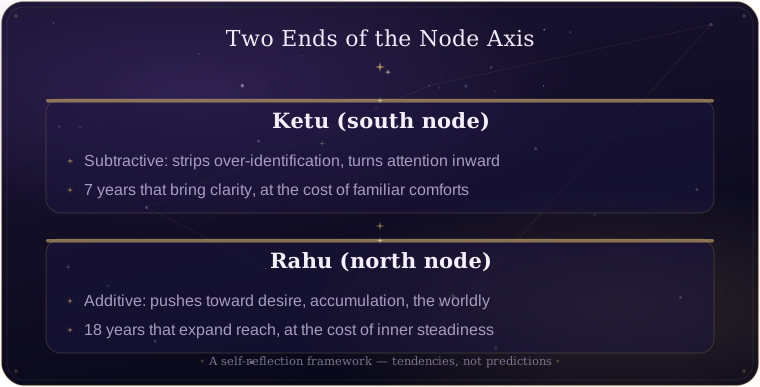
Ketu's dasha works differently from the periods around it, and the clearest contrast is with its own axis-partner. Where the companion guide to the Rahu Mahadasha period pushes outward toward desire, accumulation, and worldly ambition, Ketu pulls in the opposite direction — toward release, disinterest, and the inner search. The way it functions is subtractive: it tends to strip away what a person has over-identified with, so something quieter can surface underneath. To get that clarity and detachment, you sacrifice the comfort of the familiar attachments the period loosens. That trade is the whole point, and it is also why the same years can feel freeing to one person and unmooring to another.
It also reads differently from a generic planetary period. A benefic period might add resources or relationships; Ketu's chapter more often removes the scaffolding around an identity to test what stands without it. Choosing to read it this way gets you a usable map of where to let go, but you lose the reassurance of a forecast that promises gain. Modern classical teachers such as K. N. Rao keep stressing that a dasha marks a tendency in timing, not a fixed event — a distinction that separates a sober Vedic reading from a fatalistic one, and that keeps the south node's period from being mistaken for a guaranteed downturn.
How to Read Ketu Mahadasha in Your Chart
Reading Ketu Mahadasha in your own chart starts with noticing where detachment is already showing up, not waiting for a single dramatic event. A few observable signals:
- Fading pull toward old goals. Ambitions that once drove you quietly lose their charge, and you stop chasing them without quite deciding to.
- Rising interest in the inner life. Solitude, study, meditation, or spiritual questions start feeling more compelling than social wins or material milestones.
- Endings that arrive cleanly. Relationships or commitments close with less drama than you expected, as if they had simply finished their course.
- A sense of being between chapters. Familiar identities feel loose, and you may notice you no longer answer "what do you do" the same way.
Where these signals land depends on the house and sign Ketu occupies in your natal chart. The south node carries a fixed set of significations — detachment, past-life residue, sudden cut-offs, and a pull toward moksha or spiritual release — and the period tends to activate them through whatever life area Ketu sits in. Ketu in the tenth house may loosen ambition around career or status; in the seventh, it can quietly thin attachment to a partnership; in the ninth or twelfth, it often sharpens the inner search the node already favors. Parashara's framework also weights the dispositor of Ketu and any conjunctions, so the chapter rarely reads identically for two charts.
Working with this period consciously means meeting the loosening on purpose rather than bracing against it. Practitioners often suggest building in deliberate solitude, simplifying commitments before they fall away on their own, and treating endings as completions to close cleanly. The aim is not to force loss but to stop over-gripping what the period is already asking you to hold more lightly.
Common Misreadings
The loudest takes on Ketu's period tend to be the least accurate, and a few misreadings trap searchers before they reach the tradition:
- "It guarantees loss." The south node inclines toward release and completion, not deprivation; the tradition describes a tendency, never a locked outcome.
- "It's a Western transit." This is a Vedic dasha drawn from the Vimshottari system, a timing model with no direct equivalent in Western astrology.
- "Remedies will cancel it." Traditional practices are framed as ways to meet the period consciously, not guaranteed cures that erase its themes.
- "Detachment means depression." Spiritual disinterest in the classical reading is a reorientation of attention, not a clinical mood state to diagnose.
Ketu's Dasha at a Glance
| Property | How It Works | Natal Anchor | How to Observe |
|---|---|---|---|
| Duration | Runs seven fixed years inside the Vimshottari sequence | Begins by dasha order, not by age | Track the start date from your Vedic chart's dasha table |
| Core theme | Subtracts over-identification so detachment can surface | Ketu's natal house and sign | Notice which life area quietly loosens its grip |
| Inner pull | Turns attention from outer gain to inner search | The house Ketu occupies natally | Watch for rising interest in solitude or study |
| Emotional tone | Loosens attachments so endings feel clean | Sign and house of natal Ketu | See whether closures arrive with less drama than expected |
Ketu Mahadasha FAQ
How long does the Ketu Mahadasha period last?
It runs for exactly seven years within the Vimshottari cycle. That makes it the shortest of the system's major planetary periods.
Is this period always a difficult one?
No — the tradition reads it as a tendency toward detachment and completion, not a guaranteed misfortune. Its themes can register as relief and clarity rather than loss when met consciously.
How does it differ from the Rahu period?
Rahu's period pulls toward worldly desire and ambition, while the south node's pulls toward release and inner focus. They sit on opposite ends of the same lunar-node axis.
Can remedies change how it unfolds?
Classical remedies are framed as ways to engage the period with awareness, not as cures that delete its lessons. They support how you meet the themes rather than canceling them.
Reflection Prompts
- Think of a recent attachment you've felt quietly loosen — what changed once you stopped gripping it?
- Recall a moment this year when an ending arrived more cleanly than you feared. What did it free up?
- Name one identity you would struggle to release. Where does that resistance actually come from?
Related Reading
- explainer on the difference between Vedic and Western astrology — clarifies why a dasha period has no direct equivalent in a Western chart.
- Dasha (astrology) (Wikipedia) — background on the timing framework behind the seven-year cycle.
Take Action
Want the full system first? Read the complete guide to mahadasha and the Vimshottari periods to see exactly where Ketu's seven years sit in the wider sequence of planetary timings. You'll come away able to locate your current period on the full timeline — and that context is what turns a feared chapter into one you can read as a tendency to work with, and meet on your own terms.
Sources
- Parashara — traditionally credited with the classical Vimshottari dasha system this period belongs to
- K. N. Rao — modern Jyotish teacher known for tendency-based, research-driven dasha analysis