
What is Rahu Mahadasha?
This period is the roughly 18-year stretch in a Vedic birth chart when Rahu, the north lunar node, sets the background tone of a person's life. It is one of nine planetary periods in the pillar guide to the mahadasha system and Vimshottari periods, the timing framework that splits a 120-year cycle among nine planets. In this tradition, the period reads as a roughly 18-year stretch of amplification, ambition, and unconventional growth. Because Rahu is a calculated point rather than a visible planet, its years tend to pull a person toward what is foreign, novel, or just outside the script they inherited.
- Runs about 18 years, the second-longest single share in the Vimshottari sequence
- Anchored to the north lunar node, not a physical planet you can point at in the sky
- Associated with strong ambition, foreign or unfamiliar pulls, and a hunger for the new
The Brihat Parashara Hora Shastra, which sets out the Vimshottari scheme, fixes this 18-year allotment precisely and places it in a defined order among the nine rulers. In practice the long period is never read as a single flat tone. It is subdivided into antardashas, sub-periods governed in turn by each of the nine planets, so the opening years under Rahu's own sub-period read differently from the later years colored by Jupiter or Saturn. That internal structure is what lets a practitioner trace how the chapter actually moves rather than treating eighteen years as one undifferentiated block.
Why It Matters for Self-Awareness
Rahu Mahadasha matters because of one specific dread: people hear the name and brace for eighteen years of disaster, then read every setback as proof the curse is real. The tradition does not say that. It describes a long season of intensified wanting and rapid, often disorienting growth — something to work with, not something to survive. Across a decade of independent research in the classical Sanskrit texts I grew up around as a second-generation Jyotish practitioner, I have watched this single misreading create more needless fear than almost any other placement.
It also helps to know which system you are reading. Vedic astrology uses the sidereal zodiac and the dasha timeline, so a Rahu period has no clean equivalent in the tropical, transit-based approach most Western horoscopes use. The two describe different machinery, and conflating them muddies both — a distinction worth understanding through a plain explanation of how Vedic and Western astrology differ in zodiac and timing. Reading the period as tendency rather than decree is what turns it into useful self-knowledge instead of low-grade anxiety.
Rahu Mahadasha vs Adjacent Concepts: How It Works + Trade-offs
Rahu's dasha is easiest to understand next to its natural pair. The clearest contrast is with the sibling page on the Ketu mahadasha period of the south lunar node, Rahu's opposite node. Here is how each works and what each asks you to trade.
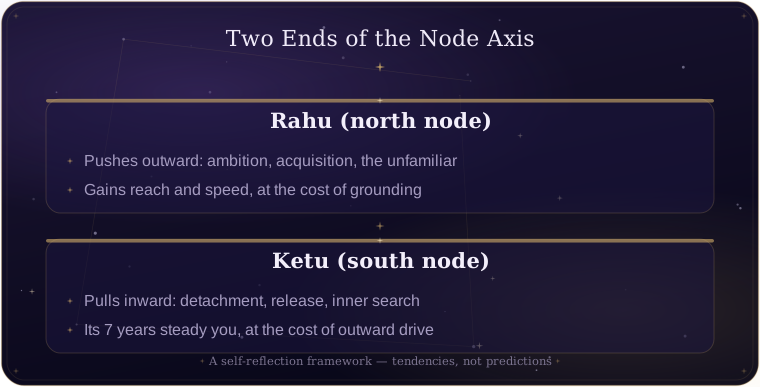
- Rahu period vs Ketu period. Rahu's years work by pushing outward — toward acquisition, status, and the unfamiliar — while Ketu's seven-year period works by pulling inward toward detachment and release. To get Rahu's expansion and worldly drive, you tend to sacrifice some inner steadiness; the reaching can outrun your sense of who you are.
- Rahu period vs Saturn period. Saturn's long period works through structure, patience, and slow consolidation. Rahu works through sudden acceleration and shortcut-seeking. To get Rahu's speed and reach, you give up Saturn's reliability — gains can arrive fast and prove hard to hold.
- This dasha vs a passing Rahu transit. A transit is a brief weather pattern; the mahadasha is the whole climate of a multi-year chapter. The way it functions is cumulative, so the trade is depth for immediacy: the period shapes long arcs, not a single dramatic week.
The thread across all three is that Rahu rewards ambition and novelty at the cost of grounding. Naming that trade is what keeps a long period of amplification from being read as fate.
How to Read Rahu Mahadasha in Yourself
The point of the Rahu period is not prediction but recognition. These are observable signals the tradition links to the period — patterns to notice, not omens to fear.
- Sudden, unfamiliar ambition. You might find yourself drawn to fields, places, or goals that have no precedent in your past or your family.
- A pull toward the foreign. Many people describe new interest in other cultures, languages, technologies, or subcultures that feel both magnetic and slightly off-script.
- Fast rises that feel ungrounded. Opportunities can arrive quickly; the unsettled feeling underneath often matters more than the wins themselves.
- Restlessness with the conventional. Routines that once fit can start to feel too small, prompting unconventional choices.
- Intensity of desire. Wanting itself can sharpen — useful as fuel, costly when it tips into obsession or chasing the next thing.
Common Misreadings
Most surface-level write-ups distort Rahu Mahadasha in a few predictable ways. Each correction below moves from the popular misread to what the tradition actually holds.
- "It guarantees ruin." Misread: eighteen years of guaranteed disaster. Reality: the texts describe amplification and unconventional growth that can swing either way depending on the whole chart and how the energy is handled.
- "Remedies cancel it out." Misread: the right ritual makes the period painless. Reality: classical sources frame practices as ways to work with a tendency, never as guaranteed cures that override it.
- "Rahu is simply malefic." Misread: Rahu only destroys. Reality: it is read as a worldly, boundary-pushing force that can drive real achievement, not a one-note villain.
- "It overrides everything." Misread: the period dictates your life alone. Reality: it is always weighed against the natal placement of Rahu and the rest of the chart.
Rahu Mahadasha at a Glance
| Property | How It Works | Natal Placement | How to Observe |
|---|---|---|---|
| Duration | Runs about 18 years as one continuous Vimshottari period | Sits within the standard nine-planet dasha sequence | Note the start year from your dasha chart |
| Core theme | Amplifies desire and the pull toward the unfamiliar | Colored by the house and sign Rahu occupies in the birth chart | Watch where ambition and restlessness concentrate |
| Sub-periods | Each antardasha shifts the tone over months to years | Each sub-period ruled by a different planet in turn | Track which antardasha is currently active for nuance |
| Reading stance | Read as tendency, never as a fixed outcome | Weighed against the whole chart, not Rahu in isolation | Separate recurring patterns from one-off events |
Questions People Ask About the Rahu Period
Is the Rahu period always bad?
No. The Vimshottari tradition reads it as a period of amplification and unconventional growth, not a sentence. How it unfolds depends on Rahu's placement and the chart as a whole.
How long does the Rahu period last?
It runs about 18 years, the second-longest of the nine planetary periods. Within it, shorter sub-periods called antardashas change the tone every few months to years.
What is the classical source for Rahu Mahadasha?
The Vimshottari dasha system is set out in the Brihat Parashara Hora Shastra, the classical text attributed to the sage Parashara. It defines the period lengths and the order in which the nine planets rule.
Does this dasha mean the same thing in Western astrology?
Not directly. The dasha system belongs to Vedic astrology and its sidereal zodiac, so there is no clean Western equivalent built on tropical transits.
Reflection Prompts
- Think of a recent goal that surprised you because it had no precedent in your past — what was actually driving the wanting?
- Recall a fast opportunity you chased; did the rush feel grounded, or slightly ahead of you?
- Name one unfamiliar pull you feel now, and ask whether it is genuine growth or restlessness.
Related Reading
- Dasha (astrology) (Wikipedia) — for the broader timing framework behind the 18-year period.
- Lunar node (Wikipedia) — for what the north node actually is in observational terms.
Take Action
Pull your dasha timeline and find the start year of your Rahu period; doing so reveals exactly which 18-year chapter you are in and which sub-period is active right now. That single act trades vague dread for a clear map — and once you can see the period as a season of amplified wanting rather than a verdict, you can decide what to do with the drive instead of bracing against it. Want the full system first? Read the complete guide to mahadasha and the Vimshottari periods: https://astrologywiki.com/en/wiki/mahadasha
Sources
- Parashara — the sage to whom the Vimshottari dasha system and its classical text, the Brihat Parashara Hora Shastra, are traditionally attributed
- B. V. Raman — a modern interpreter who kept these planetary periods read as tendency rather than fixed decree