
Feeling jittery, overthinking every text, or waking up with a sense of dread for no reason? Before you blame the coffee, it's worth asking a more precise question: is this the texture of Mercury Retrograde, or is this your own emotional tide rising? They can feel almost identical from the inside, but they come from different places — and they ask for different kinds of care.
Quick Answer: Is This Mercury Retrograde or My Own Anxiety?
Here's the fastest way to tell them apart. Notice where the discomfort lives and what it's attached to.
If your unease is wrapped around external friction — a misread message, a delayed reply, a calendar mix-up, a device that won't cooperate, an old conversation you suddenly need to revisit — that has the fingerprint of Mercury retrograde. It tends to be situational and mental: your thoughts are scattered, your logistics are tangled, and the anxiety spikes when something out there snags.
If your unease has no obvious trigger — it's a heaviness in the chest, a "nobody really wants me here" feeling, a wave that crests and recedes on its own clock — that points toward a Moon-driven emotional tide. It's bodily and cyclical. Nothing "happened"; the mood simply moved through you.
In practice it's rarely 100% one or the other. But naming which one is louder right now tells you whether to reach for organization and clarity (Mercury) or comfort and self-soothing (the Moon). The rest of this guide gives you the side-by-side signatures so you can read your own experience in real time.
---
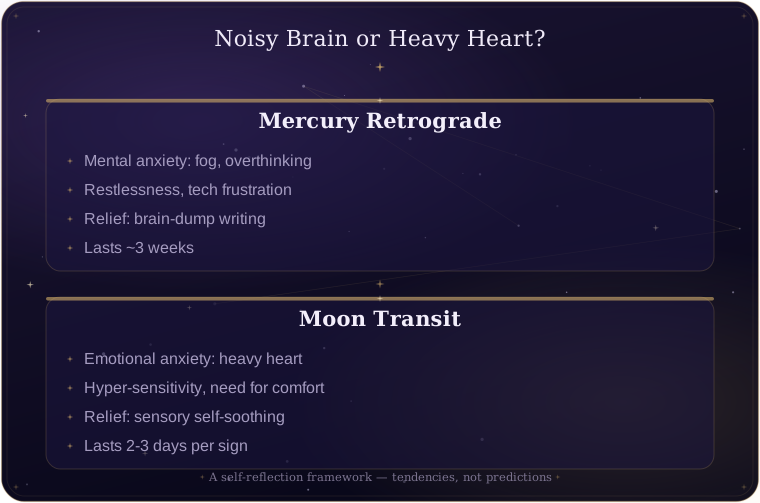
The Two Signatures, Side by Side
| What you're noticing | Mercury Retrograde (mental / logistical) | Moon-Driven Anxiety (emotional / bodily) |
|---|---|---|
| Where it lives | In the head — thoughts, words, plans | In the body — chest, gut, throat |
| What sets it off | An external snag: a text, a glitch, a delay | Often nothing external; it just rises |
| Core flavor | Scattered, foggy, "I can't think straight" | Heavy, tender, "I don't feel safe" |
| Thought pattern | Overthinking logistics, analysis paralysis | Ruminating on hurts, replaying who-loves-me |
| Time direction | Pulled backward — old emails, exes, redoing | Pulled inward — present mood, raw need |
| Communication | Miscommunication, tech issues, missed signals | Feeling misunderstood, withdrawing, going quiet |
| Physical tell | Restlessness, fidgeting, mental buzz | Fatigue, the urge to hide, wanting comfort food |
| Best relief | Write it out, organize, double-check, slow down | Sensory comfort, warmth, nurturing, rest |
| Typical duration | ~3 weeks (the retrograde window) | A few hours to ~2-3 days (Moon in one sign) |
Read the table as a spectrum, not a verdict. Most anxious days have a bit of both. The duration row is the quietest but most useful clue: a feeling that tracks a roughly three-week external-friction phase reads as Mercury; a feeling that crests and passes within a day or two, on no clear cause, reads as the Moon.
---
How Mercury Retrograde Actually Feels
Mercury is the planet of the mind — it rules communication, logic, and the small machinery of daily life: messages, schedules, contracts, commutes, devices. When Mercury appears to move backward (an optical effect of orbital geometry, not a literal reversal), those logical pathways feel tangled. Nothing is broken; the wiring just runs hot.
The Telltale Signs
- Brain fog: Walking into a room and forgetting why. Names slipping. Losing your thread mid-sentence.
- Racing, looping thoughts: Re-reading a sent email five times hunting for a typo you're sure is there.
- Logistics gremlins: A double-booked calendar, a payment that won't go through, a train that's mysteriously late.
- Tech friction: A laptop crash that triggers a meltdown wildly out of proportion to a lost paragraph.
- The pull to revisit: An old message thread, an ex's name, a project you'd shelved — all suddenly demanding a second look.
What makes this anxiety rather than mere inconvenience is the meaning the mind layers on top. The delayed reply becomes "they're upset with me." The glitch becomes "everything is falling apart." Mercury doesn't manufacture catastrophe; it loosens the screws on your interpretations so small snags amplify.
What to Do for Mercury Anxiety
The move is externalize and slow down. Open a note or a moon journal-style page and spill everything in your head onto paper, unedited — Mercury anxiety eases the moment your brain stops trying to be the only storage system. Then build in friction on purpose: re-read before you send, confirm times twice, back up your files, leave ten extra minutes. You're not being paranoid; you're meeting a foggy transit with structure.
---
How Moon-Driven Anxiety Actually Feels
Where Mercury is the head, the Moon is the gut. In psychological astrology the Moon represents your inner child, your subconscious baseline, and what you need in order to feel safe and held. The Moon also moves fast — it changes signs every two to three days — which is exactly why its anxiety has a tidal quality.
The Telltale Signs
- A heavy heart with no story: Loneliness or a sense of being unloved that has no event behind it.
- Hyper-sensitivity: A neutral comment from a friend lands as a personal wound.
- Rumination on feeling, not logistics: You're not replaying an email — you're replaying how it felt to be left out.
- A bodily pull toward shelter: The irrational, almost physical urge to get under the covers ("blanket burrito" mode).
- Cyclical timing: It rises, peaks, and recedes on its own, often syncing loosely with the lunar month or your personal cycles.
The hallmark is that the feeling is older and bodily — it tends to echo early templates about safety and belonging rather than respond to anything happening today.
What to Do for Moon Anxiety
Here the move is comfort first, analysis later. You can't reason a tide into receding; you signal safety to the body and let it pass. Lean into sensory comfort — a warm shower, soft lighting, a weighted blanket, a slow walk, calming music, food that feels like care. Tracking matters too: noticing that the heaviness tends to arrive around the full moon, or on the same few days each month, turns a frightening fog into a predictable weather pattern you can prepare for instead of fear.
---
How to Tell Them Apart in Real Time
When you're in it, run three quick checks:
- Where do I feel it? Head-and-thoughts → lean Mercury. Chest-and-gut → lean Moon.
- Can I name a trigger? A specific snag, message, or glitch → Mercury. "It just came over me" → Moon.
- What's the time shape? A roughly three-week stretch of things-going-sideways → Mercury. A wave that swells and passes in a day or two → Moon.
For a sharper read, bring in your own chart. The Moon's effect lands hardest in whatever house it's transiting and on your personal placements — so what feels like vague dread is often the Moon spotlighting a specific area of life (home, relationships, work, identity). Learning how to read your birth chart lets you see which house the current Moon is lighting up, and following daily transits shows you when Mercury and the Moon are actually doing something versus when you've simply had a hard day. Knowing the 2026 retrograde windows in advance helps too — Mercury is retrograde Feb 26–Mar 20, Jun 29–Jul 23, and Oct 24–Nov 13 (see the full 2026 astrology calendar for exact dates).
---
When It's Both at Once
Sometimes the honest answer is "both," and that's worth naming rather than forcing a clean diagnosis. A classic stack: Mercury retrograde garbles a conversation with someone you love, and a tender Moon transit makes the resulting confusion feel like rejection. Now the mental snag and the emotional tide are feeding each other — your thoughts loop on what was said while your body braces as if you're unsafe.
When the two overlap, treat them in order: soothe the body first (Moon work), then sort the logistics (Mercury work). Trying to organize your way out while your nervous system is flooded rarely sticks; calm the tide, and the tangle is much easier to untangle.
---
A Gentle Caveat
Astrology here is a lens for self-reflection, not a diagnosis and not a substitute for care. If your anxiety is persistent, intense, or interfering with daily life — if it doesn't lift when the transit passes — that's a wellness matter, not a cosmic one, and it deserves real support from a professional. The sky can name a season; it can't treat one. Use these patterns to understand yourself more kindly, and reach for human help when you need it.
---
Questions People Ask
How do I know if my anxiety is Mercury retrograde or just my mood?
Check where it lives and what it's attached to. Mercury retrograde anxiety is mental and situational — it spikes around miscommunication, tech snags, delays, and the urge to revisit the past, and it tends to track a roughly three-week window. Moon-driven anxiety is bodily and cyclical — a heaviness or vulnerability that rises and passes on its own clock, often with no external trigger.
Does Mercury retrograde actually cause anxiety?
Not in a mechanical, cause-and-effect way. The framing in psychological astrology is that the retrograde period correlates with more communication and logistics friction, and that friction can amplify an already busy mind. It's a lens for noticing patterns, not a force acting on your brain.
How long does each kind last?
A Mercury retrograde phase runs about three weeks (in 2026: Feb 26–Mar 20, Jun 29–Jul 23, Oct 24–Nov 13). A Moon transit through a single sign lasts only two to three days, so Moon-driven moods are usually much shorter — often resolving within a day.
What if it feels like both at the same time?
That's common, especially when a Mercury miscommunication collides with a sensitive Moon transit. Soothe the body first, then sort the logistics — calming the emotional tide makes the mental tangle far easier to clear.
When should I stop blaming the stars and get help?
When the anxiety is persistent, severe, or doesn't ease after the transit passes. Astrology is a reflective tool, not a clinical one — ongoing anxiety is a wellness matter that deserves support from a qualified professional.
---
Take Action
Understanding the cosmic weather report isn't about blaming the planets — it's about reading your own patterns before they overwhelm you. Start by keeping a record of your internal weather: a simple moon journal is the easiest way to spot whether your hard days cluster around retrogrades or around the lunar month. To go deeper, learn how to read your birth chart so you can see which house the Moon is lighting up, and keep our guide on How to Track Your Mood with Astrology handy to sync your self-care with the sky.