
What Is a Moon Journal?
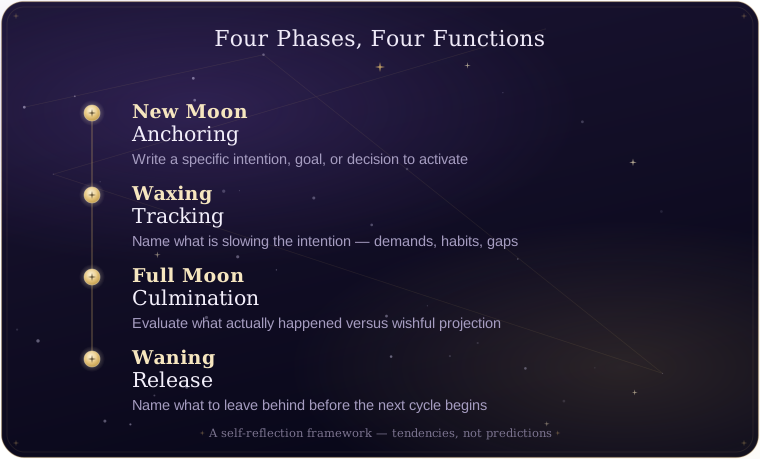
A moon journal is a structured journaling practice organized around the four distinct phases of the lunar cycle — new moon, waxing, full moon, and waning — each assigned a different psychological function. It frames each moon phase as a specific moment for a different kind of inner work rather than a point on an undifferentiated monthly circle. At the new moon, the practice anchors a specific intention. During the waxing phase, it tracks what's slowing that intention down. At the full moon, it evaluates honestly what actually materialized. During the waning phase, it names what to consciously release before the next cycle begins. In practice, the two phases that carry the most weight are the bookends: a tightly structured new moon entry built from new moon journal prompts, and an honest full moon entry guided by full moon journal prompts — the gap between the two is where the practice's tracking value lives.
- Organized around four phase-specific written tasks rather than open-ended daily reflection
- Uses the 28-day lunar rhythm as a repeating review loop, not a schedule for noting moods
- Links each phase to a different cognitive task: goal-setting, obstacle-mapping, evaluation, and release
Why It Matters for Self-Awareness
The most common advice for moon journaling — write about how you feel each phase, notice what comes up, sit with the energy — sounds complete until you try to sustain it past the first two cycles. That advice collapses the four distinct psychological functions into a single repeated task: describing your inner state. When every phase asks the same open-ended question, the practice becomes a mood log with lunar branding. The feedback loop that gives the format its tracking value never activates.
The specific frustration practitioners report is this: after two or three cycles of writing similar entries at every phase, there is no cumulative knowledge to show for it. The practice's structural value comes from the gap between entries — the new moon entry naming an intention, and the full moon entry honestly evaluating whether that intention materialized. If the full moon entry is also an emotional snapshot, that comparison never happens. You get atmosphere instead of information.
The self-awareness that phase-specific journaling offers is structural, not decorative. It comes from comparing a goal-setting entry against an honest evaluation entry, then identifying what patterns carry from one cycle to the next without scrutiny. That comparison requires each phase to do a different job. Resources that advise "document your feelings each phase" remove the phase differentiation and, with it, the iterative self-knowledge that makes the practice worth sustaining.
Moon Journal vs General, Gratitude, and Calendar Journaling
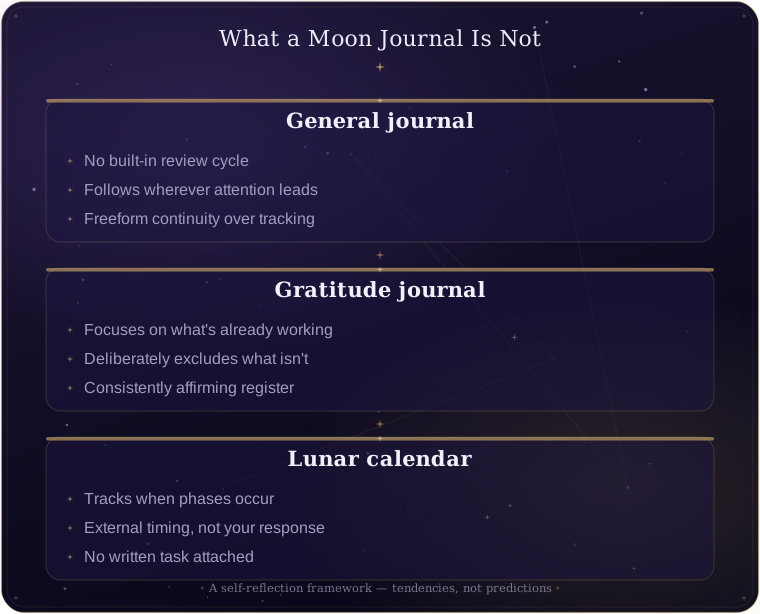
Three formats are regularly confused with a moon journal, and the distinctions carry real trade-offs worth naming explicitly.
- Moon journal vs. general journal. A general journal records thoughts and responses without a built-in review cycle. A moon journal uses the 28-day lunar loop to force a structured comparison between what you intended at the new moon and what actually happened at the full moon. To get iterative self-tracking across cycles, you give up freeform continuity — entries must fit phase-specific functions rather than follow wherever attention leads on a given day. If unconstrained expression is the goal, a general journal fits better. If comparing intention to outcome across time is the goal, the moon journal's phase structure is precisely what makes that comparison possible.
- Moon journal vs. gratitude journal. Gratitude journaling focuses on what is already present and working, deliberately excluding evaluation of what isn't. A moon journal includes a waning phase designed to name exactly what isn't working — what to consciously release before the next cycle begins. To get the release-and-evaluate function, you trade the consistently affirming register that gratitude formats maintain. The two can coexist — gratitude as a daily habit, moon journaling at the four phase points — but treating them as interchangeable removes what makes each distinctive.
- Moon journal vs. lunar calendar. A lunar calendar tracks when phases occur; a moon journal gives you a specific written task to do during each one. The calendar handles external timing; the journal handles your internal response to that timing. To get a reflective record across multiple cycles, you trade the at-a-glance simplicity of pure calendar use. Used together — calendar as timing reference, journal as the practice — they form a more complete system than either alone.
In the psychological astrology tradition — a framework that practitioners like Steven Forrest helped shape — the lunar cycle functions as a repeating feedback structure, not a passive backdrop. The moon journal applies that principle at the personal scale: each 28-day cycle is a complete loop of intention, resistance, evaluation, and release. Collapsing that into undifferentiated emotional documentation removes the loop while keeping the aesthetic.
How to Tell a Moon Journal Practice Is Working
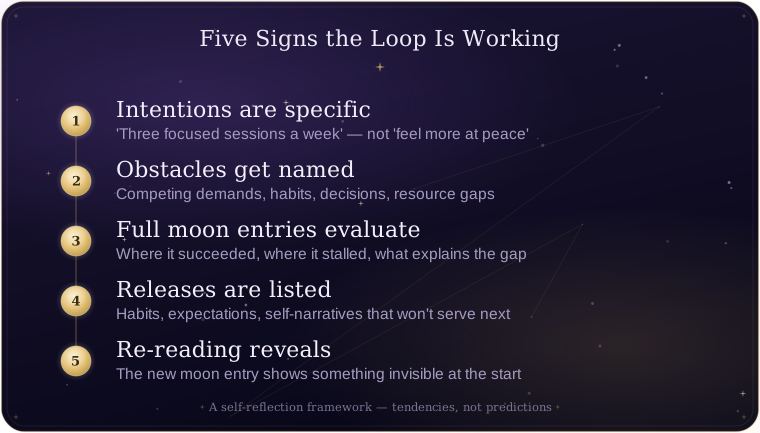
Recognizing whether a moon journal practice is functioning as designed comes down to whether each phase entry activates a distinct task. Five observable signals indicate the structure is working:
- New moon entries name a specific intention. The entry identifies a particular goal, project, or decision to set in motion — not a general wish for openness or alignment. "I want to feel more at peace" is a mood preference. "I'm committing to three focused work sessions on this project each week" is an intention the practice can later evaluate.
- Waxing entries name specific obstacles. The question at this phase is not "how is this going?" but "what specifically is slowing this down?" Naming friction by category — a competing demand, a habit pattern, an unresolved decision, a resource gap — is the task. General progress summaries skip the obstacle function entirely.
- Full moon entries evaluate, not confirm. An honest culmination review asks what actually materialized against the new moon intention, not whether the intention still feels right. A full moon entry that confirms everything is on track and the original intention was sound has avoided the evaluative work. The useful question is: where did the intention succeed, where did it stall, and what explains the gap? This is also the phase where the heightened charge of full moon energy makes honest assessment easier — and where pairing the entry with a deliberate full moon ritual turns evaluation into action.
- Waning entries list specific releases. This phase is most often skipped. The entry should name what you're choosing to leave behind before the next cycle — a habit pattern, an expectation, a commitment that no longer fits, a self-narrative that served the last intention but won't serve the next. Vague feelings of "letting go" without specifics mean the release function hasn't been completed.
- Re-reading across a full cycle surfaces new information. The test of whether the structure is working: reading the new moon entry at the end of a full cycle should reveal something you couldn't see at the start. If it produces nothing, the phase functions have collapsed into entries that all read the same.
Common Misreadings
Generic descriptions of moon journaling produce consistent misreadings that explain why practitioners lose interest within two cycles. Four of the most common, and what they miss:
- "Write about the moon's energy." Atmospheric writing about lunar symbolism is not the practice — the phase function is. Writing poetically about the full moon's light doesn't constitute a culmination review. The phase prompts the written task; describing the phase is optional decoration, not the substance.
- "Track your emotions across the cycle." Emotion tracking is one output of a functioning practice, not its framework. The journal tracks intentions against outcomes; emotions are data within that evaluation process. Treating emotional documentation as the goal removes the evaluative structure and leaves a mood record organized by lunar date rather than a feedback loop.
- "The full moon is when to release." Release belongs to the waning phase, not the full moon. The full moon's designated function is honest assessment: what actually came to fruition versus what was wishful projection. Moving release to the full moon compresses two distinct functions into one undifferentiated entry — the result is that neither evaluation nor release is done well.
- "Any journaling timed to the moon counts." The feedback loop only activates when each phase uses its designated function. Journaling near moon dates without phase-differentiated prompts is general journaling on a lunar schedule. The phases provide the structural framework; without it, the cumulative tracking value never accumulates across cycles.
Moon Phases at a Glance
| Phase | How It Works | Psychological Function | How to Observe |
|---|---|---|---|
| New Moon | Write a specific intention, goal, or decision to activate over the coming 28-day cycle | Anchoring — commits attention and direction before momentum builds | Entry reads like a commitment or target, not a mood reflection |
| Waxing | Identify by name what is slowing the intention — competing demands, habit patterns, resource gaps | Tracking — surfaces resistance before it derails the cycle | Entry names specific friction, not general progress updates |
| Full Moon | Evaluate what actually materialized against the new moon intention — what worked, what was projection | Culmination — honest gap analysis between intention and outcome | Entry asks "did this actually happen and why?" not "doesn't this feel right?" |
| Waning | Name what to consciously leave behind before the next cycle begins | Release — clears patterns and expectations that no longer fit the next intention | Entry lists specific releases, not a vague sense of letting go |
Common Questions About Moon Journal
What is a moon journal for?
This practice is a structured tool for tracking intentions and outcomes across repeating 28-day lunar cycles. Unlike open-ended journaling, each phase asks a functionally different question — making each entry part of a cumulative review rather than a standalone emotional record.
How does moon journaling work in practice?
Each lunar phase maps to a distinct task: new moon for intention-setting, waxing for obstacle-tracking, full moon for honest evaluation, and waning for conscious release. The feedback loop closes when you re-read the new moon entry at the full moon and honestly assess what actually happened — over multiple cycles, that gap between intention and outcome becomes the most revealing part of the record.
Do I need to write at every phase?
Skipping phases disrupts the feedback loop. The waning phase is most commonly dropped, which removes the release function — and without deliberate release, patterns that no longer serve the next intention carry silently into the following cycle. A minimal version using new moon and full moon only maintains the intention-to-evaluation arc but loses the obstacle-mapping and release layers.
How is this practice different from a lunar calendar?
A lunar calendar tracks external timing — when phases occur. A structured phase journal tracks your internal response to that timing through written phase-specific tasks. The calendar tells you when the full moon is; the journal gives you something structured to do because of it. Used together, they form a more complete system; the calendar alone stays observational.
Reflection Prompts
- Name the last goal you set at a new moon: did your full moon entry show it actually happened?
- Name one obstacle from a recent waxing phase that you avoided writing down, and what it cost you.
- What expectation did you carry into your last new moon that should have been released at the prior waning phase?
Related Reading
- New moon journal prompts — expands the new moon anchoring step with a three-layer structure for intentions you can actually assess later.
- Full moon journal prompts — deepens the culmination review function with prompts grouped by release, gratitude, relationships, and birth chart.
- Full moon energy — the astrological significance behind the culmination phase and how to read which house it activates.
- What to do on a full moon spiritually — extends the waning and release work beyond journaling into a broader ritual context.
- Lunar phase (Wikipedia)
Take Action
Generate your free birth chart to see how your natal moon sign shapes which phase of a moon journal comes most naturally to you. Your moon placement describes whether intention-setting, obstacle-tracking, evaluation, or release tends to be your default mode of self-reflection — and which function you are most likely to skip or abbreviate. That gap between where your natal moon is strong and the phase you tend to avoid is often where the most revealing journaling across cycles happens.
Sources
- Steven Forrest — shaped the person-centered framework for working with planetary timing and lunar cycles as repeating feedback structures in psychological astrology