What Is Full Moon Energy?
Full moon energy is the heightened emotional charge at the lunar cycle's brightest point — the spike in feeling, restlessness, and sudden clarity that many people notice around the full moon. In practical terms, here is what it does: when the Moon sits directly opposite the Sun and reflects maximum light back to Earth, whatever has been building quietly since the last new moon gets turned up in volume. Old tensions resurface. Sleep turns lighter. A decision you have circled for weeks can suddenly feel obvious. The full moon does not invent new feelings — it illuminates the ones already present, which is why the experience reads less like a mood that comes from nowhere and more like a tide reaching its high mark.
If you came here because you felt unexpectedly charged, wired, or emotional and wondered whether the moon had anything to do with it, the short answer is: the timing is real and worth tracking, even if the mechanism is symbolic rather than proven. The full moon peaks once a month at the midpoint of the roughly 29.5-day cycle, then eases as the moon wanes toward the next new moon. You can work with it without believing anything cosmic — simply note when you feel oddly intense and check it against the lunar calendar. This page sits inside the broader practice of reading the lunar cycle; if you want to turn that noticing into a habit, a structured moon journal tracks the charge across all four phases so the pattern becomes visible over time.
- Peaks once a month, then eases as the moon wanes toward the next new moon
- Tends to amplify what is already unresolved rather than introduce something new
- Often read as a window for clarity, completion, and release
Why It Matters for Self-Awareness
This pattern matters because a lot of people quietly notice they feel more reactive near the full moon, then immediately talk themselves out of it. Someone snaps at a partner over nothing, lies awake replaying a conversation, or feels a wave of restlessness with no obvious source. Because secular framing often treats lunar sensitivity as coincidence or mild superstition, the reaction gets buried under a layer of embarrassment instead of being used as information. The shame is the real cost here, not the feeling itself.
Reframed as a timing cue rather than a verdict on your stability, the same experience becomes practical. If your mood reliably sharpens around the same point each month, that is worth tracking — it reads more like a tide chart than a character flaw. Many people find that simply naming the pattern lowers its grip, because a reaction you can see coming rarely runs the show the way an unnamed one does. You can test this without believing anything cosmic: note the date the next time you feel oddly charged, and check it against the moon. The same logic works at the other end of the cycle, where new moon journal prompts set the quiet baseline this peak later illuminates.
Full Moon vs New Moon Energy — What Actually Differs
Full moon energy is easiest to understand next to the phases around it, building on the framework Dane Rudhyar established for reading the lunar phases as one continuous cycle rather than isolated events. Here is how each one works and what you give up by leaning into it.
Full Moon vs New Moon Energy
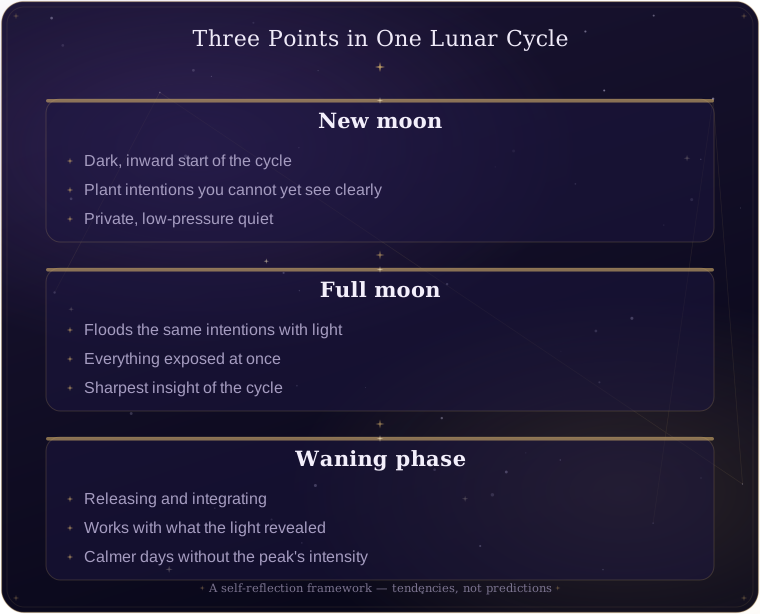
The new moon is the dark, inward start of the cycle — the time for planting intentions you cannot yet see clearly. The full moon works in the opposite direction: it floods those same intentions with light so you can finally judge how they are doing. To get that clarity, you sacrifice the private, low-pressure quiet of the new moon, because at the peak everything is exposed at once. This is the core reason the two halves of the cycle call for different practices: the new moon rewards quiet intention-setting, while the full moon rewards honest review and release. If you want to act on that difference, the practical split is to use new moon journal prompts to plant and full moon journal prompts to take stock two weeks later.
Full Moon vs Eclipse Energy
An eclipse is an intensified, higher-stakes version of a lunation that can push change along a six-to-twelve-month timeline. A regular full moon is gentler and dependable, arriving every month like clockwork. Choosing the steady monthly rhythm over eclipse intensity gets you a reliable check-in, but you lose the forced momentum an eclipse can deliver. A useful rule of thumb: treat ordinary full moons as monthly housekeeping and eclipses as the moments the housekeeping suddenly has consequences.
Full Moon vs the Waning Phase
Once the peak passes, the waning moon is about releasing and integrating what the light revealed. The full moon itself holds clarity and emotional charge in the very same moment. Leaning into the peak gets you the sharpest insight of the cycle, but the cost is the intensity that the calmer waning days simply do not carry — which is exactly why so much release work is best started at the full moon and finished in the days that follow.
Full Moon Energy vs an Ordinary Mood Swing
An everyday mood swing has no predictable timing and tends to fade on its own. Full-moon reactivity often clusters around the same few days each month and echoes themes that began at the last new moon. Treating it as a cycle rather than random noise gets you a usable pattern, but you give up the easy excuse that it was "just a bad day." If your charged days reliably track the lunar calendar, that is information worth keeping — and it separates a genuine rhythm from a one-off bad night.
How to Read Full Moon Energy in Your Own Chart
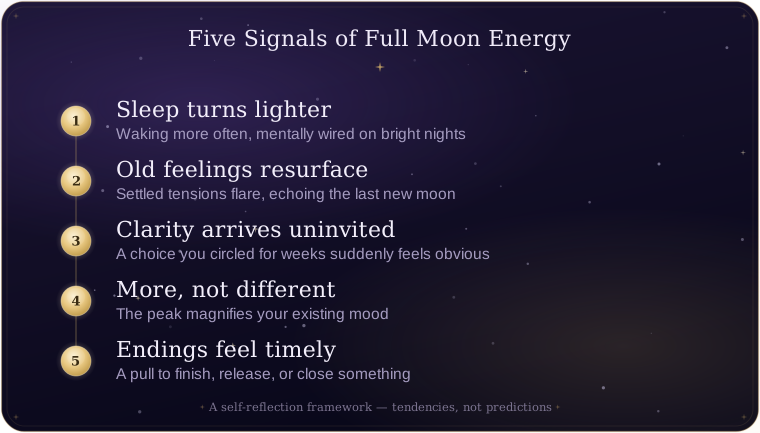
Reading this energy in yourself is mostly about tracking timing and intensity, not hunting for dramatic omens. The clues are usually small and repeatable, so it helps to watch for the same handful of signals around the nights the moon looks full and bright:
- Sleep turns lighter. You may notice you wake more often or feel mentally wired on the brightest nights of the month.
- Old feelings resurface. Tensions you thought were settled can flare again, often the same themes that stirred at the last new moon.
- Clarity arrives uninvited. A choice you have circled for weeks can suddenly feel obvious, sometimes with more charge than the moment calls for.
- You feel "more," not different. The peak tends to magnify your existing mood rather than hand you a brand-new one.
- Endings feel timely. You might find yourself wanting to finish, release, or close something you had been carrying for a while.
Finding Which House the Full Moon Activates
The signals above tell you the energy is present; your chart tells you where it is landing. Every full moon falls in a particular sign, and that sign occupies a specific house in your birth chart — and the house is the part of life that gets "lit up" that week. A full moon in your fourth house tends to surface home, family, and emotional roots; the same full moon in your tenth house pulls toward career, reputation, and public results. If you do not know your houses yet, the fastest way in is to generate your birth chart and note which house the current full moon sign occupies. From there, the vague sense of "everything feels loud" resolves into a single area: the one this month's peak is asking you to look at honestly. Tracking which house each month's full moon hits, over a year, gives you a quiet map of where your attention keeps returning — which is the kind of pattern a moon journal is built to capture.
When the Full Moon Aspects Your Natal Planets
A full moon feels sharper than usual when it lands close to one of your natal planets. The Moon and Sun at the peak form an opposition across the sky, and if that axis touches a planet in your chart — within a few degrees — the effect concentrates. A full moon contacting your natal Venus can bring a relationship or a question of worth to a head; one touching your natal Mars can raise the temperature on anger, drive, or a decision about action; one near your natal Mercury tends to make a conversation or a piece of writing demand resolution. The contacts that feel most intense are the conjunction (the full moon sitting directly on your planet) and the opposition (the full moon sitting directly across from it). You do not need to calculate this to use it — simply notice which area of life feels disproportionately charged, and you are usually reading the aspect after the fact. People who feel lunar peaks unusually strongly often have a prominent natal Moon, a theme explored further in the relationship between your rising sign and your moon.
Full Moon by Zodiac Sign — What Each Axis Amplifies
Because a full moon always sits opposite the Sun, it activates a polarity, not a single sign. Each of the six axes amplifies a particular tension:
- Aries–Libra full moons sharpen the pull between self and other — independence versus partnership, your needs versus keeping the peace.
- Taurus–Scorpio full moons bring up security versus intimacy: what you own and value against what you share, merge, or risk.
- Gemini–Sagittarius full moons heighten the contrast between information and meaning — the scattered details versus the bigger story they add up to.
- Cancer–Capricorn full moons surface the tension between emotional foundation and public structure: home life against career and responsibility. (The June 2026 full moon falls on exactly this axis.)
- Leo–Aquarius full moons raise the question of personal recognition versus collective contribution — being seen as an individual against belonging to something larger. (The July 2026 full moon lands here.)
- Virgo–Pisces full moons amplify the difference between practical refinement and surrender — fixing the details against letting the bigger flow carry you.
Knowing the axis tells you the theme before the night arrives; knowing the house (above) tells you where it lands in your life.
Full Moons, Sleep, and Dreams
One of the most commonly reported full moon effects is disrupted sleep — lighter rest, more frequent waking, and unusually vivid or memorable dreams. Some sleep studies have observed slightly reduced sleep duration and altered sleep architecture around the full moon, though researchers are careful to note the findings are mixed and the causes unclear. Whether the effect is the extra ambient light, a heightened nervous system, or simply expectation, the practical move is the same: treat the brightest nights of the month as a likely window for restless sleep, keep the bedroom genuinely dark, and keep a notebook within reach. Dreams around the full moon often carry the same theme the peak is amplifying in waking life, which makes them worth recording rather than dismissing.
Common Misreadings
Most popular write-ups get this slightly wrong in ways that feed the exact shame people are searching to escape. A few misreadings come up again and again:
- Misreading: the moon "makes" you emotional. In reality, the timing coincides with a spike in feeling, but the emotional content was already yours and already building beneath the surface.
- Misreading: feeling reactive means you are unstable. A repeating monthly rhythm is closer to a pattern than a flaw, and noticing it is a mark of self-awareness rather than evidence against it.
- Misreading: it is only chaos to endure. The same light that raises the charge is what lets you see clearly, so the full moon is as much a clarity window as a stress test.
- Misreading: full moon energy affects everyone identically. People differ widely — some barely register the peak while others feel it sharply — and both responses are completely normal.
The Full Moon at a Glance
| Property | How It Works | Energy Center | How to Observe |
|---|---|---|---|
| Peak light | Maximum illumination in the 29.5-day cycle reflects built-up content back to you | The natal house and sign the full moon falls in | Notice which area of life feels suddenly "lit up" that week |
| Amplification | Raises the volume on whatever is already present, both clarity and charge | Your natal Moon and the points this month's full moon contacts | Track whether your mood spikes around the same dates each cycle |
| Culmination | Completes a cycle seeded at the new moon, bringing results to the surface | The chart point opposite where the new moon began | See what reaches a head or a decision near the full moon |
| Release | Starts the turn toward the waning, letting-go stretch of the cycle | Wherever the cycle is winding down in your chart | Watch for a pull to finish, hand off, or let something go |
Questions People Ask About the Full Moon
What does the full moon mean spiritually?
Spiritually, the full moon is often read as a point of culmination and clear seeing, the moment a cycle reaches its peak. Many traditions use it to reflect on what has come to light since the new moon and what is finally ready to be released.
Do full moons actually affect humans?
Secular framing treats reported full moon reactivity as coincidence rather than proven cause, and that is a fair scientific caution to keep. Used as a symbolic timing cue instead of a claim about biology, the pattern can still support genuine self-reflection.
What are some simple full moon ritual ideas?
Common practices include journaling about what came to a head this month, naming one thing you are ready to release, and revisiting the intentions you set at the new moon. The point is structured reflection on a regular rhythm, not a fixed or elaborate formula.
Why do I feel more emotional during a full moon?
The full moon lines up with the brightest part of the cycle, which many people experience as a surge in whatever they were already carrying. Noticing the timing tends to make that intensity easier to hold rather than more alarming.
Reflection Prompts
- Think back to a recent full moon week — which feeling got suddenly louder, and when had it first started building?
- Recall a decision that turned clear around a full moon; what had the brighter light finally let you admit?
- Name one thing you brought to an end last cycle — what did finishing it free up for you?
Related Reading
- What a full moon ritual really does — how to turn the peak charge described here into a structured release-and-reclamation practice.
- What to do on a full moon spiritually — concrete practices for working with this energy instead of being caught off guard by it.
- Full moon journal prompts — reflective questions timed to the completion-and-release phase you feel peaking here.
- Full moon June 2026 and full moon July 2026 — how this energy reads in two specific upcoming lunations.
- Moon journal — track full moon energy across all four phases so the monthly pattern becomes visible over time.
- Full moon (Wikipedia) — plain background on what is physically happening at the full moon.
Take Action
The full moon shows you what is peaking; your birth chart shows you where it lands. Generate your free birth chart to explore full moon energy, and you can see exactly which house each month's full moon lights up for you. Read together, they turn a vague monthly mood into a map of where your attention keeps returning — the first real step toward working with your own timing instead of being caught off guard by it.
Sources
- Dane Rudhyar — pioneered the person-centered reading of the lunation cycle, including the full moon as the phase of fullest illumination