
What Is Morocco World Cup 2026 Astrology?
Morocco World Cup 2026 Astrology is a way of reading the tournament through birth charts and national charts instead of form tables or betting odds. At its core, it treats astrological symbolism as an interpretive lens that maps players and teams onto chart patterns. The approach looks at three things together: a player's natal placements, a country's national chart, and the timing of major 2026 transits such as Jupiter's transit through Cancer during the mid-June group stage and on into Leo from June 30, spanning the full June–July 2026 tournament rather than any single week.
- Reads squads and fixtures as symbolic stories, not fixed outcomes
- Combines individual birth charts with each nation's founding chart
- Leans on transit timing rather than single-sign stereotypes
It is best understood as a storytelling and reflection tool. The framework does not claim to predict scorelines; it offers fans a structured way to talk about momentum, pressure, and personality. Think of it as a shared vocabulary for discussing a squad, not a forecast you can bet on. The aim is to give supporters something more considered to weigh than form alone. This page sits under the broader World Cup 2026 astrology prediction hub, which maps the wider topic.
Why It Matters for Self-Awareness
Understanding how astrology frames Morocco's run at the 2026 World Cup matters because the search results pull fans in several directions at once, and most can't tell which page answers their real question. The confusion shows up in a few ways:
- Definitions blur with tools. Some pages explain the idea while others push chart generators, so newcomers can't separate the concept from a product.
- Broad advice crowds the topic. General horoscope columns rank for the same terms, burying anything specific to the tournament.
- Adjacent topics get blended. Football astrology, national charts, and 2026 transit pages all overlap, which leaves readers unsure where one ends and the next begins.
Self-awareness enters when fans use the framework to notice their own assumptions — why they expect a favourite to advance, or why they read steadiness into a captain's chart when a recent run of results is really doing the talking. The point is reflection, not certainty. Naming that gap — between what a chart hints at and what the table already shows — is where the practical value sits. Used this way, the framework works like a mirror, turning a fan's quick judgements into something they can actually examine.
Morocco World Cup 2026 Astrology vs General Football Astrology: What Actually Differs
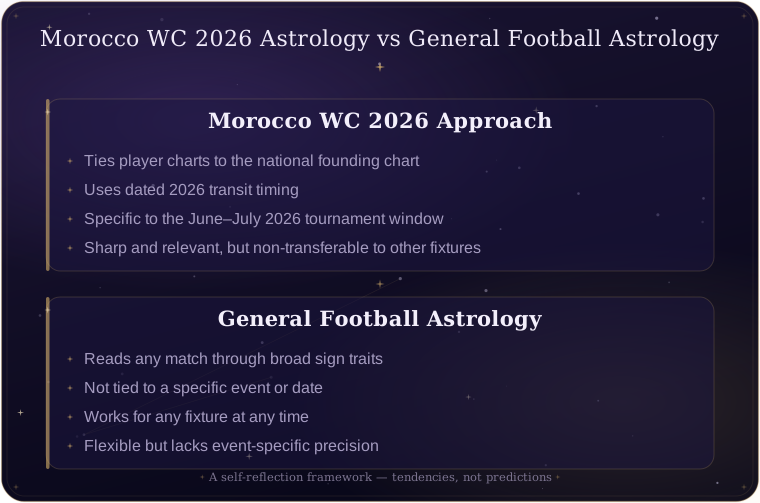
This Morocco World Cup reading differs from general football astrology mainly in scope and timing. General football astrology reads any match or club through broad sign traits — a fire-sign striker plays aggressively, and so on. How it works is straightforward pattern-matching from a single chart factor. The way the tournament framework functions is narrower: it ties player charts to a specific national chart and to dated 2026 transits, so the reading only holds for this event window. This event-focused approach draws on the mundane-astrology tradition that figures like Robert Hand helped formalise, and on the cyclic-timing reading Dane Rudhyar popularised, both of which treat charts as descriptive rather than predictive. It also overlaps with the wider field covered in best soccer players by zodiac sign.
That focus creates a clear trade-off. To get the precision of event-specific timing, you sacrifice the all-purpose flexibility of general football astrology — the tournament reading is sharp for June and July 2026 but useless for a random league game in 2028. General football astrology gives you something to say about any fixture; the cost is that it rarely says anything pointed about why this squad, this summer. Choosing the dated approach over the evergreen one gets you relevance, but you lose reusability. A reading of Morocco's run, for example, leans on the country's national chart plus who in the squad has live 2026 transits — a frame that simply doesn't transfer to a friendly two years later. The pay-off is sharper relevance: a dated reading can speak directly to why a particular side feels heavy or buoyant going into one tournament.
How to Read the Astrology Behind a 2026 Squad
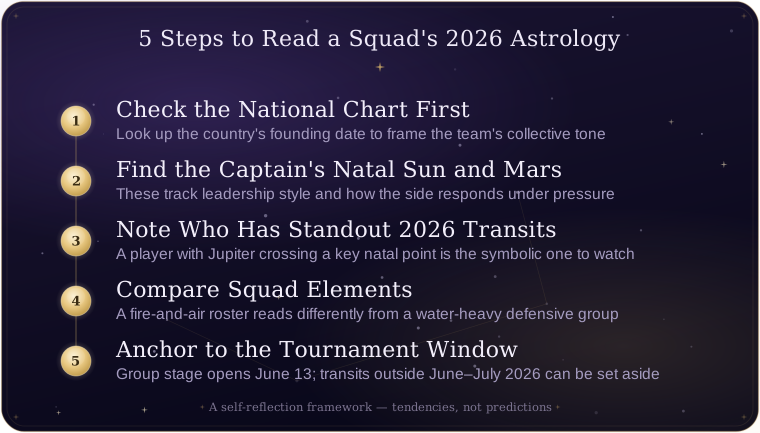
Putting the astrology of Morocco's 2026 World Cup run into practice means looking at a few observable signals rather than one headline sign. Start with these:
- Check the national chart first. Look up a country's founding date to frame the team's collective tone before weighing any single player.
- Find the captain's natal Sun and Mars. These often track leadership style and how a side tends to respond under pressure.
- Note who has standout 2026 transits. A player with Jupiter crossing a key natal point is the symbolic one to watch during the window.
- Compare squad elements. A roster stacked with fire and air placements reads differently from a water-heavy, defensive group.
- Anchor everything to the tournament window. The tournament window — Morocco's group stage opens June 13 and the event runs into July 2026 — is what matters; transits that fall outside it can be set aside.
Taken together, these signals sketch a tone rather than a result. If most of them point the same way, the symbolic read is simply more coherent — not more certain.
Common Misreadings
Most casual coverage gets a few things wrong about the framework. These are the recurring misreadings worth correcting:
- Misreading: a sign guarantees a result. Reality: charts describe tendencies and pressure points, not scorelines, and a so-called "lucky" placement never overrides what happens on the pitch.
- Misreading: only the star player's chart matters. Reality: the national chart and the wider squad usually carry more of the story than one name.
- Misreading: any horoscope app covers it. Reality: generic daily horoscopes ignore national charts and dated 2026 transits entirely.
- Misreading: the framework competes with tactics or stats. Reality: it sits beside them as a symbolic layer, and it tends to fall apart the moment anyone treats it as a forecasting engine.
Morocco World Cup 2026 Astrology at a Glance
| Property | How It Works | Energy Center | How to Observe |
|---|---|---|---|
| National chart | Frames a team's collective tone | Country's founding chart | Look up the nation's founding date and Sun sign |
| Player birth chart | Maps individual style onto symbolism | Natal Sun, Moon, Mars | Compare a captain's placements to their playing role |
| 2026 transits | Times symbolic peaks for the event | Jupiter moving from Cancer into Leo, June–July 2026 | Note which starters have transits hitting natal points |
| Squad elements | Balances fire, earth, air, water | Dominant element across the roster | Tally how many starters share an element |
Questions Fans Ask About Morocco World Cup 2026 Astrology
What does morocco world cup 2026 astrology actually predict?
It does not predict scorelines or winners. The framework offers a symbolic way to discuss momentum, pressure, and personality across teams and players.
Do I need a player's exact birth time?
A birth date alone supports a general reading of the Sun and sign placements. An exact time sharpens it by fixing the Moon and the houses, but most public charts still work without one.
Why does Jupiter's 2026 sign change come up so often?
According to NASA, Jupiter takes about 12 years to orbit the Sun, so it spends close to a year in each sign. Analysts use its 2026 position as a shared timing marker rather than as a cause of any result.
Is this the same as a daily football horoscope?
No. Daily horoscopes use broad sign traits, while this approach ties charts to national founding charts and dated transits.
Can it tell me who will win the tournament?
No. Treating it as a forecasting tool is the quickest way to misuse it. The framework maps tone and timing onto a squad, but the result still turns on tactics, fitness, and luck — none of which a chart controls.
Reflection Prompts
- Think of a recent match you were sure a team would win — what shaped that certainty before kickoff, beyond the stats?
- Recall a player you read as a natural leader; which traits, not numbers, built that impression?
- Notice the last time you mixed a horoscope app's advice with a real fixture — what got blended that shouldn't have?
Related Reading
- June 2026 World Cup astrology calendar — covers the transit timing this framework leans on.
- Argentina World Cup 2026 astrology — explains the country charts behind each team read.
- astrology terms glossary — background for comparing squad elements across a roster.
- 2026 FIFA World Cup (Wikipedia) — neutral reference for dates, hosts, and format.
Take Action
Want to see how your own chart fits the tournament picture? Generate your free birth chart to explore the 2026 World Cup through astrology and get a full map of your placements in minutes. Seeing your own patterns laid out makes it easier to read any chart — a squad's or your own — with a clearer, less superstitious eye.
This is not a clinical interpretation or mental health advice.
Sources
- Robert Hand — known for formalising modern approaches to mundane and event astrology
- Dane Rudhyar — pioneered the person-centered reading of astrological cycles and timing