
What Are New Moon Journal Prompts?
New moon journal prompts are structured questions for setting specific, assessable intentions at the lunar cycle's start.
- Timed to the new moon phase, when the sky is dark and a fresh cycle begins
- Designed for planting intentions, not releasing what is past — release belongs to the full moon two weeks later
- Most effective when the answers are concrete enough to honestly revisit at the corresponding full moon
This is the forward-facing half of lunar journaling. Its counterpart is the set of full moon journal prompts, which handle the backward-facing work of review and release two weeks later — and keeping the two distinct is exactly the point. The term here covers everything from a single question to a full structured entry, but what separates a useful set from an unhelpful one is whether the answers are specific enough to assess later. Most available resources skip that test, mixing full moon release language — "release what no longer serves you" — directly into new moon sets. That bidirectional phase confusion means most new moon journal prompts produce entries that feel meaningful in the moment but cannot be honestly evaluated when the full moon arrives.
Why It Matters for Self-Awareness
New moon journal prompts matter for self-awareness because they create a feedback loop, not just a ritual. A journaler who writes "I intend to feel more at peace" on the new moon has no meaningful way to measure whether that happened by the full moon. The aspiration is real, the writing is real — but the entry produces no anchor, nothing to honestly confirm or deny two weeks later.
The confusion found in most published prompt resources compounds the problem in three specific ways:
- Aspirational vagueness. Questions like "What do you want to call in?" invite entries about abundant feelings and expanded creativity — states that cannot be assessed. The full moon arrives and there is no honest answer to "did this happen?"
- Phase confusion. When release-oriented prompts ("What am I ready to let go of?") appear in new moon sets, the journaler is doing full moon work at the wrong time. The cycle's internal logic breaks before it has begun, compounding vagueness with misdirected focus.
- No behavioral anchor. Without a question that asks for one concrete action within 48 hours, even a well-framed intention stays abstract. Nothing moves from the page into the world.
Understanding which of these three patterns is active in a given entry is the first step toward building a new moon practice that produces usable information over time. Each failure produces the same result: a beautifully written entry that closes no loop and teaches the journaler nothing about their own follow-through.
New Moon Prompts vs Gratitude, Manifestation, and Freewriting
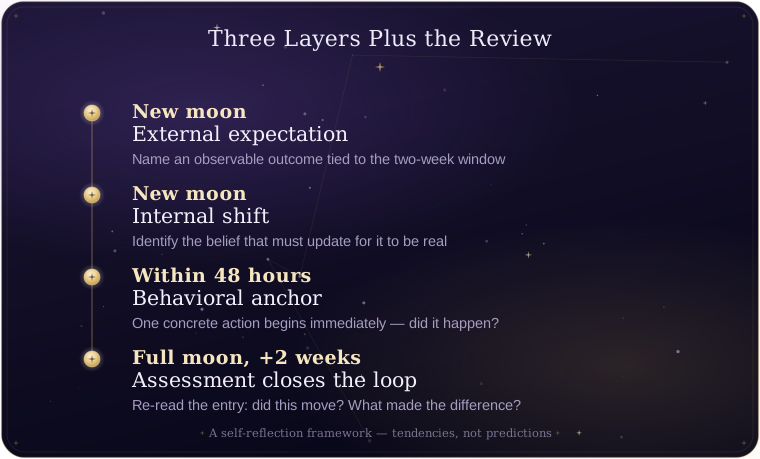
This practice is frequently grouped with general journaling, gratitude writing, and manifestation scripting — but how each one functions differs in ways that affect what a practitioner actually gets. What separates new moon journal prompts from looser approaches is a three-layer structure: an observable external expectation (something you can confirm or deny at the full moon), an internal shift (the belief that must change for the intention to be genuine), and a behavioral anchor (one concrete action within 48 hours). This structure, rooted in the tradition practitioners like Bernadette Brady helped establish, treats the lunar phase as a specific functional window — not a mood descriptor.
Each adjacent practice makes a different trade:
- Gratitude journaling. Reviews what already exists and builds a sense of arrival in the present. Effective for recognizing what is working — but does not ask the journaler to project forward, commit to an action, or create a testable reckoning two weeks later.
- Manifestation scripting. Immerses the writer in the felt sense of an outcome to activate emotional investment. The cost is the layer-by-layer specificity that makes a new moon entry closeable at the full moon.
- General freewriting. Captures mood and process in real time — useful for emotional clarity, but generates no structure for cycle-based self-tracking.
Mixing these approaches — as most published moon-prompt collections do — produces entries that are neither usable for assessment nor satisfying as pure expression.
How to Tell a New Moon Entry Is Working
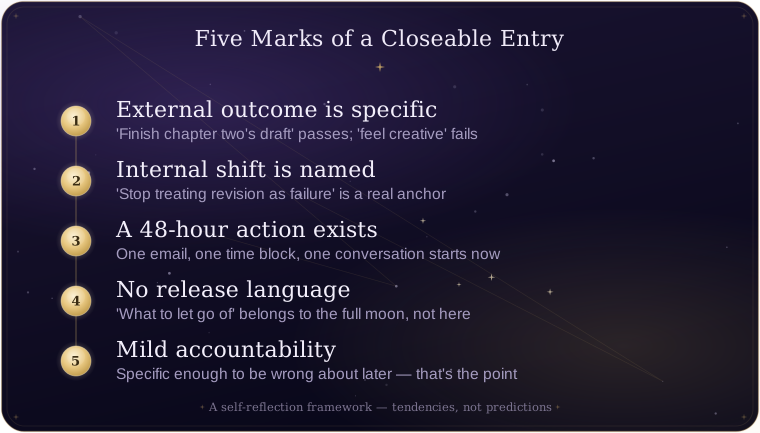
The clearest sign that a prompt set is doing its job at the new moon level is whether the entry produces something you can honestly revisit at the full moon. Here are five observable signals:
- The external outcome is specific. "Finish the first draft of chapter two" passes the test. "Feel more creative" does not — there is no point at which you can confirm it happened.
- An internal shift is named. A functional entry identifies the belief that would need to change: "Stop treating revision as failure" is a real anchor. "Be more open" is not, because it describes no actual change in how you operate.
- There is a 48-hour action. The entry includes something that can begin immediately — a single email sent, a time block scheduled, one conversation started. This action is the proof that the intention is real rather than aspirational.
- Release language is absent. If a prompt asks "What are you ready to let go of?" it has crossed into full moon territory. Correctly structured prompts at the new moon phase do not ask for release.
- You feel mild accountability. The slight discomfort of having written something specific enough to be wrong about later is a reliable signal that the prompts are doing their job. If an entry only feels inspiring, it is likely too vague to close.
Common Misreadings
Several misreadings are widespread in new moon journaling content. Each produces the same outcome: a meaningful-feeling entry that generates no useful information about the journaler's actual follow-through.
- "Release prompts belong in new moon sets." Multiple top-ranking resources include "release what no longer serves you" as a core new moon prompt — which is a full moon function. The full moon is the phase of completion and illumination; the new moon is the phase of planting. Mixing them scrambles the cycle before it starts. New moon journal prompts built correctly do not include release language.
- "Vague intentions are safer." Generic prompts feel kind because they cannot be wrong. But "I intend to thrive" cannot be honestly assessed at the full moon, which means the cycle never closes. Specificity is not harsh — it is what makes the practice worth returning to.
- "Manifestation and new moon journaling are the same thing." Manifestation scripting activates emotional investment; intention-setting activates behavioral accountability. A manifestation script describes a desired state; a structured new moon entry should produce a claim you can confirm or deny.
- "Any reflective question counts." Reflection and intention-setting are distinct. A reflective question asks where you are now; an intention-setting prompt asks what specifically will be different by the next full moon and what action begins that shift today.
New Moon Prompts at a Glance
| Prompt Layer | How It Works | Timing Window | How to Observe |
|---|---|---|---|
| External expectation | Names an observable outcome tied to the two-week lunar window | Set at the new moon, before the cycle builds | Re-read at the full moon: can you honestly confirm or deny it? |
| Internal shift | Identifies the belief or self-story that must update for the intention to be real | Set at the new moon alongside the outcome | Notice at the first quarter whether the old belief surfaces in your behavior |
| Behavioral anchor | Requires one concrete action within 48 hours of the new moon entry | New moon — immediately operational | Check at 48 hours: did the action happen or did you avoid it? |
| Full moon assessment | Closes the loop — honest review of what was planted | Full moon, two weeks after the new moon entry | Read the original entry and answer: did this move? What made the difference? |
Questions About New Moon Journaling
What distinguishes these prompts from general journaling questions?
A new moon journaling prompt is timed to the start of a lunar cycle and structured to produce an assessable claim — something you can honestly confirm or deny at the full moon two weeks later. A general journaling question captures mood or reflection without requiring a testable outcome, making it useful for a different purpose but not for cycle-based self-tracking.
How many prompts should a new moon session include?
Three to five prompts is the functional range — more than five tends to produce shallower answers per question, which works against the three-layer structure (external expectation, internal shift, behavioral anchor) that makes an entry worth revisiting. One well-layered entry outperforms six vague ones.
Can these prompts be used outside of any astrological practice?
Yes. The lunar cycle provides a natural two-week rhythm for setting and then honestly assessing an intention, and that structure works as a self-tracking tool regardless of whether you hold any astrological beliefs. The moon's phase is a timing framework, not a metaphysical requirement.
Why do so many published new moon prompts include release language?
Because content is often drawn from general moon-cycle libraries without distinguishing phase function — and release is a full moon theme. When it appears in new moon sets, it reflects the same bidirectional phase confusion that makes most new moon journal prompts difficult to honestly assess at the full moon two weeks later.
Reflection Prompts
- Think back to one new moon intention you wrote — what single detail would have made it honestly assessable by the full moon?
- Name one belief you currently hold that would need to change for your next new moon intention to be real rather than aspirational.
- What one action, completable within 48 hours, would prove your next new moon intention has actually begun?
Related Reading
- Full moon journal prompts — the counterpart practice for the other half of the cycle: where the new moon set plants an intention, the full moon journal prompts two weeks later take honest stock of what grew and name what to release.
- Moon journal — the four-phase practice these new moon prompts fit inside, from new moon intention through full moon evaluation to waning release.
- Full moon energy — what the peak this entry is later assessed against actually feels like and how to read it.
Take Action
Generate your free birth chart to see which house each new moon activates in your natal chart. That house points to the specific area of life — career, relationships, creative work, financial stability — where your intentions are most likely to find traction in a given cycle. Knowing which house is activated turns a general lunar journaling ritual into a chart-informed conversation with the part of your life that is genuinely ready to move.
Sources
- Bernadette Brady — developed the predictive framework for reading eclipse cycles as intensified new and full moon events, foundational for understanding the new moon phase as a specific functional window in the lunar cycle