
What Are Full Moon Journal Prompts?
Full moon journal prompts are reflective questions timed to the full moon's completion and release phase. Rather than calling in new intentions, they ask what a lunar cycle produced, what reached its natural peak, and what can be consciously closed. They are the counterpart to new moon journal prompts: the new moon set plants intentions, and the full moon set, two weeks later, takes honest stock of what grew and names what to let go.
If you came here for the prompts themselves, skip ahead to the full list of full moon journal prompts — there are 25 below, grouped by release, gratitude, relationships, and your birth chart. The short version of how to use them: choose three or four that match where you are this cycle, write for 15 to 30 minutes within a day or two of the full moon, and let each answer point backward at what happened rather than forward at what you want next.
- Draw attention to what has arrived or peaked since the preceding new moon — not what is desired next
- Ask for honest accounting of whether the intentions set two weeks earlier actually produced anything concrete
- Prompt a named, deliberate release of what no longer fits this cycle's continuation
Traditional lunar practice — including the progressed lunation frameworks Bernadette Brady systematized — treats the full moon as the cycle's midpoint illumination: whatever was seeded at the new moon has grown to full visibility, and what no longer serves rises to be named. The phase sits roughly two weeks after the new moon, making it the natural moment for assessment and completion, not initiation.
25 Full Moon Journal Prompts by Theme
Here is the working list. Each group does a different part of the full moon's job — naming what to release, recognizing what grew, taking honest stock of relationships, and locating the cycle in your chart. You do not need all 25 in one sitting; pick three or four that match this cycle and answer them slowly.
Prompts for Release and Letting Go
- What am I still carrying from this cycle that I am ready to set down for good?
- What expectation did I hold two weeks ago that turned out to be wrong, and what would it mean to release it without blame?
- Where have I been forcing something that has clearly run its course?
- What story about myself did this cycle finally disprove?
- If I could put down one resentment tonight, which one would lighten the most?
- What habit served an old version of me but no longer fits the direction I am heading?
- What am I afraid to release because I am not sure who I am without it?
Prompts for Recognizing What Grew
- Looking back at the past two weeks, what actually arrived that I had hoped for?
- What effort of mine produced a real result this cycle, even a small one?
- What did I learn about my own follow-through since the last new moon?
- Where did I surprise myself this cycle?
- What am I genuinely grateful for right now that did not exist a month ago?
- Which quiet, unglamorous thing did I do consistently that is starting to add up?
- What reached its full, natural peak this cycle — and how do I want to honor it before it passes?
Prompts for Relationships and Connection
- Which relationship came into clearer focus this cycle, for better or worse?
- Is there a conversation I have been postponing that the full moon's clarity is asking me to have?
- Where did I give more than felt sustainable, and what boundary is ready to be named?
- Who supported a cycle of mine in closing well, and have I acknowledged them?
- What pattern in how I relate to others showed up again this month?
- What am I ready to forgive — in someone else or in myself — so I can close this chapter cleanly?
Prompts for Your Birth Chart and This Moon
- Which house is this month's full moon activating in my chart, and what area of life does that point to? (If you are not sure, generate your birth chart to find the house.)
- How does the sign of this full moon — and the polarity it sits on — describe the tension I have been feeling?
- Does this full moon contact any of my natal planets closely, and if so, what does that planet govern in my life?
- Reading my natal Moon, where do I most naturally process emotion — and is this cycle asking me to use that strength or stretch beyond it?
- Set against the intention I planted at the last new moon, what does this full moon reveal about whether it took root?
For more context on why the full moon, specifically, amplifies all of this, see full moon energy; for the wider set of evening practices these prompts fit inside, see what to do on a full moon spiritually.
Why It Matters for Self-Awareness
The core problem with most circulating full moon journal prompts is that they invert the phase's function entirely. A search for full moon journaling resources returns pages that frame the full moon as "a time for new beginnings" and "manifesting your goals" — language that belongs to the new moon, applied wholesale to a culmination event. Journalers following those prompts set fresh intentions at the exact moment the cycle calls for honest assessment, and the disconnect compounds over time.
The confusion shows up in predictable patterns:
- The wrong direction. Manifestation prompts ask writers to look forward and call things in. Full moon energy moves in the opposite direction — toward what already exists, what has arrived, and what has run its natural course.
- Completion deferred. When release isn't named at the full moon, it gets postponed to the next cycle, which then starts loaded with unfinished threads. The journal becomes a running list of additions with no closures.
- The blank page problem. Journalers who sit down at the full moon with goal-setting prompts often find they have nothing new to write — because what the moment calls for is looking back, not forward. The page stays blank, and the phase feels like it isn't working.
- Cycle accumulation. Over months, unresolved patterns from past cycles layer underneath current intentions, making each new moon feel heavier than the last without any clear explanation why.
Understanding full moon journal prompts as a completion tool changes what makes it into your journal — and what finally gets left behind.
Full Moon vs New Moon and Gratitude Journaling — How They Differ
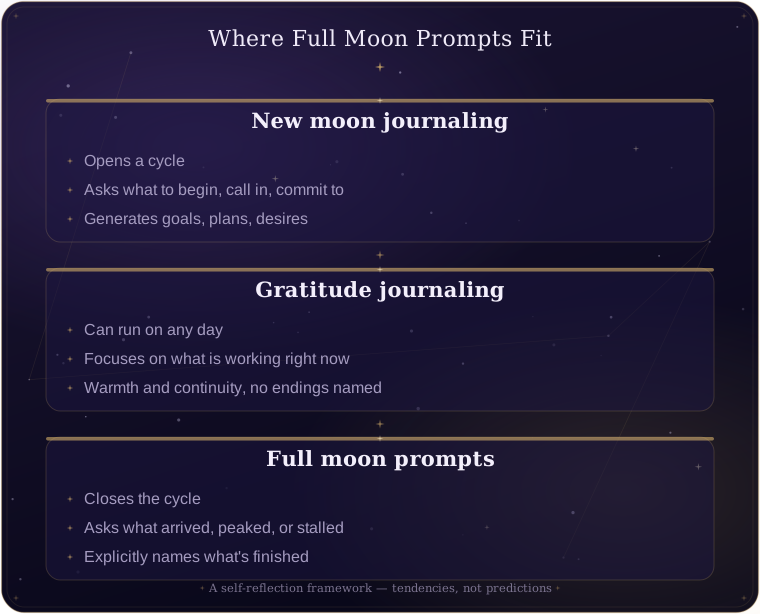
Full moon journal prompts function by constraining reflection to a specific window — the two weeks since the new moon — and asking what that window produced, what peaked, and what can be consciously closed. Three adjacent practices sharpen what makes this tool distinct:
- vs new moon journaling. New moon prompts open a cycle: they ask what to begin, call in, or commit to. Full moon prompts close one. The way it works at the full moon is that accumulation has reached its peak — what started has either arrived or stalled, and both outcomes deserve naming. To stay in new-moon mode at the full moon is to keep adding without ever taking stock. The cost: cycles compound rather than complete, and the intention list grows longer than any single month can resolve.
- vs gratitude journaling. Gratitude practices can run on any day and focus on what is working right now. Full moon reflection includes appreciation but doesn't stop there — it specifically targets what has peaked and what can be released. To use gratitude-only prompts at the full moon is to circle the feeling without making a deliberate choice about what ends. The trade-off: gratitude gives warmth and continuity; you lose the clarity that only comes from explicitly naming what's finished.
- vs open reflective writing. Unstructured journaling follows wherever attention leads. Full moon reflection prompts constrain that flow to the cycle: what was seeded, what grew, what peaked, and what can go. The trade-off is structure over spontaneity — but at the full moon, unanchored writing tends to loop without landing. The new moon journal prompts cover the initiating side of the lunation cycle; full moon prompts close the loop by asking what that initiation actually produced.
How to Tell the Prompts Are Working
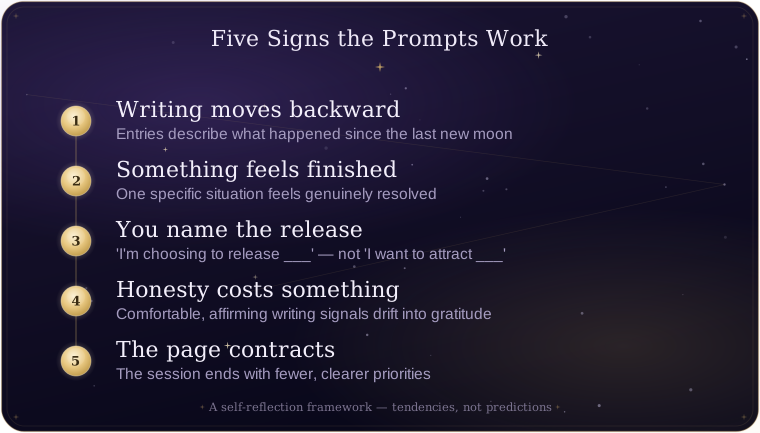
Recognizing whether a full moon journaling practice is working comes down to what you find yourself writing. Five observable signals:
- Writing moves backward, not forward. If responses naturally describe what happened since the last new moon — not what you want next — the prompts are pulling in the right direction.
- Something feels finished. These sessions tend to surface a clear sense of completion around one specific situation. If one thing feels genuinely resolved when you close the journal, the phase is functioning correctly.
- You name what you're releasing. A prompt answered with "I'm choosing to release ___" is being used correctly. If the blank fills with "I want to attract ___," the prompt has been redirected toward new moon territory.
- Honesty costs something. Completion reflection requires accurate assessment of what worked and what didn't. If the writing feels comfortable and affirming throughout, the session may have drifted into gratitude rather than reckoning.
- The page contracts. New moon energy generates more — goals, plans, desires. Full moon energy moves toward what actually matters. A session that ends with fewer, clearer priorities is working as it should.
Common Misreadings
The most widespread errors in full moon journaling trace back to one root inversion: applying the new moon's generative mechanics to a culmination event. Four common misreadings:
- "The full moon is for setting new intentions." This is the core confusion. The full moon journal prompts circulating at the top of most search results explicitly frame the phase as "a time to manifest goals" and "set fresh intentions." That's not a minor framing difference — it's a complete phase swap. The new moon initiates; the full moon reveals. Setting new intentions at the full moon skips the accounting that makes the next new moon's intentions coherent.
- "Manifestation prompts work on any moon phase." Visualization and attraction-based prompts ask you to feel a desired outcome as already real. That's specifically a new moon function — calling something in. At the full moon, what matters is what actually arrived and what didn't, not what to add to the queue.
- "If I don't feel emotional, the practice isn't working." The full moon is traditionally associated with heightened feeling, and some resources suggest the practice is only valid when the writer feels intensely moved. In practice, many full moon sessions produce quiet, unemotional clarity — a calm recognition that something is done. The goal is honest assessment, not emotional performance.
- "Release means letting go of negative things only." Release at the full moon can include ending goals that no longer fit, stopping habits you genuinely tried but that don't serve you, or completing expectations you set at the new moon that turned out to be wrong. It's a broader accounting than clearing bad feelings — it includes conscious completion of anything that reached its natural limit, positive or otherwise.
Full Moon Journaling Quick Reference
| Property | How It Works | Phase Timing | How to Observe |
|---|---|---|---|
| Completion function | Surfaces what reached its natural end in the cycle — not what is newly desired | Full moon, roughly 2 weeks after the new moon | Writing describes what already happened, not what is hoped for next |
| Release practice | Names what requires deliberate ending — a goal, a habit, an expectation | Within a day or two of peak illumination | Session ends with at least one specific thing explicitly named as done |
| New moon accounting | Checks whether intentions from two weeks earlier produced anything concrete | Anchored to the prior new moon's stated intention | Prompt asks "what did I set in motion, and what actually arrived?" |
| Honest assessment | Asks what worked and what fell short without softening either answer | Full moon as the symbolic reflective midpoint | Discomfort in writing is a useful signal — not a failure mode |
Full Moon Journaling FAQ
What makes full moon journal prompts different from regular journal prompts?
Full moon journal prompts are phase-specific: they activate the culmination and release function of that moon phase, not open-ended reflection. A general prompt can be used any time; these are anchored to the two-week window since the new moon and ask for an honest close on that cycle.
Can I use these prompts if I don't track the lunar calendar?
You can adapt them to any natural endpoint — end of week, end of month, any completed project window. The prompts work because they target completion, not because of the moon specifically. Using them within a day or two of the actual full moon aligns the practice with the phase's traditional energy, which many practitioners find adds useful context.
How long should a full moon journaling session run?
Most practitioners keep it to 15–30 minutes. The goal is honest assessment, not exhaustive writing. If you haven't found what you're releasing by the 30-minute mark, the session may have drifted into new moon territory — generating instead of closing.
What if I didn't set intentions at the new moon?
The prompts still work without a prior new moon record. They apply equally well to any open cycle — an unresolved situation, an ongoing project, a pattern that has been running. The phase supports honest accounting regardless of whether a specific intention was logged two weeks earlier.
Should I write before or after the full moon?
Either works, and many practitioners do a little of both. Writing on the night of the peak captures the charge while it is strongest; writing in the day or two after lets the clarity settle into something more usable. The traditional window is the three nights around the exact full moon. If you only journal once, the evening of the peak or the morning after are the two most common choices — pick whichever fits your sleep and schedule rather than forcing a specific minute.
Reflection Prompts
- Think back to what you said you wanted two weeks ago — what actually arrived, and what part of that are you choosing to carry forward?
- Name one thing you invested effort in this cycle that has reached its natural limit — what would it mean to stop here and call it complete?
- Recall a moment this month when something felt genuinely finished — what was present in that moment that you want to acknowledge before it passes?
Related Reading
- New moon journal prompts — the intention-setting counterpart; explains where manifestation prompts actually belong in the cycle and how they pair with the full moon's release function.
- Moon journal — maps each phase's distinct inner function and how the four written tasks build on one another across the month.
- Full moon energy — why the full moon amplifies what these prompts are designed to surface.
- What to do on a full moon spiritually — the wider set of evening practices these prompts fit inside.
- Lunar phase (Wikipedia)
Take Action
Generate your free birth chart to explore full moon journal prompts aligned with your natal chart. Your birth chart identifies which house the full moon illuminates each month — giving your completion and release practice a specific life area to anchor to. When you know which part of the chart is activated, the reflection stops being generic and starts pointing at something real.
Sources
- Bernadette Brady — foundational work on the progressed lunation cycle and the distinct psychological function the full moon phase carries relative to the new moon