What is Orange Aura?
Orange Aura is the energy field most commonly read as a warm, creative current tied to the sacral center. In plain terms, it points to someone who runs on emotional flow, pleasure, and easy connection with other people rather than cool logic or quiet restraint. The full orange aura meaning shifts with shade: a bright, clear orange reads as creative drive and social warmth, a muddy or darkened orange tends to signal depletion or guilt about enjoying yourself, and an amber, gold-tinged orange reads as steadier, more mature creativity. In the chakra framework Anodea Judith helped systematize, this color maps to Svadhisthana, the center of creativity and relating. Treat it less as a fixed label and more as a snapshot of how your creative and relational energy is moving — one thread inside the broader pillar page on all aura colors, which maps every color's tone.
- Leads with creative and emotional flow more than logic or restraint
- Most often linked to the sacral center (Svadhisthana) in chakra-aura systems
- Easily flattened into a "libido" label when it is really about pleasure and openness
Why It Matters for Self-Awareness
Understanding orange aura meaning matters because the popular write-ups pull readers in two opposite directions at once, and most people genuinely can't tell which one describes them. The confusion tends to show up in a few specific ways:
- The two-camp split. One stack of articles says orange means you're overflowing with creativity and social spark; another says it means you're burned out from giving too much. Both can't be the headline, and nobody explains how to tell which one applies to you this week.
- The worry sitting underneath. A lot of searchers aren't actually confused about the color at all. They're warm, generous people who quietly suspect their giving has tipped into exhaustion, and they want to know whether a muddy orange just confirmed it.
- The label that stings. Artists, caretakers, and naturally affectionate people keep getting reduced to "sexual energy," so a rich, creative trait gets flattened into nothing more than appetite — which feels less like insight and more like a costume that doesn't fit.
In my years reading auras — eight of them now, following an earlier career in advertising and later somatic therapy training — the people who land on this color are rarely "too much." Far more often they're generous to the point of running dry, and the shade of orange, read the way the energy-field tradition Barbara Ann Brennan helped popularize treats it, is what separates a full tank from an empty one.
Orange Aura vs Adjacent Concepts: How It Works + Trade-offs
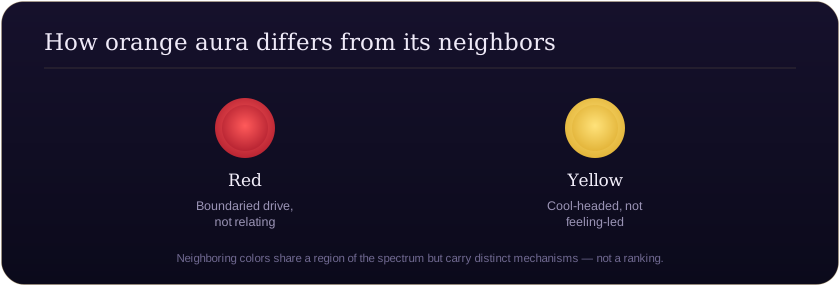
The clearest way to pin down orange aura meaning is to set this color beside the ones it gets confused with, since orange sits right between red and yellow on the warm end of the spectrum. Red aura runs on drive, grounding, and physical boundaries — the way it works is to push energy down and out, fueling action and protecting your edges. Orange softens that downward push into pleasure and relating; instead of holding a boundary, it keeps creative and emotional energy moving between you and the people around you. The trade-off is honest: to get orange's social warmth and flexibility, you give up some of red's hard edges, which is exactly why so many orange-leaning people struggle to say no. If you recognize more of that protective, boundaried energy in yourself, the comparison with the red aura entry is worth a look.
Against yellow aura
Yellow aura makes a useful contrast on the other side. Yellow leads with confidence, mental clarity, and a certain sunny detachment — it tends to process the world through the head and keep a little distance from the emotional weather. Orange leads with feeling and the body instead. The way it functions is to read the emotional temperature of a room and respond to it, often before anyone has said a word out loud. To get that relational openness and quick attunement, you sacrifice some of yellow's cool steadiness: orange feels everything that moves through a space, and that sensitivity is both its real gift and its hidden cost. Where a yellow type can shrug off a tense dinner and move on, an orange one tends to carry the whole evening home and replay it.
Vibrant, muddy, and amber orange
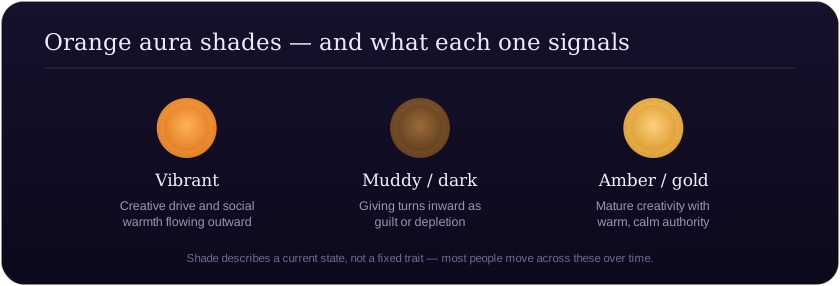
The harder comparison is orange measured against itself, because the very same color reads in three distinct ways depending on its shade. A vibrant, clear orange works like an open tap — creative ideas and social warmth pour out easily, and you rarely stop to wonder whether you have enough left to give. A muddy or darkened orange is that same energy running low: the giving continues out of habit, but it's shadowed by guilt and a quiet depletion, and rest starts to feel like something you have to earn rather than something you're allowed. Amber or gold-orange is the most settled of the three — creativity that no longer needs an audience to feel real, paired with a warm, steady kind of authority. None of these shades makes you a better or worse person than the others; each is a snapshot of where your energy happens to sit today, which is why treating any single shade as a permanent identity tends to do more harm than good.
How to Read Orange Aura in Yourself
You don't need a special photograph or a professional reader to catch orange in yourself — it tends to show up in ordinary moments. Watch for these signals:
- You think best while making something — cooking, sketching, rearranging a room — rather than while sitting still.
- Other people's moods land on you fast, and you adjust the room before anyone has to ask.
- Saying yes feels natural, while saying no leaves a small guilt you can't quite explain.
- After a generous stretch, the warmth dims and everything goes flat — your cue that orange has slid toward muddy.
- A second wind arrives the moment you create purely for pleasure, with no one to impress.
Common Misreadings
Most of the confusion around orange aura meaning comes from a handful of misreadings that get repeated across the internet. Here's what's actually going on:
- "Orange means high libido." Orange is about pleasure and creative flow in the widest sense — taste, art, connection, play — not a reading of your sex drive. Treating it as appetite is the shallow take, not a limit of the framework.
- "Muddy orange means you're broken." A darker, cloudier orange usually points to overgiving and guilt around rest, not damage of any kind. It describes a passing state, not a verdict on who you are.
- "All oranges are the same." Vibrant, muddy, and amber are three different signals, and using them interchangeably is exactly why so many readers feel mislabeled.
- "Your color is fixed." Aura color is read as a snapshot of a prevailing state, so the same person can show vibrant one month and muddy the next without anything being wrong.
Orange Aura at a Glance
| Shade | How It Works | Energy Center | How to Observe |
|---|---|---|---|
| Vibrant orange | Creative drive and social warmth flow outward freely | Sacral center (Svadhisthana) | You start projects easily and light up around people |
| Muddy / dark orange | Pleasure and giving turn inward as guilt or depletion | Sacral center, running low | You feel drained after generosity and resist resting |
| Amber / gold-orange | Mature creativity steadied by a warm, calm authority | Sacral center, balanced | You create and lead without needing applause |
Common Questions About Orange Aura
What does an orange aura mean spiritually?
In subtle-energy traditions, orange aura meaning centers on creative flow, pleasure, and an easy openness to other people, all mapped to the sacral center the chakra system calls Svadhisthana. It describes how your relational and creative energy is moving in this season of your life, not a fixed spiritual rank or a measure of your worth as a person.
Does an orange aura mean I'm a highly sexual person?
No — that flattening is the single most common stereotype this color gets saddled with. Orange points to pleasure and creativity in a broad sense, including art, taste, conversation, connection, and play, and reading it as raw libido misses nearly everything the color is genuinely describing.
What does a muddy or dark orange aura mean?
A muddy orange is usually read as overgiving paired with guilt around resting, rather than as a sign that something is fundamentally wrong with you. It tends to brighten again on its own once you create or enjoy something for its own sake, with no audience to perform for.
Can my aura shift between orange shades over time?
Most aura literature treats color as a snapshot of a prevailing state rather than a permanent trait. The same person can read vibrant one week and muddy the next, depending mostly on how rested or depleted they happen to be.
Reflection Prompts
- Think back to the last time you made something purely for pleasure — how did your energy feel before, and how did it feel after?
- Recall a recent moment when you said yes too quickly; what would saying no have protected?
- Notice when your warmth toward others last left you running on empty, and what it was that refilled you.
Related Reading
These pieces go deeper on threads this entry only touches:
- yellow aura entry — the confidence-led neighbor that gets mistaken for orange's warmth.
- sacral chakra explainer — the energy center this color is most often mapped onto.
- guide to aura color shades — how vibrant, muddy, and amber versions of one color read differently.
- Svadhishthana (Wikipedia)
Take Action
Explore the aura colors guide to see how your colors map and combine. It can help you tell whether your orange is running vibrant, muddy, or amber right now — and that one small distinction is often the difference between knowing you need to create again and knowing you simply need to rest before you give anything more.
Sources
- Judith, A. (1999). Wheels of Life. Llewellyn Publications.
- Brennan, B. A. (1988). Hands of Light. Bantam Books.