What are aura colors?
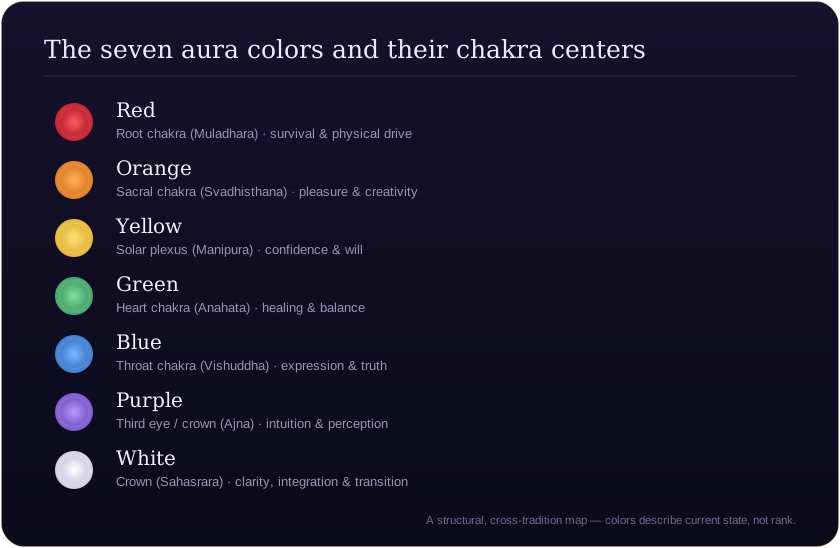
Aura colors are the color labels practitioners use to describe a person's prevailing energetic state within subtle-energy traditions. They are not a single thing — they are a family of seven main color categories (red, orange, yellow, green, blue, purple, and white) that together form an interpretive vocabulary. Each color maps to one of the seven main chakra centers, and the whole set is treated as a framework for self-reflection rather than a measurable physical signal. The aura colors meaning system gives readers a shared language for describing how someone's energy reads in a moment, without forcing every person into a single fixed label.
Why it matters for self-awareness
Most articles on aura colors meaning treat each color as a personality verdict — read one paragraph, get told you are "a green person," move on. That misses the actual question people bring to the search bar. Readers usually arrive with three friction points stacked on top of each other. First, they cannot tell if the framework has any internal consistency or if every site is just inventing vibes. Second, they have seen aura photos showing two or three colors at once, and the articles around them keep picking only one as the answer. Third, they have read three sites giving three different definitions of the same color, and they want to know which tradition to trust.
Vocabulary, not verdict
Looking at the entire family before any single color helps with all three. Once you see how the seven colors sit next to each other — red at the grounded end, purple at the inward end, white as integration — the individual readings stop feeling like horoscope labels and start feeling like positions on a spectrum. The aura colors meaning system was always meant to be read this way: as a vocabulary, not a verdict. A green reading does not say you "are green forever"; it says that at this moment, the relational, heart-centered tone is what shows up most. That reframing matters because it lets people use the language without surrendering their identity to it.
A structure for self-reflection
The framework also matters because it gives self-reflection a structure that pure feelings-talk cannot. When someone says "I have been feeling off," that sentence has nowhere to land. When the same person says "lately my yellow feels muddy and my blue keeps getting blocked," they are using a shared vocabulary to describe an internal state with more precision than mood words alone allow. That is the real value of the aura colors meaning family — it is a self-awareness scaffold, not a diagnostic tool.
There is also a social function worth naming. Friends, partners, and small communities use color language as a low-stakes way to discuss energetic dynamics without forcing each other into psychological labels. Saying "your green is doing a lot of work this week" lands differently than saying "you are burning out on caretaking." The first is observational and lets the person respond; the second feels like a verdict. The vocabulary works as a shared interface, not a stack of diagnoses, which is why people who grew up around it often keep using it long after they stop taking the metaphysical claims literally. The framework outlives its origin story because the language itself is useful.
Avoiding the identity trap
Finally, looking at the whole family first protects readers from the most common trap: walking into a single-color article, identifying with the description, and walking out with an identity. Single-entity pages are deeper, but they are also where the "I am a green person" mistake gets minted. Pillar-level orientation — seeing the spectrum, seeing the overlaps, seeing the shade variations — gives readers context to use any single-color page as a description rather than a category they have to live inside.
The aura colors at a glance
| Aura Color | Core Theme | Energy Center (Chakra) | Common Misread |
|---|---|---|---|
| Red | Vitality, drive, grounded action | Root | Read as "anger" when it is simply unspent energy |
| Orange | Creativity, sensuality, embodiment | Sacral | Read as "flirty" when it is creative aliveness |
| Yellow | Confidence, intellect, momentum | Solar Plexus | Bright yellow read as ego when it is healthy self-trust |
| Green | Care, healing, relational tuning | Heart | Read as "people-pleaser" when it is empathic capacity |
| Blue | Calm, truth-telling, clear expression | Throat | Read as "cold" when it is measured composure |
| Purple | Intuition, inward processing, mysticism | Third Eye / Crown | Read as "spaced out" when it is reflective depth |
| White | Integration, full-spectrum balance | Crown / Soul Star | Read as "purity" when it is balance across the others |
The 7 aura colors: quick guide
Red aura
Red aura — Red sits at the root chakra end of the family and reads as raw vitality: physical drive, embodied presence, and the willingness to take grounded action. People showing strong red tend to be doers, and the color often deepens when someone is in a survival-mode push rather than purely thriving. The common misread is to flatten red into "angry person." Red is energy and grounding, not aggression by default — muddy or overheated red can read as frustration, but bright clear red usually just means someone is alive in their body. For the deeper aura colors meaning of red, see red aura explainer.
Orange aura
Orange aura — Orange maps to the sacral chakra and reads as creative, sensual, expressive aliveness. People showing strong orange tend to be embodied and emotionally fluid, often working in creative or relational fields where being permeable to feeling is a feature, not a bug. The misread is to slot orange into "flirty" or "attention-seeking." That projection misses what orange actually carries: the capacity to make something — a meal, a room, a conversation — feel warm and alive. For the deeper reading, see orange aura explainer.
Yellow aura
Yellow aura — Yellow sits at the solar plexus and reads as confidence, mental clarity, and forward momentum. A bright clear yellow often shows up in people running on healthy self-trust — they make decisions and follow through without needing constant outside validation. The misread is to call bright yellow "ego." Self-trust is not the same as arrogance; muddy or anxious yellow reads very differently from clear yellow, and the distinction matters. For the deeper reading, see yellow aura explainer.
Green aura
Green aura — Green maps to the heart chakra and reads as nurturing, healing-oriented, relationally tuned. People with strong green often work in caregiving roles or are the friend who notices when others are off. The common misread is to label green a "people-pleaser." Green's care is not codependence by default — it is empathic capacity, and the unhealthy version (muddy green leaning toward giving past one's limits) is a distortion of the core trait, not the core trait itself. For the deeper reading, see green aura explainer.
Blue aura
Blue aura — Blue sits at the throat chakra and reads as calm communication, truth-telling, and measured self-expression. People showing strong blue tend to be the steady voices in a group — they say what is true without theatrical delivery. The misread is to call blue "cold" or "detached." Composure under pressure is not absence of feeling; it is feeling that has been routed through clear expression rather than reactive volume. For the deeper reading, see blue aura explainer.
Purple aura
Purple aura — Purple bridges the third eye and crown chakras and reads as intuition, mystical orientation, and inward processing. People showing strong purple tend to be reflective, often picking up on subtle dynamics before others name them. The misread is to write purple off as "spaced out" or unfocused. Inward processing is not absence of presence — it is a different attention rhythm, and the depth purple brings is often what makes someone trustworthy in big-picture decisions. For the deeper reading, see purple aura explainer.
White aura
White aura — White sits at the crown and is treated in most traditions as full-spectrum integration rather than a single trait. People showing white are not "purer" than others — they typically read as having the other colors held in some kind of working balance, often in a season of integration or transition. The misread is to romanticize white as "spiritually advanced." White is balance, not hierarchy. For the deeper reading, see white aura explainer.
How shade and combination shift readings
One of the biggest gaps in standard aura colors meaning coverage is that the seven main colors are not discrete labels. Real readings come in shades, combinations, and gradients, and the same base color can read in very different directions depending on its state and what else sits next to it.
Shade changes a single color
Take blue as an example. A bright clear sky-blue reads as approachable, conversational truth-telling — the kind of communicator who lands a hard point without making the room tense. A deeper indigo-leaning blue gets you more depth of expression, but loses the lightness that makes communication feel approachable. To get the depth, you sacrifice the easy social flow. Neither is "better"; they describe different states of the same family.
Combinations and shade-states
Combinations work the same way. A green-blue reading (heart and throat together) often describes someone whose care comes out through measured language — they nurture by listening and reflecting, not by visibly fussing. A yellow-orange reading describes confidence channelled through creative expression — momentum that produces things rather than momentum that just powers through. These combination readings are not "tiebreakers"; they are richer descriptions that single-color readings flatten.
Shade-state sensitivity is the meta layer that most quizzes drop entirely. Bright vs muddy is not a small distinction. A muddy green reads as care that has tipped into self-erasure; a bright green reads as care that has clear edges. A muddy yellow reads as anxious cognition spinning in place; a bright yellow reads as decisive self-trust. The same color name covers both, which is why a reading without shade information is roughly half the picture. When two sources disagree on what a color "means," they are often describing different shade-states of the same family.
A combination example and the takeaway
A third example helps. Consider a red-purple reading: vitality and inward intuition together. On the surface those two seem to pull against each other — red wants to move, purple wants to reflect. In practice this combination often describes someone whose action choices are driven by a strong internal compass rather than by external incentives. They look decisive from the outside but only after a lot of inner processing the room never sees. Read that pair as "contradiction" and you miss the actual pattern; read it as "embodied intuition" and the reading actually describes the person. The point is not that any rule produces the right combo reading — the point is that combinations are where the framework gets specific.
The takeaway for working with the aura colors meaning framework: train yourself to ask three questions instead of one. Which color? Which shade? What is it sitting next to? That shifts the reading from a personality verdict into something closer to a snapshot — useful for the moment, not binding for the year. Practitioners who have worked with the family for a long time tend to describe readings in two or three layers rather than a single label, and that habit is exactly what lets the framework stay accurate as people change over time.
Common misreads + framework limits
The aura colors meaning system gets misread in predictable ways once people start treating it as more than a vocabulary. Four patterns come up across almost every advice column and forum thread.
Misread 1: treating colors as diagnostic
The first is treating the colors as a diagnostic instead of an interpretive language. "I have a green aura" is a sentence that only makes sense if the colors are stable physical properties measurable from the outside. They are not. The whole framework is built on practitioner observation and trained intuition, not instruments. Reading it as a diagnostic — the same way you would read a blood panel — overloads the system with claims it was never designed to make.
Misread 2: forcing cross-lineage consistency
The second is forcing consistency across lineages that genuinely disagree. Some traditions split violet from purple; others treat them as one color. Some include gold as a separate eighth category; others fold gold into yellow or white. Some teach the chakra mapping as fixed; others treat it as one mapping among several. When three sites give three different answers for "what does purple mean," they are often reflecting actual lineage differences, not bad scholarship. Picking one as "the correct one" and dismissing the others as wrong misses what the framework actually is — an interpretive convention that varies by school.
Misread 3: escalating into an identity label
The third is escalating the framework into an identity label. "I am a yellow person" closes a reading that was meant to open one. The colors describe states, tendencies, and moments — not fixed traits. Someone reading bright yellow this season may read muddy green in two years if their relational ground shifts. Locking in the label freezes a snapshot into a uniform.
Misread 4: expecting work it cannot do
The fourth — and most important for honest use — is expecting the framework to do work it was never built to do. Aura readings cannot replace clinical assessment for mental-health concerns. They cannot resolve relational conflicts by telling you "your partner has a yellow aura, that's why." They cannot tell you whether to take a job or leave one. The system gives you a vocabulary for self-reflection; it does not substitute for the kinds of ground-truth checks (clinical, relational, practical) that the relevant questions actually need. Holding the aura colors meaning framework at the right altitude — useful for self-awareness, not for diagnosis — is the difference between a tool that helps and a costume that gets in the way.
Two practical guardrails
Two practical guardrails make the framework safer to work with over time. The first is to keep the language descriptive, not prescriptive: "my green is doing a lot right now" rather than "I have to honor my green energy." The descriptive frame keeps the reading reversible, which is the whole point of treating it as a snapshot. The second is to cross-check important decisions outside the framework entirely. If a reading is telling you something you would not be willing to act on without confirmation from a friend, a therapist, or your own quiet judgment, then the reading was never going to be the deciding factor anyway — it was a prompt to look closer, and looking closer is the actual work.
Reflection prompts
- Think of a recent moment when you read someone — which color or shade did you reach for, and which would you reach for after sitting with it longer?
- Recall a season when your dominant color seemed to shift; what changed in your relationships or work that made the new reading more accurate?
- Notice when a single color label felt too small for what you were experiencing; what combination would have described it better?
Common Questions About Aura Colors
Q: How many aura colors are there? A: Most traditions identify 7 primary aura colors (red, orange, yellow, green, blue, purple, white), each corresponding to a chakra center. Shades and combinations within these colors further refine the reading.
Q: Can your aura color change? A: Yes. Aura colors shift with emotional states, health, and energy levels. A reading reflects a moment in time, not a fixed identity.
Q: Why do different readers see different colors for the same person? A: Readers come from different traditions and perceptual frameworks. This guide uses a structural, cross-tradition approach to reduce that confusion.
Q: Do I need special ability to read auras? A: Basic aura awareness is a trainable skill. See our aura reading guide for a step-by-step methodology.
Sources
- Brennan, B. A. (1988). Hands of Light. Bantam Books.
- Hunt, V. (1996). Infinite Mind: Science of the Human Vibrations of Consciousness. Malibu Publishing.
- Motoyama, H. (1982). Theories of the Chakras. Quest Books.
Related Reading
- red aura explainer
- orange aura explainer
- yellow aura explainer
- green aura explainer
- blue aura explainer
- purple aura explainer
- white aura explainer
- overview of the chakra system
- guide to aura reading
- comparison with the four-element framework
Take Action
Start with the aura reading guide to see how to read your colors and what they map to.