What is Yellow Aura?
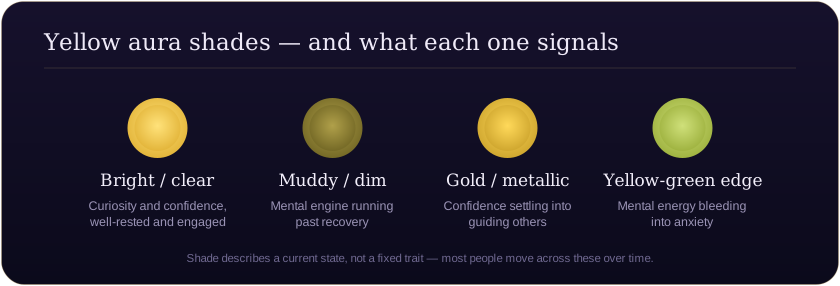
In subtle-energy traditions, a yellow aura is read as a mental and confident energy field tied to the solar plexus center. The color is commonly associated with the solar plexus chakra (Manipura), which most aura literature links to intellect, self-esteem, and a steady sense of personal power. A bright, clear yellow usually points to curiosity, optimism, and creative flow; a muddy or dim yellow tends to flag overthinking, nervous-system strain, or running on fumes; gold or metallic yellow leans toward a mentoring, teaching presence. The yellow aura meaning therefore depends less on whether yellow shows up and more on which shade shows up, and against what life context. It is an interpretive convention, not a measurable field, and is most useful as a quick self-reflection prompt rather than a fixed personality verdict.
Why It Matters for Self-Awareness
Most people who search for the yellow aura meaning are stuck between two confident, opposite stories. One set of pages says yellow equals joyful, witty, intellectually alive. Another set says yellow equals burnout, anxiety, or a nervous system stuck in fifth gear. Both can be true on different days, which is exactly why a single-sentence answer fails the reader.
The honest read
The honest read is that yellow tracks the same engine that drives confident thinking and the same engine that, when over-revved, looks like wired exhaustion. The solar plexus is where most aura writers place ambition, will, and a steady "I can handle this." When that energy sits in healthy range, it reads as warmth and quick mind. When it is overdrawn, the same wattage flickers into irritability, restless sleep, and tunnel vision around work.
Using it as a mirror
Used well, this framework gives you a label for a state you already feel but cannot name. If you have been telling yourself "I am fine, just busy" for three months while sleeping poorly, a muddy-yellow reading is not a diagnosis; it is a mirror. The point is not to chase a "better" color. The point is to notice which version of yellow is showing up this season, and to use that read to make one concrete change this week — a real bedtime, a delegated task, a no — instead of stacking another productivity hack.
Three real-life situations
Three concrete situations make this useful in real life. First, the job-change question. If you are weighing whether to take a stretch role and your self-read keeps coming back bright yellow on the weekends but muddy yellow during the workweek, the yellow aura meaning is doing real work for you — it is telling you the current job is the one running you past recovery, not your baseline temperament. Second, the relationship pattern. If you notice your yellow goes muddy specifically around one person, the framework is not labeling them toxic; it is flagging which conversations leave you spinning at 2 a.m. and which ones land cleanly. Third, the founder or operator stretch. People running on willpower for a launch will often read as bright yellow right up until the week they crash; the framework gives you a way to spot the drift from bright to muddy a few weeks earlier than the body will, while you can still trade an hour of sleep back into the next day.
What this framework is not
A short word on what this framework is not. It is not a personality test, and it is not a substitute for clinical care. If your read keeps surfacing real strain — persistent sleep loss, panic, intrusive thinking — the right next step is a clinician, not another aura article. The yellow aura meaning is a self-reflection convention, useful as one input among several, not a diagnosis you give yourself in place of getting help.
Yellow Aura vs Adjacent Concepts: Mechanism + Trade-offs
The yellow aura meaning makes more sense when you put it next to the colors and ideas it is most often confused with.
Yellow vs orange aura
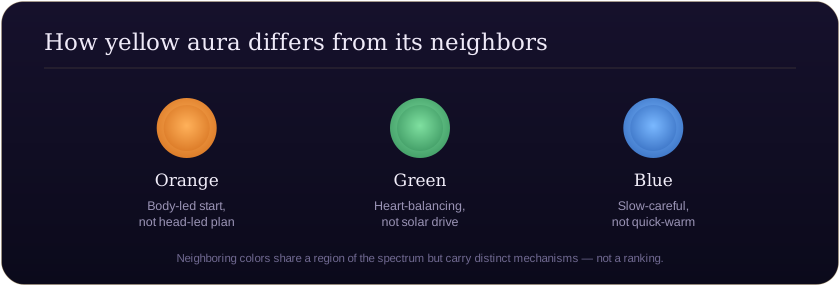
Yellow aura vs orange aura. Yellow runs through the solar plexus and reads as mental confidence, planning, and verbal quickness. Orange sits one center lower at the sacral and reads as appetite, play, and creative impulse. Mechanically, yellow turns experience into models and orange turns experience into movement. To get the sharp planning yellow is known for, you sacrifice some of the loose, body-led spontaneity orange brings. Someone running yellow-dominant will often have the better strategy on paper; someone running orange-dominant will often be the one who actually starts.
Yellow vs gold or metallic yellow
Yellow aura vs gold or metallic yellow. Most aura writers treat plain yellow and gold as related but distinct. Plain yellow is everyday intellect and personal optimism. Gold or metallic yellow leans toward teaching, mentoring, and a steadier kind of confidence that wants to share what it knows. To get gold's mentoring pull, you sacrifice some of plain yellow's quick, unattached curiosity — gold tends to slow down, because teaching does not work at the speed of thought.
Yellow aura vs the solar plexus chakra
Yellow aura vs solar plexus chakra. These are related but not the same thing. The chakra is the energy center; the aura color is one possible reading of that center's current state. A balanced solar plexus does not always read as bright yellow in every framework, and a yellow aura is not proof that the chakra is "healed." Choosing the aura-color frame over the chakra frame buys you a quicker self-check; the cost is precision, because aura color flickers day to day while chakra work tends to be a longer practice.
Bright vs muddy yellow
Bright yellow vs muddy yellow as a within-color split. This is the split most beginner pages skip. Bright, clear yellow points to vitality and clean motivation. Muddy, dim, or greenish-yellow points to strain, anxious overthinking, or running too long on stimulants and willpower. To get the steady, confident yellow people admire, you sacrifice the ability to push through indefinitely — the bright version requires actual rest, and the muddy version is what shows up when you skip it. A useful field test: think about the last time you felt sharp, witty, and quick on your feet at the end of a long day. That is bright yellow with the tank still full. Now think about the last time you said something clever you regretted ten minutes later, or got snappy at someone you love because their question was "in the way." That is the same engine, but with the oil light on.
Yellow vs throat-led blue
Yellow aura vs throat-led blue energy. Blue is usually read as a calmer, communication-led color tied to the throat center. Yellow runs faster and warmer; blue runs cooler and more careful. To get yellow's quickness, you sacrifice some of blue's ability to slow a conversation down until everyone is actually heard. People who lead with yellow will often be the first to name the problem in a meeting; people who lead with blue will often be the ones who get the room to agree on a definition before solving it. Neither is the better color; they answer different questions.
A caveat across traditions
A practical caveat applies across these comparisons: aura color systems are not consistent across traditions. One school will split bright yellow and gold into separate categories; another will collapse them; a third will treat shade variation as more meaningful than category. When you read a description that does not match yours, the move is not to declare a source wrong; it is to ask which lineage is being used, and whether its way of assigning the color matches the question you actually came in with. Most disagreements between aura sources are not "is yellow good or bad" — they are which sub-shade each writer is centering as the default, and how strict each one is about separating gold from plain yellow.
How to Read Yellow Aura in Yourself
Yellow aura often reveals itself through a person's relationship with creative energy and self-confidence.
Three self-check indicators:
- Idea generation: Do ideas and connections come to you rapidly,
sometimes faster than you can act on them?
- Social radiance: Do people frequently describe you as energizing or uplifting to be around?
- Confidence cycles: Is your confidence tied to intellectual or creative output —
high when you're making things, lower when you're not?
If two or more apply consistently, yellow is likely a dominant frequency in your current field.
Common Misreadings
Misread 1: Yellow always means happy Yellow signals active solar energy — intellectual drive, creative output, confidence. Happiness may accompany it, but a yellow aura in an anxious or overloaded person will read as scattered or erratic, not calm joy.
Misread 2: Pale yellow means weak Pale or soft yellow often indicates emerging gifts — particularly in people developing their intellectual or creative voice. It is potential, not deficiency.
Misread 3: Yellow is a "beginner" color Chakra frameworks have sometimes implied lower-spectrum colors are less evolved. Yellow governs personal power and mental clarity — capacities that require sustained development, not luck.
Quick Reference Table
| Property | Mechanism | Energy Center | Common Misread |
|---|---|---|---|
| Bright clear yellow | Curiosity and confidence with sleep and intake in range | Solar plexus (Manipura) | Read as "always happy"; really means well-rested and engaged |
| Muddy or dim yellow | Mental engine running past recovery; willpower covering for rest | Solar plexus, under strain | Read as a fixed personality trait; really a state to act on |
| Gold or metallic yellow | Confidence settling into teaching or guiding others | Solar plexus, with overlap toward heart and throat | Read as ego or grandiosity; usually reads as steady authority |
| Yellow-green edge | Mental energy bleeding into anxiety or comparison | Solar plexus drifting toward heart | Read as jealousy; often just overthinking dressed as feeling |
Reflection Prompts
- Think of a recent week when your thinking felt sharp and your sleep felt fine — did the yellow aura meaning of "bright, in range" match how you actually showed up?
- Recall the last time someone called you "on" or "wired" — what was running underneath, and which shade of yellow would honestly describe that day?
- Notice one decision this month where you used optimism to skip a hard conversation — what would a steadier, gold-leaning yellow have chosen instead?
Common Questions About Yellow Aura
Q: What does a bright yellow aura vs. pale yellow mean? A: Bright yellow signals high creative output, intellectual confidence, and active engagement. Pale yellow indicates emerging energy — often seen in people developing their sense of self or a new skill.
Q: Is yellow aura connected to a chakra? A: Yes — yellow corresponds to the Solar Plexus Chakra (Manipura), located above the navel. It governs personal power, self-worth, and mental clarity.
Q: What does it mean if my yellow aura has green in it? A: Yellow-green combinations often appear in people bridging intellectual work with relational care — teachers, healers, and communicators who use ideas to serve others.
Q: Can a yellow aura shift color? A: Yes. Under stress, yellow can intensify into a muddy or greenish yellow — signaling mental overload or unprocessed self-doubt. During creative flow states, it often brightens toward gold.
Sources
- Judith, A. (1999). Wheels of Life. Llewellyn Publications.
- Brennan, B. A. (1988). Hands of Light. Bantam Books.
Related Reading
- pillar page on aura colors overview — the full color map this entry sits inside, useful before comparing shades.
- blue aura explainer — contrast with a cooler, throat-led energy that reads as calm rather than quick.
- comparison with orange aura — the closest neighbor on the warm side, with a clearer body-led mechanism.
- guide to the solar plexus chakra — the energy center most aura traditions tie yellow to, with longer-form practice notes.
- green aura explainer — the heart-centered neighbor, useful for telling solar-plexus drive apart from relational, balancing energy.
- red aura explainer — the root-center contrast: physical drive and survival energy versus yellow's mental, solar-plexus confidence.
Take Action
Not sure which shade of yellow is showing up right now? Explore the aura colors guide to see how your colors map and combine.