
What Is Prince William's Birth Chart?
Prince William's birth chart is a Cancer-dominant natal map set for June 21, 1982, at 9:03 PM in London, featuring a Cancer Sun, Cancer Moon, and Sagittarius Rising with Neptune conjunct the Ascendant.
- Both the Sun and Moon land in Cancer, meaning core identity and emotional instinct run through the same water-sign lens with no internal separation between them
- The Sagittarius Rising with Neptune conjunct the Ascendant wraps that Cancer interior in an idealistic, impressionistic public image — accessible-feeling on the surface, carefully guarded beneath
- He turns 44 on June 21, 2026, a birthday falling simultaneously on Father's Day and the summer solstice, creating a rare triple Cancer Season alignment
This sits alongside the broader pillar page on how to read a birth chart, which maps how Sun, Moon, and Rising interact in any natal chart. In prince william birth chart, the defining structural feature is the Sun-Moon conjunction: both luminaries in Cancer means there is no internal gap between who he is and what he feels. The Sagittarius Rising then functions as an outward interface, projecting idealism and range toward the world, while Neptune sitting on the Ascendant gives the public image an impressionistic, slightly elusive quality. The result is a chart that reads as open and warm at the surface while keeping the emotional interior carefully protected.
Why It Matters for Self-Awareness
People see a Cancer Sun and expect visible nurturance — the sign's best-known quality is outward warmth, family-centered care, and sensitivity on display. That picture captures part of what Cancer produces. It misses the Cancer Moon, and that omission changes the whole reading of prince william birth chart.
In my years of energy-work and somatic therapy practice, I've noticed that people with double placements in water signs often present the opposite of what the stereotype promises. The more an interior world is organized around one emotional lens, the more carefully that lens tends to be protected. The Cancer Moon describes who someone already is at their most unguarded — the emotional reflex that runs automatically before any conscious choice kicks in. When Sun and Moon both point toward Cancer, there is no internal counterweight creating visible contrast. What you get instead is a deeply unified inner world and a proportionally stronger instinct to keep it shielded. The warmth that comes through the Sagittarius Rising is genuine. So is the wall directly behind it — and those two facts coexist without contradiction.
Sagittarius Rising vs. Cancer Moon: Public Face and Private Interior
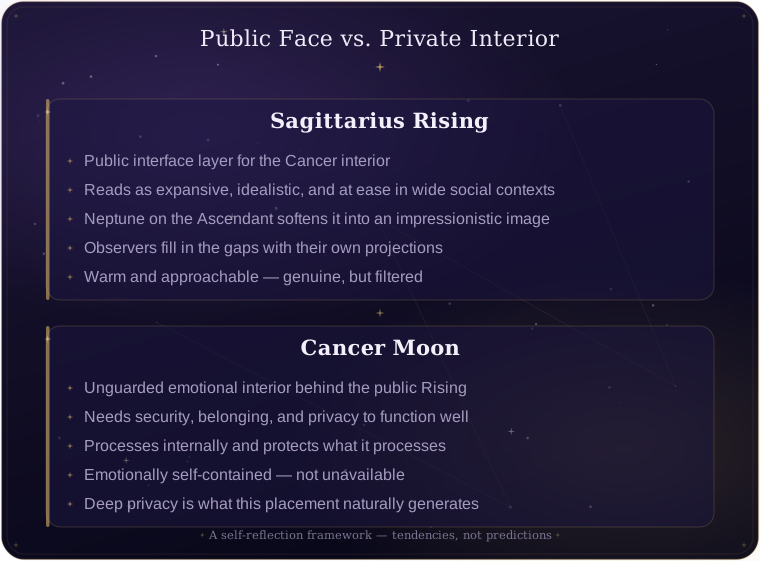
Most readers treat a person's Rising sign and Moon as roughly interchangeable descriptions of how someone comes across. In prince william birth chart, they're doing fundamentally different work, and collapsing them is where most surface-level chart readings go wrong.
The Sagittarius Rising with Neptune conjunct the Ascendant is the public image layer. Sagittarius Rising reads as expansive, idealistic, and at ease across wide social and cultural contexts. Neptune on the Ascendant softens those edges further, giving the public persona an impressionistic, fluid quality — observers tend to fill in the gaps with their own projections of who he is or what he represents. To get that warm, approachable public presence, the chart absorbs a lot of outside idealization. The trade-off: the Sagittarius Rising image is real but filtered, and it consistently reads as more emotionally available than what the Cancer Moon interior actually offers. Being approachable at the public level and genuinely private at every level beneath it aren't contradictions in this chart. They're two functions of the same design.
The Cancer Moon sits behind all of that. Where the Rising describes the public interface, the Moon describes the unguarded interior — the emotional reflex that operates when no performance is happening. Cancer Moon needs security, belonging, and privacy to function well. It processes internally and protects what it processes. To get the depth and self-sufficiency that come from a unified Cancer Sun-Moon lens, you give up the visible internal contrast that usually signals emotional complexity to outside observers. The chart is not emotionally unavailable — it is emotionally self-contained, which is a different thing, and easy to mistake for the former.
How to Read This Placement in Your Own Chart
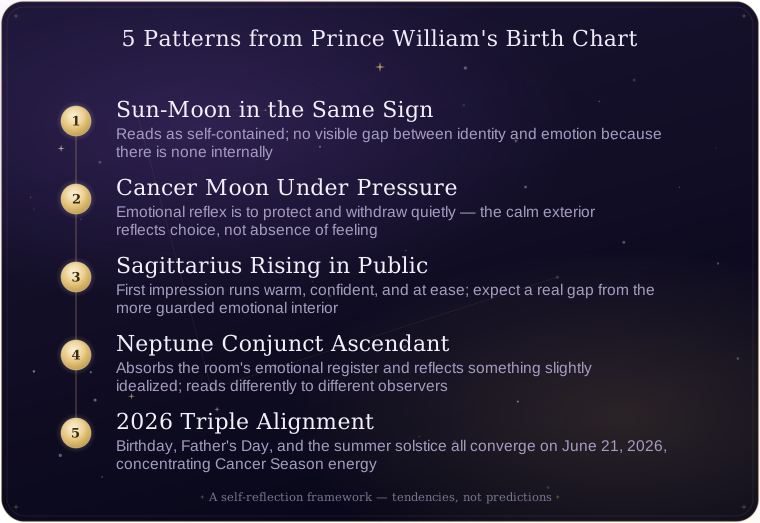
Reading the structure of prince william birth chart is more useful when you know what each placement looks like in practice. These patterns appear across many charts, not just his:
- Sun-Moon in the same sign. The person reads as self-contained. There's no visible gap between identity and emotion because there isn't one internally. That consistency can look like composure, flatness, or reserve from the outside — it's usually integration.
- Cancer Moon under pressure. The emotional reflex is to protect and withdraw quietly rather than react visibly. Someone with this Moon who appears calm in public may be processing something significant internally. The calm exterior reflects choice, not absence of feeling.
- Sagittarius Rising in public contexts. The first impression runs warm, confident, and at ease across broad social situations. Expect a real gap between that surface and the more guarded emotional interior. The Rising communicates something genuine — it's just not the whole picture.
- Neptune conjunct Ascendant. The person absorbs the emotional register of a room and reflects back something slightly idealized. They tend to read differently to different observers because the public image is impressionistic rather than sharp. That quality belongs to Neptune, not to evasion.
- The 2026 triple alignment. When birthday, Father's Day, and the summer solstice converge on June 21, 2026, Cancer Season energy concentrates in an unusual way. For any chart with strong Cancer placements, the solstice often surfaces themes that have been quietly processed through the year rather than shown outward.
Common Misreadings
Four consistent errors show up in popular coverage of this chart:
- "Cancer Sun means visible nurturance." Cancer is a nurturing sign, but nurturance doesn't require display. The Cancer Moon here suggests that emotional giving flows privately — within trusted relationships, within family — not for a public audience.
- "Double Cancer should mean more emotional openness." Double water placements intensify the interior experience and the protective response around it. Two Cancer placements don't add up to twice the expressiveness — they tend to add up to twice the self-containment.
- "Neptune on the Ascendant signals intentional concealment." Neptune conjunct Ascendant is permeability, not deception. The public image absorbs idealization from outside and reflects something impressionistic back. Observers fill in the gaps with their own projections. That's a feature of how the placement works, not evidence of deliberate opacity.
- "Sagittarius Rising and Cancer placements work against each other." They serve different functions in the same chart. The Sagittarius Rising provides the outward interface through which a deeply private Cancer interior engages with public life. One does the public work; the other runs the interior. They complement rather than contradict.
Prince William Birth Chart at a Glance
| Property | How It Works | Element / House | How to Observe |
|---|---|---|---|
| Cancer Sun | Core identity built around emotional security and careful protection | Water / 8th House (approx.) | Consistent composure under pressure; composure breaks happen by choice, not reactively |
| Cancer Moon | Emotional reflex matches the Sun sign — instinct and identity reinforce each other with no internal counterweight | Water / 8th House (approx.) | Public warmth is genuine; deeper emotional processing happens privately, after the fact |
| Sagittarius Rising | Public interface reads as open, idealistic, and at ease across wide social contexts | Fire / 1st House | Warm, confident first impression; visibly comfortable in high-visibility roles |
| Neptune conjunct Ascendant | Idealism overlays the public image; the boundary between self and outside projection stays fluid | Water / 1st House cusp | Hard to read clearly; different observers fill in the impressionistic gaps differently |
| Cancer Sun-Moon conjunction | No internal Sun-Moon tension; identity and emotion move through one unified lens | Cancer | Deep self-sufficiency; consistent and strong instinct to protect the interior world |
| 2026 birthday triple alignment | Cancer Season, Father's Day, and the summer solstice all land on June 21 | Triple Cancer activation | A year with concentrated emphasis on family identity, public role, and legacy themes |
Questions People Ask About Prince William's Birth Chart
What zodiac sign is Prince William?
Prince William is a Cancer, born June 21, 1982. With both the Sun and Moon in Cancer — and the Sagittarius Rising creating the public layer — Cancer isn't just a sun-sign label here. It functions as the emotional through-line organizing the entire chart, showing up in both how he consciously builds his identity and how he operates at the level of instinct and reflex.
What does prince william birth chart reveal about his public image?
The Sagittarius Rising with Neptune conjunct the Ascendant explains most of what people observe publicly: warm, idealistic, impressionistic, and easy to project onto. The Sagittarius Rising provides the confident, wide-ranging public interface; Neptune softens its edges into something impressionistic. Observers fill in what they can't quite pin down with their own expectations — that's very Neptune. The gap between that image and the Cancer Moon interior is structural, not personal.
Why does he seem emotionally private for someone with strong Cancer placements?
The Cancer Sun-Moon conjunction is the core reason. When identity and emotional instinct both move through Cancer, the sign's protective instinct intensifies rather than softens. Double Cancer is not double openness — it produces double self-containment. The privacy is what the chart generates naturally. It isn't a contradiction of the Cancer placements; it is what those placements tend to produce when they're this concentrated.
What makes the 2026 birthday alignment significant?
June 21, 2026 places three distinct markers on the same date: Prince William's 44th birthday, Father's Day, and the summer solstice — the exact moment the Sun enters Cancer. According to NASA, the June solstice marks the longest day of the year in the Northern Hemisphere, which is why Cancer Season traditions treat it as a threshold for family and identity themes. For a chart this Cancer-dominant, that convergence makes questions about family identity, public legacy, and how much the private self gets shown into especially active territory for the year.
Reflection Prompts
- Think of a recent moment when you felt something strongly but said very little — who in your life had access to what was actually happening, and what made them the ones you let in?
- Recall a time you assumed someone was emotionally available because their public warmth told you so — what shifted when the interior picture turned out to be different from the surface?
- Notice the last time your public face and your private experience ran on completely separate tracks — what held that gap in place, and what felt at stake in closing it?
Related Reading
- guide to Cancer-dominant rising charts — expands on what Cancer placements produce when they dominate the rising and luminary layers
- explainer on Neptune in Pisces and its impressionistic signature — covers how Neptune shapes a public image and why observers tend to fill in the impressionistic gaps it creates
- overview of the Ascendant and how the Rising layer reads to the world — the outward interface that sits between an interior chart and the wider world
- Prince William, Prince of Wales (Wikipedia)
Take Action
Generate your free birth chart to map your own Sun, Moon, and Rising placements the same way this reading examines prince william birth chart. You'll see which part of your chart is doing the outward-facing work and where your emotional instinct actually sits in relation to your identity. Understanding how those two layers interact — how much your public image matches your interior, and what it costs when they diverge — is one of the more concrete things a natal chart can give you.
Sources
- Birth data for Prince William (June 21, 1982, 9:03 PM, London) is a matter of public record, documented with Rodden Rating AA in astrological data archives, indicating sourcing from official records.
- The interpretive framework distinguishing Sun (conscious identity) from Moon (emotional instinct) from Rising (public interface) draws on the psychological astrology tradition that shaped 20th-century humanistic chart reading in the West.