What Is the Sacral Chakra?
The Sacral Chakra is the second of the seven main energy centers in the traditional chakra system, sitting just below the navel and tied to creativity, pleasure, and emotional flow. In plain terms, sacral chakra meaning describes how freely you create, feel, and connect, not just sex. It sits within the broader Chakra System overview pillar page, which maps where every center falls in sequence — the seven-center layout early writers such as Charles Leadbeater helped popularize and Anodea Judith later systematized. Most people meet this center through one narrow association, so it helps to name what it actually covers:
- Governs creativity, pleasure, and the movement of emotion, not sexuality alone
- Associated with the lower belly and, in many traditions, the element of water
- Often flattened into a "sex chakra" when its real theme is flow and responsiveness
Why It Matters for Self-Awareness
Understanding sacral chakra meaning matters because the popular version traps people inside a single story, and that story quietly costs them. In eight years of energy-work and aura-reading practice, I've watched person after person arrive certain this center is only about libido, then discover the thing actually stalling them is creative or emotional. When you believe the sacral center equals sex, a flat week of no ideas or a numbed-out stretch of feeling reads as unrelated to your energy at all, so it goes unnamed and unexamined. The narrow definition doesn't just simplify the idea; it hides the very signals you most need to catch.
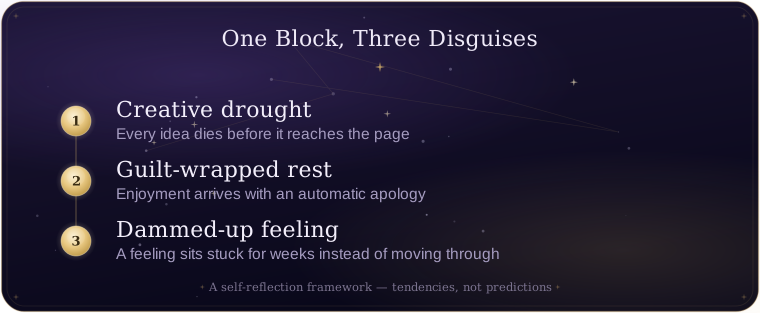
Widening the definition gives you somewhere useful to look. Think of a stretch where every idea died before it reached the page, where rest came wrapped in guilt, or where a feeling sat stuck for weeks instead of moving through you. In the narrow framing, none of that registers as a sacral signal at all. In the wider one, all three are the same center asking for attention, just wearing different clothes. That shift — from "nothing's really wrong" to "here's what's contracted" — is the practical payoff of getting the definition right, and it's the difference between drifting and noticing.
Self-awareness here isn't about chasing a perfect, wide-open state. It's about recognizing the early signs that your creative and emotional flow has narrowed while the change is still small and easy to work with. People who only know the sexual association tend to wait until something feels dramatic before they look inward. People who hold the wider meaning catch the dip when it's still just a slow creative week or a faint flicker of guilt around enjoying themselves.
Sacral Chakra vs Root Chakra — Desire After Safety
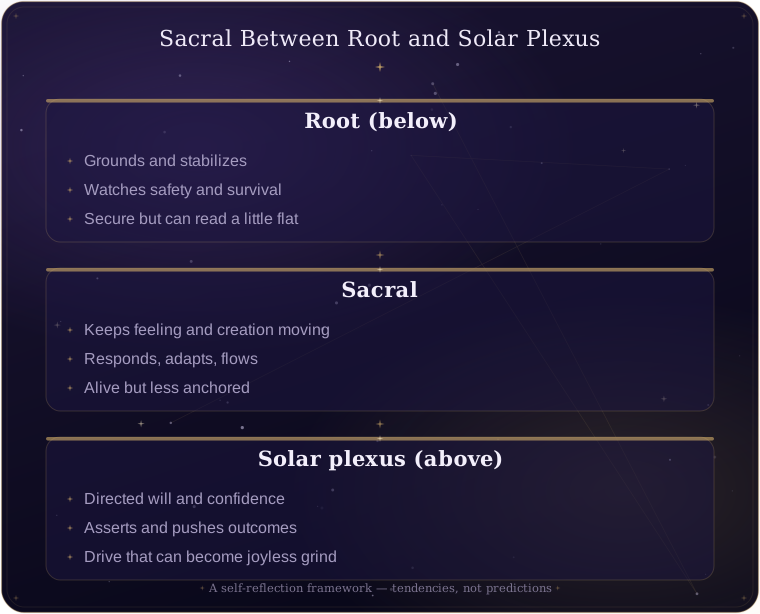
Sacral chakra meaning becomes clearer when you set this center beside the ones it's most often confused with. The Sacral Chakra works by keeping creative and emotional energy in motion — taking experience in, responding to it, and letting feeling pass through rather than pool. The root center directly below it does the opposite job: it grounds, stabilizes, and watches over safety and survival, the themes mapped to the root chakra meaning explainer just beneath it. To get the root's steadiness and sense of security, you sacrifice some of the sacral's improvisation and its willingness to be moved by feeling, because stability and fluidity pull in genuinely different directions.
The sequence is the practical part: desire tends to follow safety, not precede it. When the root feels shaky — money stress, an unstable home, a body running on no sleep — the sacral usually contracts first, because play and creative risk feel unaffordable when survival is in question. This is why pushing for more creativity or pleasure while the ground is unstable so often fails. The more reliable move is to steady the root, then let the sacral loosen on its own. A creatively flat month during a hard, unsafe stretch is frequently a root problem wearing sacral clothes.
Sacral Chakra vs Solar Plexus — Flow Before Force
The solar plexus center just above runs on directed will, confidence, and the push to make things happen. It functions through assertion, where the sacral functions through response and flow. To get the solar plexus's focused drive, you trade away some of the sacral's softer attunement to pleasure and emotion, the part that doesn't force outcomes so much as follow what feels alive. Many people who pride themselves on willpower quietly run a tight, blocked sacral underneath, mistaking grind for health and wondering why the work feels joyless even when it's productive. If your output is steady but flavorless, the missing ingredient is often sacral flow, not more will — a distinction the solar plexus chakra affirmations guide draws out from the other side.
Sacral Chakra vs Orange Aura — Shared Language
The sacral chakra and the orange aura describe the same band of energy from two directions. The sacral reads it from the inside — how freely you create, feel, and respond. The orange aura explainer reads it from the outside — the playful, sensual, experimental quality others pick up around you. They usually agree: a person in steady sacral flow tends to give off warm, creative orange. They can also diverge, and the gap is informative. Someone can radiate bright social orange while privately running a contracted sacral, performing aliveness they don't feel. Reading both keeps you honest about whether the flow is real or just visible.
Sacral Chakra vs Sexuality — The Most Common Flattening
The most common confusion, though, isn't with another center at all — it's with sexuality itself. Sex is one real expression of sacral energy, but the wider current is creativity, pleasure, and emotional exchange of every kind. To reduce this center to sex, you lose sight of why a creative drought, a joyless month, or a frozen feeling can each signal a sacral block just as loudly as anything to do with desire. That trade — the vividness of one striking image for accuracy across the whole center — is exactly the friction this page exists to clear up.
How to Read the Sacral Chakra in Yourself
Reading sacral chakra meaning in yourself doesn't take special training — the signals show up in ordinary moments. A few worth noticing:
- Creative momentum. Do ideas arrive and move into action, or stall out before they ever begin?
- Pleasure without guilt. Can you enjoy food, rest, or closeness without an automatic apology running underneath it?
- Emotional movement. When a feeling rises, does it pass through within a day, or get dammed up for weeks?
- Response to change. Do shifts in plans feel workable, or does any disruption lock you up tight?
- Room for play. Is there space in your week for something done purely because it's enjoyable, or has everything turned useful?
Sacral Energy in Creative Work
The clearest place to read this center is whatever you make. In open sacral flow, ideas arrive easily, you start before everything is perfect, and the work has a felt quality — it carries play, texture, and a sense of being alive rather than only correct. When the center contracts, the same person can stay productive yet describe the output as flat, dutiful, or forced. The tell is not whether you finish things but whether starting feels possible and finishing feels satisfying. A long stretch of "I can execute but I can't begin," or work that meets the brief while leaving you cold, is a sacral signal more often than a discipline problem. Restoring flow usually looks like lowering the stakes — making something small and useless on purpose — rather than trying harder.
Sacral Energy in Relationships
The sacral also governs how feeling moves between you and other people. In balance, you can be affected by someone without losing yourself, let warmth and attraction surface, and stay responsive when a mood shifts in the room. Closeness feels like exchange rather than performance. When the center is tight, intimacy can start to feel like a script: you go through the motions, manage the other person's reactions, and notice a strange flatness where responsiveness used to be. Pleasure in company gets edited down to what feels safe or appropriate. None of this is about how much sex or romance is present; it is about whether emotional current actually flows between you and the people you're close to, or stalls behind a held breath.
When Sacral Patterns Turn Avoidant
A contracted sacral does not always look shut down — sometimes it looks like motion. Under stress, the same center can tip into avoidance dressed as activity: chasing novelty, scrolling, snacking, over-scheduling, or jumping from one stimulating thing to the next. The movement is real, but it is being used to outrun a feeling rather than to express anything. The honest question is whether the activity has presence and consent behind it, or whether it is a way to not sit with grief, boredom, or discomfort. Avoidant flow burns the same energy as creative flow but leaves you more depleted, not more alive — and noticing that difference is what keeps "I'm just busy and spontaneous" from quietly becoming "I can't be still."
Common Misreadings
More than almost any other center, sacral chakra meaning gets flattened by a handful of popular misreadings — and those misreadings are usually exactly what send people searching in the first place.
- "It's only about sex." The sacral center covers creativity, pleasure, and emotional flow as a whole. Sex is one channel among several, not the definition of the center. The cost of the narrow reading is practical: it hides the creative and emotional signals that are usually the first to fade, so the imbalance goes unnamed until it shows up somewhere louder.
- "A blocked sacral just means low libido." A block as often shows up as creative drought, emotional numbness, or rigidity around change. Desire is only one place the contraction can land, and for many people it is not even the first place — flat creativity and stuck feeling tend to arrive earlier.
- "Healing it means more indulgence." Subtle-energy traditions describe the aim as flow and balance, not maximum pleasure. Constant overflow is its own kind of imbalance, not proof of an open center. An overactive sacral — restlessness, difficulty saying no, chasing the next stimulation — needs containment as much as a blocked one needs loosening.
- "You either have it open or you don't." Most teaching treats this as a shifting state, not a fixed trait. The same person can read open during a creative season and contracted under stress, which is why a single reading says less than the same reading checked again a month later.
- "More feeling always means it's working." Emotional flow is the goal, but volume is not the measure. Being constantly flooded — every feeling at full intensity, none of it moving through — is contraction wearing the mask of openness. Healthy sacral flow is feeling that arrives, gets felt, and passes, not feeling that pools and overwhelms.
The Sacral Chakra at a Glance
| Property | How It Works | Energy Center | How to Observe |
|---|---|---|---|
| Balanced flow | Creative and emotional energy moves freely and responds to life | Sacral center, just below the navel | Ideas turn into action, pleasure feels easy, feelings pass through |
| Underactive or blocked | The same current contracts, so expression and feeling stall | Sacral center (depleted reading) | Creative drought, emotional numbness, guilt around rest or pleasure |
| Overactive | Flow tips into excess and becomes hard to contain | Sacral center (overflow reading) | Emotional volatility, restlessness, difficulty saying no to indulgence |
| Core quality | Water-like movement — taking in, responding, adapting | Sacral center, paired with the element of water | Comfort with change and ease around closeness |
Common Questions About the Sacral Chakra
What does the sacral chakra represent beyond sexuality?
It points to creativity, pleasure, and the movement of emotion as a whole — the wider sacral chakra meaning that the "sex chakra" label hides. Subtle-energy traditions treat sex as one expression of this center, alongside artistic drive, healthy enjoyment, and the freedom to let feelings flow.
What are the signs of a blocked sacral chakra?
Common signs described in chakra teaching include creative block, emotional numbness, guilt around pleasure, and rigidity when plans change. The pattern is contraction — energy that should be moving instead stays stuck.
How do you balance the sacral chakra?
Most approaches focus on restoring flow: creative play, time near water, honest contact with emotion, and permission to enjoy without guilt. The goal described is steady movement, not constant stimulation.
Where is the sacral chakra located?
It is mapped to the lower abdomen, roughly a couple of inches below the navel. In traditional systems it pairs with the element of water and the body's relationship to flow.
Reflection Prompts
- Think of a recent idea that excited you — what did you actually do with that first spark?
- Recall a moment you let yourself fully enjoy something — what made it feel safe enough to?
- Notice the last feeling that caught you off guard — did you let it move or hold it back?
Related Reading
- chakra system overview — the hub that places the sacral second in the full seven-center sequence.
- root chakra meaning — the grounding center just below, where safety has to settle before desire can flow.
- solar plexus chakra affirmations — the willpower center just above the sacral, easy to confuse with it.
- orange aura explainer — the same creative-emotional energy read from the outside.
- Svadhishthana (Wikipedia) — the traditional yogic source the modern reading grows from.
Take Action
Read the full Chakra System overview and place the sacral chakra in its sequence, between the grounding root below it and the willpower of the solar plexus above. Seeing the whole map shows how creativity and pleasure hand off to the centers around them, and that bigger picture makes it easier to notice which part of your own energy is quietly asking for attention right now.
Sources
- Anodea Judith — systematized the modern chakra framework this page draws on
- Charles Leadbeater — among the early writers who mapped the seven major chakras to the body