
If you came here for affirmations you can actually use, skip ahead to the 20 solar plexus chakra affirmations grouped by theme below. The short version first: the most effective solar plexus affirmations are not the loudest ones — they are the ones matched to whether your confidence is running low or running hot. Read which way you lean, then pick lines from the matching group. The rest of this page explains how to tell, so the lines you choose actually land instead of bouncing off.
What Is the Solar Plexus Chakra?
The Solar Plexus Chakra is the third energy center in the traditional seven-chakra system, sitting just above the navel and tied to confidence, willpower, and the felt sense that you are allowed to act on your own behalf. It anchors one corner of the broader pillar overview of the whole chakra system, which maps how each center supports the others. People reach for affirmations here when confidence feels shaky and overlooked, or, just as often, when it has tipped the other way into needing to control everything around them. Put simply, solar plexus chakra affirmations are spoken statements that rebuild personal power.
- Rooted in the gut, where most people feel confidence or its absence physically
- Spoken in the present tense to reinforce agency instead of wishing for it
- Effective only when matched to an under-active or over-active state, never recited at random
Why It Matters for Self-Awareness
Understanding solar plexus chakra affirmations matters because most people repeat lines that were never written for their actual state, then quietly decide affirmations don't work for them. The friction is specific and common. A phrase like "I am powerful and unstoppable" can read as genuine encouragement for someone who feels timid and overlooked, yet it pours fuel on someone already pushing too hard, talking over people, and wondering why every room feels tense. Picture two people saying that exact line into the same mirror: one finally straightens up, the other gets a little more rigid and defensive. The line was never the problem; the aim was, and that mismatch is what makes the practice feel hollow no matter how often you repeat it.
This is where matching pays off, and it is simpler than it sounds. For an under-active center, permission-giving lines such as "My needs matter as much as anyone else's" or "I am allowed to take up space" help it stand back up, because the missing ingredient is permission, not force. For an over-active center, those same lines make things worse; the fitting phrases sound more like "I can lead without controlling the outcome" or "I don't have to be right to be okay," because the task there is loosening the grip rather than tightening it. The point is not to collect more lines — it is to read which direction you need before you open your mouth.
In my years of energy-work and aura-reading practice, the pattern I see most is people reaching for the loudest, most assertive line they can find, on the belief that bigger is automatically better. It is an easy mistake, because the bold lines are the ones that end up printed on mugs and posters. For a depleted center that volume sometimes helps it recover its footing. For an over-active one it backfires, because intensity is the last thing it needs — it already has plenty. Knowing which way your own energy leans on a given day is the difference between a line that settles your stomach and one that simply bounces off.
Solar Plexus vs Sacral and Heart — Why the Wording Has to Match the Center
Solar plexus chakra affirmations differ from the work you would do at the centers on either side, and that distinction shapes how the wording functions. The sacral center, just below, governs pleasure, feeling, and creative flow, in the chakra framework Anodea Judith helped systematize for modern readers. The heart center, just above, governs connection and care for other people. The solar plexus sits between them as the seat of will — the part that turns feeling into action and decides whether a desire ever leaves your head. Because of that in-between position, it is easy to grab a line meant for one of its neighbors and then wonder why nothing shifts.
Here is how that plays out in everyday terms. Affirmations aimed at the sacral chakra explainer invite softness and permission to enjoy; the trade-off is that they rarely build the backbone you need to follow through on what you want. Solar-plexus phrasing does the opposite: to gain a firmer sense of agency, you sacrifice some of that easy receptivity, trading comfort for momentum. Heart-centered lines prioritize warmth and empathy, which is a genuine strength, but lean on them alone and you gain compassion while quietly losing the self-direction this center is supposed to supply. None of these is better in the abstract; each is right only for the state it was built to address.
Picture a meeting where a quiet team member finally states an opinion. An under-active solar plexus reads that small act as risky, so a soothing heart affirmation would only reinforce the urge to keep the peace and stay silent. What helps instead is a line that grants permission to be heard. The same meeting with an over-active person looks different: the work is not speaking more but leaving room, so the fitting line softens the need to dominate the conversation. Matching the phrasing to the center you actually need — not the one that sounds most appealing — is what makes an affirmation do real work over time.
How to Read the Solar Plexus Chakra in Yourself
Before choosing solar plexus chakra affirmations, read which way your center is leaning right now — what energy practitioners like Cyndi Dale describe as checking a center's charge before working with it.
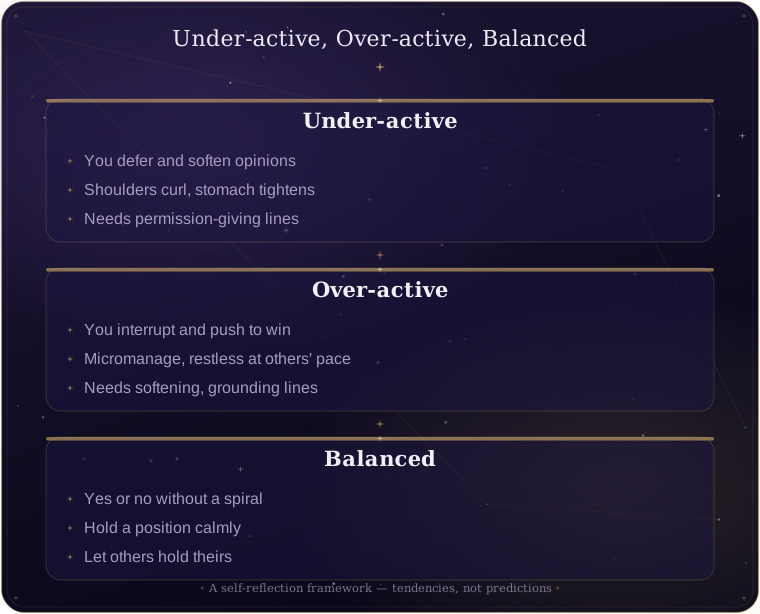
Signs of Underactive Solar Plexus Energy
When this center runs low, the theme is deference — you give your agency away to avoid friction:
- You defer. You soften your opinions, apologize for taking up space, and let others decide so you can sidestep conflict.
- The body shrinks. Your shoulders curl in, your stomach tightens before you speak, and your energy drains in moments that call for assertion.
- Decisions stall. You ask everyone what they think, second-guess after you choose, and feel safer when someone else is responsible for the outcome.
If you saw yourself here, the missing ingredient is permission, not force — so your lines should grant permission and take up space.
Signs of Overactive Solar Plexus Energy
When the center runs hot, the theme flips to control — you grip the outcome and crowd out everyone else:
- You push. You interrupt, want the last word, and treat collaboration as something to win rather than share.
- Control creeps in. You micromanage outcomes and feel restless or irritated when things move at anyone else's pace.
- Being wrong feels unsafe. A mistake reads as a threat to your standing, so you defend rather than reconsider.
If this is you, the task is loosening the grip — so your lines should give permission to ease off and trust others.
When the center is balanced, you can say yes or no without a spiral, hold a position calmly, and let other people hold theirs. Once you can name the pattern, the right wording becomes obvious instead of guessed. If you saw yourself in the deferring signals, your lines should grant permission and take up space; if you recognized the pushing signals, they should give permission to ease off and trust others. Read first, then choose the phrasing — that order is the entire method, and it is what separates affirmations that stick from the ones you abandon after a week.
20 Solar Plexus Chakra Affirmations
Here are twenty lines you can use directly, grouped by the work they do. Each group holds a mix: some grant permission (for an under-active, deferring center) and some loosen the grip (for an over-active, controlling one). Read the signals above first, then choose the lines that match your state — say one out loud before the moment that usually unsettles you, rather than reciting all twenty by rote.
Affirmations for Decision-Making
For a center that stalls, freezes, or hands choices to other people:
- I am allowed to make a decision before I feel completely certain.
- My choice does not need everyone's approval to be valid.
- I can change my mind later without that meaning I failed now.
- A clear "for now" is enough; I don't owe myself a perfect answer.
- I trust myself to handle the outcome of the choice I make.
- I can decide at my own pace and still decide.
For a center that grips and over-controls, soften toward: "I can decide my part and let others decide theirs," and "I don't have to control the outcome to make a good choice."
Affirmations for Self-Trust
For rebuilding the felt sense that your own read is worth standing behind:
- My judgment is worth listening to, even when it is quiet.
- I can trust what I notice without proof that I'm right.
- I am steady enough to sit with doubt and still act.
- Being unsure is not the same as being wrong.
- My worth does not rise and fall with each result.
- I can hold my position calmly when someone disagrees.
- I don't have to be the best to be enough.
For an over-active center, the self-trust work is the opposite tilt: "I can be wrong and still be okay," and "I don't have to win to be respected."
Affirmations for Setting Limits
For protecting your energy and saying no without collapse or combat:
- I am allowed to say no without explaining it away.
- Disappointing someone is survivable, and sometimes necessary.
- My needs matter as much as anyone else's in the room.
- I can take up space without taking it from others.
- I don't have to earn rest by exhausting myself first.
- I can hold a boundary and still care about the person across from me.
- Letting others handle their part is not the same as losing control.
If a line feels false the moment you say it, that is information, not failure — it usually means it was written for the opposite state. Swap it for one from the matching group rather than abandoning the practice.
Common Misreadings
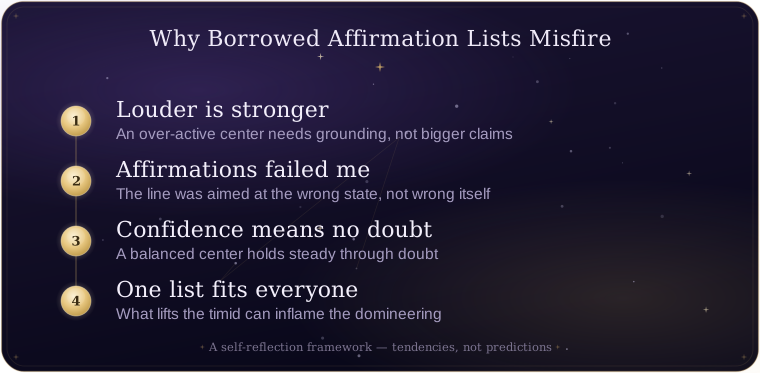
Most popular content flattens solar plexus chakra affirmations into one-size-fits-all confidence boosters, which is exactly why so many of them misfire. Four misreadings come up again and again, and each one keeps readers stuck on the same friction:
- "Louder is stronger." The reality: an over-active center needs grounding, not bigger claims, and turning up the volume only deepens the imbalance.
- "Affirmations just failed me." The reality: the line usually was not wrong, it was aimed at the wrong state, so it never had a fair chance to land.
- "Confidence means never doubting." The reality: a balanced solar plexus holds steady through doubt, so the goal is steadiness, not the disappearance of every fear.
- "One list fits everyone." The reality: the same wording that lifts a timid person can inflame a domineering one, which is why borrowed lists so often feel hollow.
The thread running through all four is the same: the wording has to be chosen for the state in front of you, not borrowed wholesale from a list that happened to work for someone else.
The Solar Plexus Chakra at a Glance
| Property | How It Works | Energy Center | How to Observe |
|---|---|---|---|
| Core theme | Converts feeling into willed action | Solar plexus (Manipura) | Notice whether you act on what you want or stall out |
| Under-active state | Confidence runs low, so you defer | Solar plexus (third center) | You apologize for your needs and shrink during conflict |
| Over-active state | Will runs hot, so you push and control | Solar plexus (third center) | You interrupt, micromanage, and need to be right |
| Affirmation fit | Wording is matched to the state to land | Solar plexus / gut | Pick softening lines when hot, empowering lines when low |
Questions People Ask About The Solar Plexus Chakra
How do I know which solar plexus chakra affirmations to use?
Read your current state before you pick any words. If you tend to defer and shrink, the center is under-active and responds best to empowering, permission-giving lines; if you push and control, it is over-active and responds to grounding, softening ones that ease the pressure to dominate.
How often should I repeat them?
Most practitioners suggest short, daily repetition tied to a real moment rather than long marathon sessions. Saying one fitted line right before a situation that usually rattles you tends to land far deeper than reciting ten of them by rote.
Can the same affirmation stop working?
Yes, because your state changes over time. A line that steadied an under-active phase can start to feel hollow once you have rebalanced, which is your cue to update the wording rather than abandon the practice.
What if I can't tell whether I'm under- or over-active?
Watch your behavior in low-stakes friction, like a small disagreement, and notice whether you go quiet or go hard. That reflex usually points to the imbalance faster than any quiz, and it tells you which way to phrase your lines.
Reflection Prompts
- Think of a recent moment you stayed quiet when you wanted to speak up. What did you fear would happen if you spoke?
- Recall a time you pushed hard to control an outcome. What were you afraid would slip if you eased your grip a little?
- Notice one decision this week you made cleanly, without spiraling. What felt different in your body the moment you chose?
Related Reading
- chakra system overview — the hub that places the solar plexus third, between the sacral below and the heart above.
- heart chakra meaning — the center just above, worth a look when affirmations need more warmth than will.
- root chakra meaning — a useful pairing when an over-active solar plexus needs steadying from below.
- sacral chakra meaning — the center just below, where flow and pleasure feed the will to act.
- yellow aura explainer — the solar plexus color read from the outside.
Take Action
Pick one affirmation that fits your current state — something softening if you run hot, something empowering if you run low — and say it once, out loud, before the next situation that usually unsettles you. Notice that saying it aloud matters more than thinking it, because the body registers your own voice differently. Over a week you begin to notice which wording actually settles your gut and which simply bounces off, and that feedback is the real skill this practice builds. To place this single center inside the larger picture, read the full Chakra System overview and see how a steady solar plexus quietly supports every other part of who you are.
Sources
- Anodea Judith — systematized the modern chakra framework these affirmations draw on
- Cyndi Dale — mapped practical energy-reading methods for working with each center