
What Are the Four Elements in Astrology?
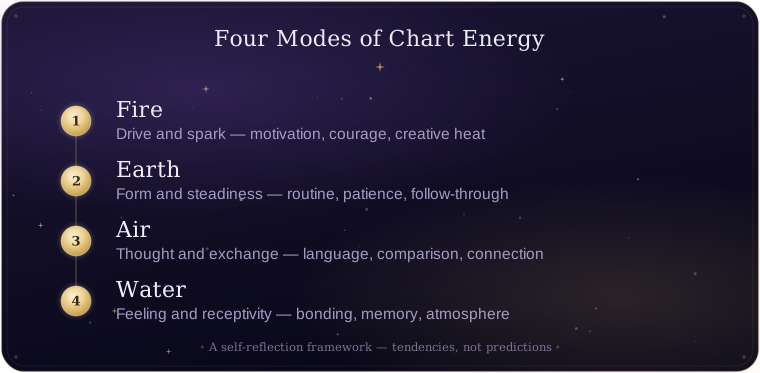
The four elements in astrology are a plain-language system that groups signs and chart placements into fire, earth, air, and water, so a birth chart can be read by elemental pattern, not only by one sign. In this elemental view, fire points to drive and spark, earth to form and steadiness, air to thought and exchange, and water to feeling and receptivity. A four-part lens for reading chart energy helps explain why two people with the same Sun sign can still feel very different. Your Sun matters, but the Moon, Ascendant, Mercury, Venus, and Mars can shift the balance. The framework is also used in aura and chakra conversations, where fire may be associated with red or orange, earth with green or brown, air with yellow or blue, and water with indigo or purple. Those color links are interpretive conventions, not physical rules or personality verdicts.
Why It Matters for Self-Awareness
Understanding the four elements in astrology matters because many people first meet the elements through a single label: fire sign, earth sign, air sign, or water sign. That shortcut is easy to remember, but it can flatten the chart. A person with a fire Sun may still have a water Moon, an earth Ascendant, and several inner planets in air signs. Another person may identify strongly with a water Sun, yet make choices through an earth-heavy pattern of routine, caution, and steady effort. The element balance gives you a broader reading than Sun sign identity alone.
The practical value is pattern recognition. Fire asks where your motivation, courage, urgency, and creative appetite show up. Earth asks how you handle body, time, money, tasks, and follow-through. Air asks how you think, speak, compare, question, and connect ideas. Water asks how you feel, receive, bond, remember, and respond to atmosphere. None of these is better or more evolved than the others. A chart with a strong element can show where energy comes quickly; a chart with a quieter element can show where skill-building may require more attention.
This is also where aura and chakra language can either help or confuse. Some traditions pair fire with red or orange aura tones, earth with green or brown, air with yellow or blue, and water with indigo or purple. These pairings are useful as symbolic vocabulary, especially when you are comparing drive, grounding, mind, and feeling. They become misleading when treated as one-to-one proof. A fire-heavy chart does not force a red aura, and a blue aura reading does not erase earth or water in the birth chart. The better use is comparison: what does each system notice, and what does it leave out?
The framework also protects against stereotypes. Water does not mean "dramatic." Earth does not mean "boring." Fire does not mean "loud." Air does not mean "shallow." Elements describe modes of attention and response. They are a map for reading tendencies, not a sentence passed on your character.
The Four Elements vs Adjacent Concepts: Mechanism + Trade-offs
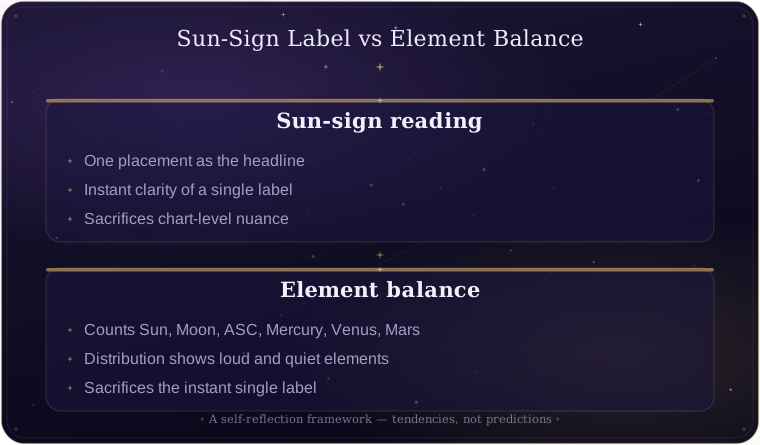
Reading a chart by its four elements differs from Sun-sign astrology by changing the unit of analysis. Sun-sign reading starts with one placement and treats it as the headline of the personality. Element reading counts the signs behind several placements, especially the Sun, Moon, Ascendant, Mercury, Venus, and Mars. The mechanism is distribution: if many key placements fall in fire signs, fire is louder in the chart; if almost none fall in earth signs, earth may need deliberate practice. To get speed and simplicity from Sun-sign reading, you sacrifice chart-level nuance. To get nuance from element balance, you sacrifice the instant clarity of a single label.
It also differs from planet-based interpretation. Planets describe functions: the Moon relates to emotional rhythm, Mercury to thinking and speech, Venus to attraction and values, Mars to assertion and action. Elements describe the style those functions use. Mercury in an air sign may think by comparing and naming; Mercury in water may think through mood, memory, and implied meaning. Mars in fire may act quickly; Mars in earth may act after testing what will last. To get precise psychological functions from planet reading, you sacrifice the quick pattern view. To get the pattern view from elements, you sacrifice some placement-by-placement detail.
The framework differs from modalities, too. Cardinal, fixed, and mutable signs describe how energy starts, holds, or adapts. Fire, earth, air, and water describe what kind of energy is moving. A fixed water placement and a mutable water placement can both be water, yet one may hold emotional memory while the other changes shape with context. To get timing and movement style from modality, you sacrifice the basic texture of the element. To get elemental texture, you sacrifice some information about pace and change.
Compared with house-based reading, element balance is less situational and more tonal. Houses tell you where something is likely to show up: relationships, home, work, community, money, study, or identity. Elements tell you the mode through which that area is approached. A person may have a heavy earth pattern and place much of that energy in relationship houses, which could show care through reliability, logistics, and embodied presence. To get life-area specificity from houses, you sacrifice a clean view of the whole chart's elemental weight. To get that whole-chart view, you sacrifice some location detail.
Compared with aura color reading, the four elements are more structural, while aura language is more impressionistic. Aura traditions often use color to speak about tone: red and orange for heat or action, green for healing and heart-centered steadiness, blue for voice and calm expression, purple or indigo for depth, intuition, or spiritual sensitivity. The mechanism is symbolic association, not proof by color. To get vivid, intuitive language from aura color, you sacrifice the birth chart's fixed placement structure. To get structure from the elements, you sacrifice some of aura reading's immediate visual language.
Compared with chakra framing, elements are broader and less center-specific. Chakra language commonly works through seven named centers: root, sacral, solar plexus, heart, throat, third eye, and crown. Element language groups experience into four modes: action, form, mind, and feeling. Fire may echo solar plexus or sacral themes; earth may echo root themes; air may echo throat or mental clarity themes; water may echo heart or third eye themes depending on the tradition. To get body-centered symbolism from chakra language, you sacrifice the chart's sign-based logic. To get chart logic from the elements, you sacrifice some of the body's symbolic map.
A careful reading can use all of these systems without merging them into one claim. Count the chart placements first. Then ask what the strongest and quietest elements mean in lived situations. After that, compare aura or chakra language as a second symbolic layer. The trade-off is discipline: you gain a richer vocabulary, but you lose the comfort of saying one system "proves" the other.
Quick Reference Table
| Property | Mechanism | Energy Center | Common Misread |
|---|---|---|---|
| Fire | Converts impulse into action, risk, visibility, and creative heat. | Often paired with solar plexus or sacral themes; red and orange aura links vary. | Fire means angry, loud, reckless, or always extroverted. |
| Earth | Turns experience into form, routine, patience, and practical follow-through. | Often paired with root themes; green or brown aura links are symbolic, not fixed. | Earth means dull, materialistic, slow, or resistant to growth. |
| Air | Works through thought, language, pattern, comparison, and social exchange. | Often paired with throat themes; yellow or blue aura links depend on the system. | Air means detached, shallow, overthinking, or unable to care. |
| Water | Reads mood, memory, bonding, subtle cues, and emotional depth. | Often paired with heart or third eye themes; indigo and purple links vary. | Water means unstable, dramatic, weak, or ruled by feelings. |
| Underrepresented element | Shows where a mode may need practice, support, pacing, or outside structure. | The related center is treated as a reflection point, not a diagnosis. | A missing element means a missing personality trait. |
| Overrepresented element | Shows where a familiar mode may carry too much of the workload. | The related center may describe symbolic emphasis, not a measured state. | A strong element makes someone superior or trapped in that element. |
Reflection Prompts
- Think of a recent choice where reading by the four elements separated drive, practicality, ideas, and feelings.
- Recall a recent conflict where your strongest element helped you, then created a blind spot.
- Notice one week when your least represented element needed practice, support, or a simpler routine.
Related Reading
pillar page on aura colors overview explains how color meanings work before element-to-color comparisons are added.
chakra system overview gives the seven-center map that often overlaps with elemental symbolism.
red aura meaning guide is useful when comparing fire, drive, vitality, and visible action.
blue aura meaning guide helps separate air-linked communication themes from blue aura interpretation.
green aura meaning guide connects grounding, care, steadiness, and heart-centered symbolism.
purple aura meaning guide supports the water-side comparison with depth, receptivity, and inner perception.
Questions People Ask About the Four Elements in Astrology
What are the four elements in astrology?
The four elements in astrology are a plain-language system that groups signs and chart placements into fire, earth, air, and water, so a birth chart can be read by elemental pattern, not only by one sign. In this elemental view, fire points to drive and spark, earth to form and steadiness, air to thought and exchange, and water to feeling and receptivity.
Why can two people with the same Sun sign feel so different?
A four-part elemental lens helps explain why two people with the same Sun sign can still feel very different. Your Sun matters, but the Moon, Ascendant, Mercury, Venus, and Mars can shift the balance, so element reading counts the signs behind several placements rather than treating one as the whole personality.
Does a missing or underrepresented element mean a missing personality trait?
No. An underrepresented element shows where a mode may need practice, support, pacing, or outside structure, not a missing personality trait. A chart with a quieter element can show where skill-building may require more attention, while a strong element shows where energy comes quickly.
How do the elements relate to aura colors?
The framework is used in aura conversations, where fire may be associated with red or orange, earth with green or brown, air with yellow or blue, and water with indigo or purple. Those color links are interpretive conventions, built on symbolic association rather than proof by color, so a fire-heavy chart does not force a red aura.
Take Action
Explore the aura colors guide to see how your colors map and combine.