
What Is Surviving Saturn Return?
Surviving Saturn Return is the practical, interpretive side of a well-known astrological transit — the roughly two-year stretch when the planet Saturn circles back to the exact position it held in your birth chart at the moment you were born. Read plainly, it is an interpretive framework for getting through Saturn's return to its natal position, not a prediction about what those years will do to you. According to NASA, Saturn takes about 29.5 years to complete one orbit, which is why this return tends to land near ages 29 and again near 58. In my years mapping chart structures through a data-analysis lens, the pattern reads less like fate and more like a scheduled review of the structures a person has built. It sits inside the broader pillar guide on how to read a birth chart, which maps how every transit is timed.
- Marks the two-year window when Saturn meets its own birth position
- Centers on responsibility, testing, and maturation rather than luck or doom
- Works as a reading framework, not a fixed forecast of outcomes
Why It Matters for Self-Awareness
Understanding surviving saturn return matters because this is the first transit many people feel as a genuine turning point rather than a passing mood. Somewhere around 29, the job, the relationship, or the city that felt settled at 24 starts to feel borrowed, and the honest question underneath is usually not "what is wrong with me" but "which of these structures is actually mine." Reading the transit gives you a frame for that question. Instead of treating the discomfort as a personal failure, you can see it as a predictable review point — a stretch where the commitments you made almost by accident get tested for whether they can hold real weight.
The value here is concrete, not vague. If you know a return is approaching, you can time large decisions with more patience, notice which relationships strain under pressure, and tell the difference between a true structural problem and ordinary fatigue. The psychological reading of Saturn that Liz Greene and Robert Hand helped establish treats the planet as a symbol of maturation rather than misfortune, and that shift changes how the whole passage feels. Many people describe the difference between drifting through these years and reading them as the difference between reacting to every wobble and choosing, deliberately, which ones actually deserve a rebuild.
How Saturn Return Differs From a Saturn Square
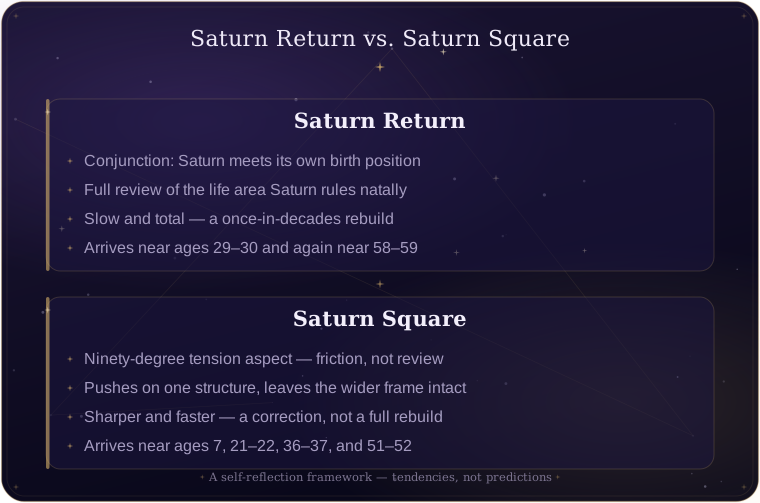
Surviving saturn return is often blurred with the Saturn square, and the two are close cousins that ask genuinely different questions. A Saturn return is a conjunction: Saturn meets its own birth position, so the whole area of life it governs in your chart comes up for a full review at once. A Saturn square — which arrives around ages 7, 21–22, 36–37, and 51–52 — is a ninety-degree tension aspect that works by friction, pushing on one part of the structure rather than reassessing the entire foundation. You can see how the square works in more detail in the square aspect in a birth chart.
The two call for different responses, and there is a real trade-off between them. To get the deep, once-in-decades rebuild a return offers, you sacrifice speed: it is slow and total, and forcing a quick answer usually backfires. To get the sharper, faster correction a square offers, you sacrifice completeness, because it fixes one strained joint but leaves the larger frame untouched. Treating a square like a return gets you drama without resolution; treating a return like a square gets you a patch where a rebuild was actually needed.
This is also why the return should not be blended with the slower outer-planet transits of Uranus, Neptune, or Pluto. Those reshape identity gradually over many years, while Saturn's return works on the concrete structures you can name out loud — work, commitment, obligation, the plans you have signed your name to.
How to Read This Transit in Your Timing
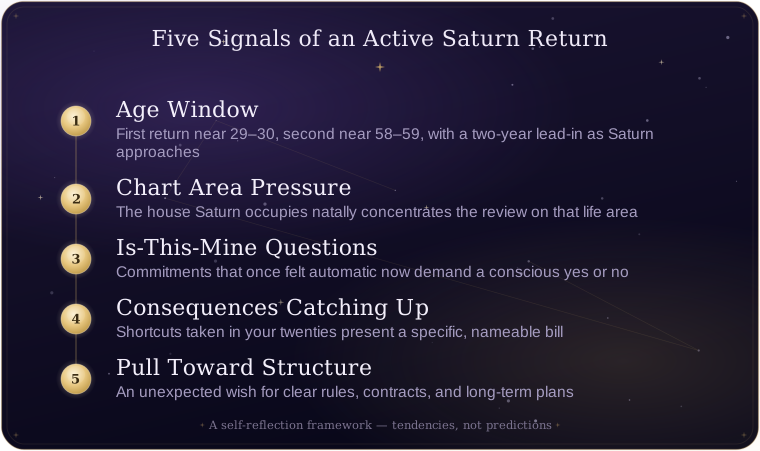
Reading surviving saturn return in your own timing comes down to a handful of observable signals rather than a mood. Watch for these markers:
- The age window. The first return lands near ages 29 to 30, the second near 58 to 59, with a two-year lead-in as Saturn approaches the exact point.
- The pressure on one chart area. Find the house Saturn sits in natally — that area, whether career, home, or partnership, is where the review concentrates.
- Recurring "is this mine?" questions. Commitments that once felt automatic start demanding a conscious yes or no rather than quiet continuation.
- Consequences catching up. Shortcuts taken in your twenties tend to present their bill in a specific, nameable way during this stretch.
- A pull toward structure. You might notice an unexpected wish for clear rules, contracts, or long-term plans where you once wanted things left open.
Common Misreadings
Most popular takes on surviving saturn return go wrong in a few repeatable ways, which is exactly why the topic feels so muddled. Correcting them keeps the reading useful:
- Reading it as a guaranteed catastrophe. The transit is a test, not a sentence; plenty of people rebuild quietly and come out steadier, with no visible crisis at all.
- Blurring it into generic life advice. "Be brave and follow your heart" is not a Saturn reading — the return is specifically about responsibility, structure, and what can bear weight.
- Confusing it with any hard year in your late twenties. A rough patch is not automatically the return; check the actual transit timing before you attach the label.
- Treating it as fate you must endure passively. It describes a tendency and a timing, not a fixed outcome, and how you respond genuinely shapes what gets rebuilt.
Surviving Saturn Return at a Glance
| Property | How It Works | Natal Anchor | How to Observe |
|---|---|---|---|
| Core theme | Tests whether built structures can hold weight | Natal Saturn's sign and house | Commitments suddenly feel heavier or open to review |
| First return | Saturn completes its first full orbit back to birth position | Around ages 29–30 | A career or relationship settled early starts to feel borrowed |
| Second return | Saturn returns to that same point a second time | Around ages 58–59 | Legacy, retirement, and long-term structures come up for review |
| Timeframe | A slow conjunction, not a single day | Roughly a two-year window per return | A lead-in period of pressure before the exact contact |
| Right response | Rebuild what is yours, release what is not | Whichever life area Saturn rules natally | Deliberate choices rather than reactive escapes |
Common Questions About Surviving Saturn Return
When does the Saturn return actually happen?
Saturn takes about 29.5 years to orbit, so the first return lands near ages 29 to 30 and the second near 58 to 59. The strongest effects usually span a roughly two-year window around the exact contact.
Is surviving saturn return always a crisis?
No. The return is a period of testing and rebuilding, and many people move through it steadily by taking their commitments seriously rather than dramatically.
How is it different from a midlife crisis?
A midlife crisis is a loose cultural phrase, while the return is tied to a specific, datable transit near age 29 and again near 58. The first return, in particular, arrives well before midlife.
Can I do anything to prepare for it?
You can note the timing, look at which life area your natal Saturn governs, and avoid locking in irreversible decisions out of panic. Preparation is mostly about slowing down and being honest about what is actually holding.
Reflection Prompts
- Think of a recent commitment that suddenly felt heavier than before — what about it stopped feeling automatic?
- Recall a structure you built in your early twenties; does it still hold weight, or are you quietly propping it up?
- Name one responsibility you keep avoiding, and picture what facing it directly this year would change.
Related Reading
- guide to the tenth house and career in a birth chart — the return often concentrates on work and public standing.
- meaning of natal Saturn by sign — shows which theme your specific return is set up to test.
- the lunar nodes and life direction — a useful pairing for reading long-term timing alongside Saturn.
- Saturn return (Wikipedia) — background on where the cycle comes from.
Take Action
This is not a clinical interpretation or mental health advice.
Explore Your Saturn Return by entering your birth date, and you'll get the exact date windows for your first and second return instead of a rough age estimate. Seeing those years mapped out turns a vague sense of pressure into a concrete stretch you can plan around — which is the whole point of reading a transit before it arrives rather than after.
Sources
- Robert Hand — mapped how Saturn transits describe the felt experience of maturation and taking responsibility
- Liz Greene — shaped the psychological reading of Saturn as a symbol of structure and growth rather than misfortune