What Is Total Solar Eclipse 2026?
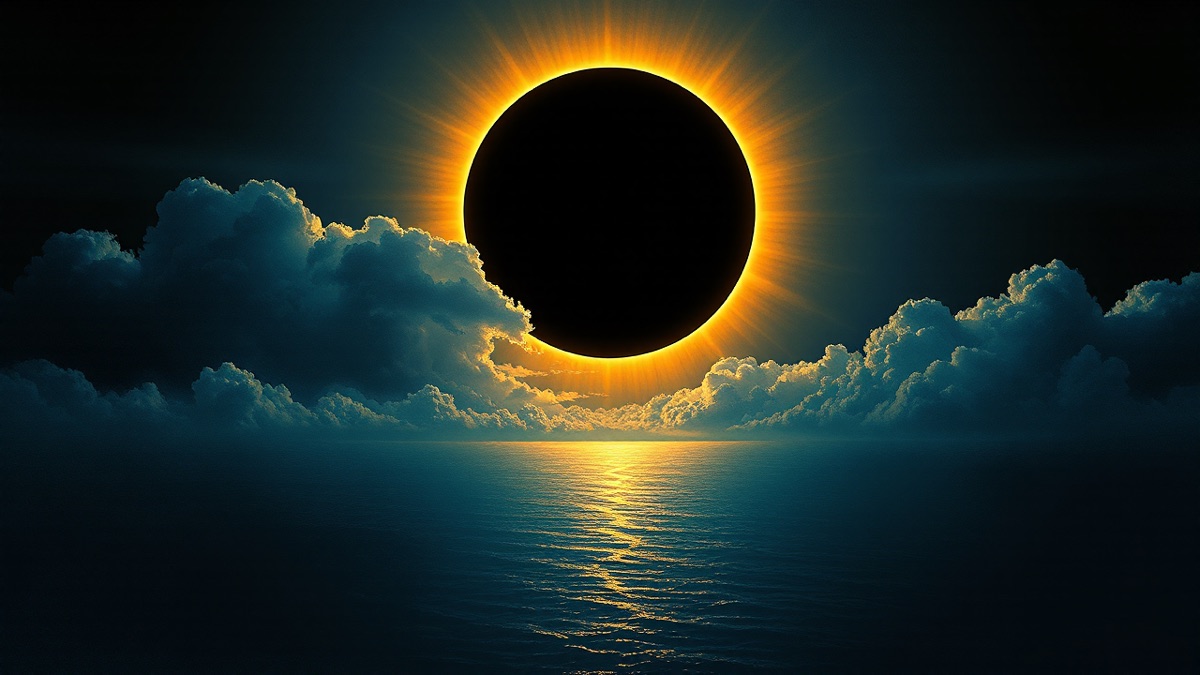
Total Solar Eclipse 2026 is the astrological label for the total solar eclipse of August 12, 2026, and in chart work it reads as a symbolic marker of endings and fresh starts, not a fixed prediction. Astronomically it is an ordinary, well-documented event: according to NASA, this eclipse reaches a magnitude of about 1.04 as the Moon fully covers the Sun along a narrow path over the far North Atlantic. Astrologers treat that alignment as an intensified New Moon — a reset point colored by the sign it lands in. Because it falls in Leo, its themes gather around visibility, creativity, and the nerve to be seen. What it can signify is a moment of emphasis and choice; what it cannot do is dictate a guaranteed outcome. It also sits inside the broader lunar-node axis behind every eclipse season, which frames how the year's eclipses relate to one another.
- Marks a Leo-season reset tied to identity, expression, and recognition
- Works like a supercharged New Moon rather than a routine daily transit
- Best used as a reflective prompt, never a guarantee of specific events
Why It Matters for Self-Awareness
Understanding Total Solar Eclipse 2026 matters because eclipse points tend to line up with moments people already sense are turning — a role winding down, a project about to go public, a relationship quietly changing gears. Used as a reflective lens rather than a forecast, it gives those shifts a vocabulary you can actually work with instead of a formless unease that follows you around.
What an honest reading gives you
The practical value shows up in a few concrete ways, and none of them require believing the sky controls your life:
- Naming a transition you already feel. When something is ending or beginning, the eclipse offers language for it, which makes the change easier to face than leaving it vague and anxious in the back of your mind.
- Timing an honest check-in. The date becomes a natural cue to ask what you've outgrown and where you want more visibility, the way you'd use the lunar nodes eclipses form on to structure the question rather than guess.
- Separating symbolism from certainty. The framework helps you reflect on your own patterns without sliding into the belief that a sky event is scripting your outcomes for you.
Read this way, the eclipse works less like a prophecy and more like a well-timed mirror. It doesn't tell you what will happen; it points at where your attention and energy already sit, and asks whether that's where you actually want them. That reframe is the difference between a tool for self-awareness and a source of low-grade dread.
Total Solar Eclipse vs the August 2026 Lunar Eclipse: What Actually Differs
Total Solar Eclipse 2026 is easy to blur with the lunar eclipse that follows it about two weeks later, but the two work in opposite directions, and treating them as one blob is where most misreadings begin.
How a solar eclipse works
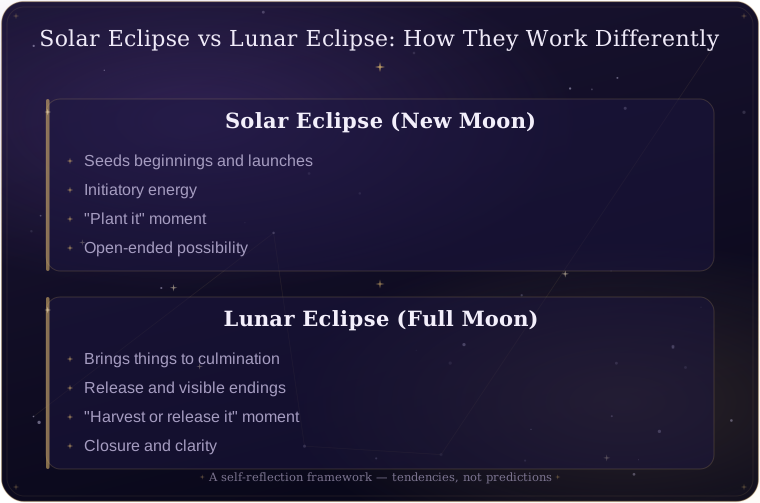
A solar eclipse belongs to the New Moon family, so the way it functions is initiatory — it points to seeds, launches, and beginnings that you may not fully see yet. A lunar eclipse belongs to the Full Moon family, so it works by bringing something to a head: culmination, release, and endings you can finally see clearly. Building on the person-centered reading of cycles Dane Rudhyar helped establish, many astrologers describe the solar eclipse as the "plant it" moment and the lunar eclipse as the "harvest or release it" moment. Same season, opposite instruction.
The trade-off, and the neighbors to keep separate
The trade-off is worth naming plainly. Lean into a solar eclipse's fresh-start charge and you gain momentum, but you sacrifice the closure a lunar eclipse is better at delivering. Choose the lunar eclipse's clarity about what to end, and you lose some of the open-ended possibility a beginning holds. It also helps to keep a third neighbor separate: an annular or partial solar eclipse is not the same as a total one, and stacking all of them into a single "eclipse energy" flattens the distinctions that make the framework useful in the first place. They are different tools for different jobs.
How to Read This Eclipse in Your Chart
You don't need advanced technique to work with this transit; you mostly need to know where it lands and what it touches. As Robert Hand's writing on transits emphasizes, the useful question is which part of your life the alignment actually activates, not what it "does" to you in the abstract. A few observable clues to look for:
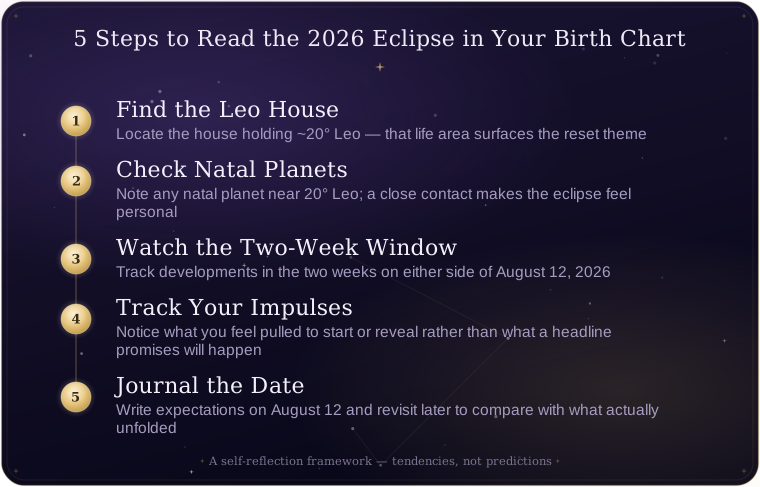
- Find the house that holds about 20° Leo in your chart — that life area is where the reset theme tends to surface.
- Notice any natal planet near 20° Leo; a close contact makes the eclipse feel far more personal and specific.
- Watch the two-week window on either side of August 12 for developments that fit the house's usual themes.
- Track what you feel pulled to start or reveal, rather than what a headline promises will happen to you.
- Journal the date so you can later compare the story you expected with the one that actually unfolded.
Treat these as prompts for observation, not a checklist that guarantees results. The point is to notice patterns in your own life, then decide what to do with them.
Common Misreadings
Total Solar Eclipse 2026 collects the same recycled myths every eclipse attracts, and the shallow versions tend to leave readers more anxious than informed. The misreadings worth correcting, one by one:
- "Eclipses are omens of disaster." Misread: something bad is guaranteed. Actually: it marks change and emphasis, which can be welcome or hard depending entirely on context.
- "It affects everyone the same way." Misread: one horoscope fits all. Actually: the impact depends on your own chart and the specific house involved.
- "Whatever happens is fated." Misread: the outcome is already sealed. Actually: the framework describes tendencies and timing, not a script you're powerless to shape.
- "Solar and lunar eclipses mean the same thing." Misread: they're interchangeable. Actually: one seeds beginnings while the other brings things to culmination.
Each of these turns a flexible interpretive tool into a rigid prophecy, which is precisely the boundary this page is trying to hold. The honest read stays with tendencies and timing and leaves the certainty out.
The 2026 Total Solar Eclipse at a Glance
| Property | How It Works | Natal Placement | How to Observe |
|---|---|---|---|
| New Moon family | Seeds beginnings and resets | House holding ~20° Leo | Note what you feel ready to start |
| Leo emphasis | Highlights visibility and self-expression | Natal Leo planets or the Leo house | Watch where you want to be seen |
| Two-week window | Concentrates the theme in time | Days around August 12, 2026 | Track events on either side of the date |
| Personal contact | Intensifies when it hits your chart | Planets near 20° Leo | Feel which contacts land closest |
Common Questions About the 2026 Eclipse
Is the total solar eclipse of 2026 a good or bad time astrologically?
Neither by default. Astrologically it marks emphasis and change in one area of life, and whether that reads as welcome depends on your chart and your circumstances.
Where will the 2026 total solar eclipse be visible?
The path of totality crosses parts of the far North Atlantic, including Greenland, Iceland, and Spain. Visibility is an astronomical detail and stays separate from how the eclipse is interpreted in a chart.
Do I need to perform a ritual for the eclipse?
No. Many people simply use the date to reflect or journal, and ritual is optional and cultural rather than a requirement of the framework.
How long does the eclipse's influence last?
Astrologers usually watch a window of roughly two weeks on either side of August 12, 2026, though the themes it names can keep unfolding more gradually after that.
Reflection Prompts
- Think of a recent moment when you wanted to be seen but held back — what stopped you?
- Where in your life does an ending currently feel closer than a beginning, and why?
- Recall a time you mistook a change for a catastrophe — how did it actually resolve?
Related Reading
- The Full Moon energy a lunar eclipse heightens — sits next to this page and sharpens the beginning-versus-ending contrast.
- The astrology houses — helps you locate which life area the eclipse activates.
- Solar eclipse of August 12, 2026 (Wikipedia) — the factual timeline this interpretation is anchored to.
Take Action
This is not a clinical interpretation or mental health advice — it stays a reflective framework, not a verdict on your future. Because the eclipse only becomes genuinely useful once you can see where the reset actually lands in your own chart, take the honest next step and generate your free birth chart to explore Total Solar Eclipse 2026.
Sources
- Dane Rudhyar — pioneered the psychological, person-centered reading of astrological cycles that frames eclipses as phases of growth
- Robert Hand — shaped modern transit interpretation, emphasizing which part of the chart an alignment activates