
What Is Argentina vs Spain 2026 World Cup Final Astrology?
Argentina vs Spain World Cup Final Astrology 2026 is a paired national-chart reading of the confirmed final, played on July 19, 2026 at New York New Jersey Stadium. FIFA’s official report records Spain’s 1-0 win over Argentina. This article uses the two national charts as a symbolic lens on the event’s narratives; it does not treat astrology as an explanation for, or prediction of, the result. It sits inside a broader pillar of World Cup 2026 astrology predictions, which maps tournament-related chart content.
- Pairs two national founding charts rather than reading a single team
- Anchors to one transit window: the July 19, 2026 final sky
- Stays symbolic and cultural, never a claim about the result
Why It Matters for Self-Awareness
Understanding Argentina vs Spain World Cup Final Astrology 2026 matters because it gives fans a cleaner way to hold two ideas at once: national identity and shared timing. Most people who follow a final are really tracking a story — momentum, morale, the mood of a whole country — and a paired-chart read puts language to that story instead of shrinking it down to a single win-or-lose verdict.
Where the real value sits
Building on the cyclic framework Dane Rudhyar established, this kind of read treats a final as one turning point in each nation's longer arc, not an isolated result. That reframing changes how you watch. Instead of asking only "who wins," you start noticing the emotional weather around a fixture: the weight a defending champion carries, the loose freedom an underdog plays with, the way a country's self-image shows up in how its team competes.
Take a concrete case. Argentina arrives as defending champion with a heavy narrative of expectation; Spain arrives as a possession-minded side often cast as the neutral's favorite. A chart-based frame lets you talk about that contrast as symbolic character rather than as pundit opinion. It also flags where the two national moods might diverge on the day — one side carrying the pressure of holding a title, the other playing with less to lose.
What an honest read gives you
For a reader, the payoff is reflective. The exercise quietly reveals how you personally weight a contest. Do you lean into the underdog narrative, the champion's pressure, or the broader cultural mood around a match? Whichever chart contrast you find most convincing says as much about your own storytelling instincts as it does about either team. If you want the underlying method, see our guide on how to read a birth chart alongside the official match record.
National-Chart Reading vs Whole-Tournament Winner Picks: What Actually Differs
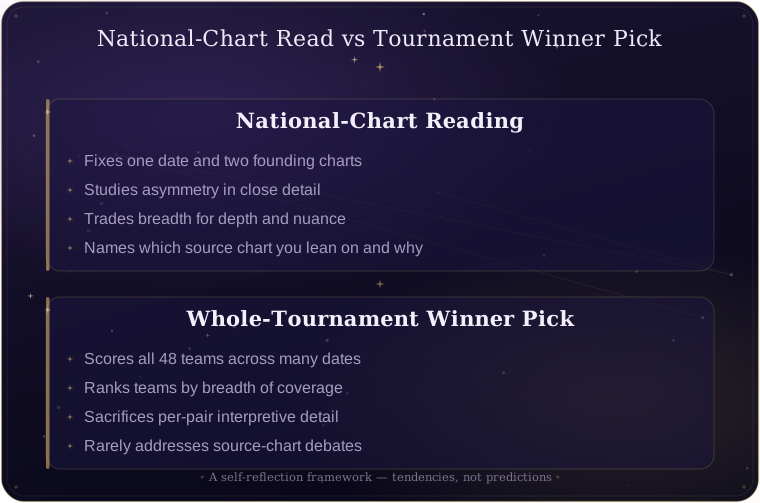
Argentina vs Spain World Cup Final Astrology 2026 answers a narrower question than a whole-tournament winner pick, and the two are easy to blur. A winner pick scans all 48 teams across a long run of dates and asks who might lift the trophy at New York New Jersey Stadium. A bilateral read looks only at two nations and asks how their founding charts contrast on one specific final day.
How breadth and depth trade off
The way each one works explains the gap. A whole-tournament pick functions by scoring many charts against many match dates and then ranking them; breadth is the entire point. A paired read does the opposite — it fixes one date and two charts, then studies the asymmetry between them in detail. To get that depth of contrast, you sacrifice breadth: a two-chart read tells you nothing about the other 46 teams, while a tournament grid rarely slows down enough to compare any single pairing closely. Choosing the paired frame gets you nuance, but you lose the wide-angle ranking. Neither format can quietly borrow the other's strength, so picking one is really a choice about the question you care most about — a wide ranking or a deep contrast.
What the paired read foregrounds
There is a second contrast worth naming. Argentina's independence is commonly traced to 9 July 1816, a chart mundane astrologers usually read with the Sun in Cancer, giving them a long-standing baseline to work from; Spain's modern national chart is debated and read several ways, so where its Sun falls is something this article treats as fan-disputed and unconfirmed rather than settled. That means a paired read is partly an argument about which founding chart you trust — a layer a quick winner-pick roundup skips entirely. To get a firm one-line ranking, that roundup sacrifices this kind of interpretive honesty about the source charts themselves. Naming which chart you lean on, and why, is part of the discipline here, not a footnote to skip. A roundup that hides that choice can look more confident than the evidence actually supports.
According to NASA, Jupiter takes about 12 years to complete one orbit of the Sun, so it lingers close to a year in each sign — which is why transiting Jupiter, which fans commonly place in Leo across the July 2026 sky (a position this article leaves unconfirmed rather than asserts), frames the whole 2026 final window rather than any single match. Its contact with Argentina's Cancer Sun is exactly the kind of specific transit a paired reading foregrounds. That broad transit context is better treated as background rather than proof of why a match ended as it did. A bilateral reading can use that context to discuss narratives around one specific final, but it should never convert it into a result claim. The two formats are different zoom levels: official reporting establishes the match facts; symbolic interpretation remains optional reflection.
How to Read This Matchup in the Transit Sky
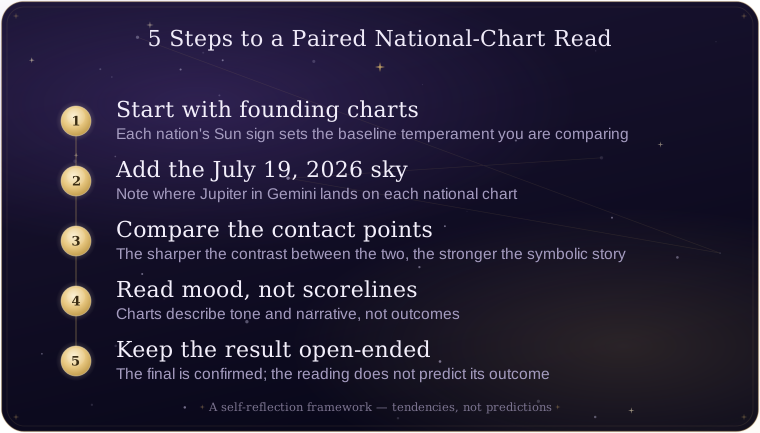
Reading this pairing comes down to a few observable moves rather than a mystical leap. Work through them in order, drawing on the transit-reading approach long associated with Robert Hand:
- Start with each nation's founding chart — its Sun sign sets the baseline temperament you're comparing.
- Use the July 19, 2026 sky only as optional symbolic context; the official record establishes the final’s date, venue and result.
- Compare the two contact points; the sharper the contrast, the stronger the symbolic story.
- Read morale and narrative mood rather than scorelines — charts describe tone, not outcomes.
- Hold the whole thing loosely: charts describe tone and narrative, not the result.
Once you've run those steps, the read almost writes itself: you end up with two short character sketches and one point of tension between them. That tension — not a predicted scoreline — is the actual deliverable. If both charts light up in different areas, treat that as a feature rather than a flaw; it simply means the day may favor two different kinds of story, and part of the fun is deciding which one you find more convincing.
Common Misreadings
A few misreadings trip people up, and most trace back to blending a final-specific read with tournament-wide picks. Argentina vs Spain World Cup Final Astrology 2026 tends to get distorted in these ways:
- Treating it as a prediction. The final was confirmed and completed: Spain beat Argentina 1-0. The read describes symbolic contrast, not a cause or forecast of that result.
- Confusing it with a 48-team forecast. A paired read covers exactly two nations, not the whole bracket.
- Reading squad form into the charts. A national chart reflects long-run cultural character, not this month's fitness, form, or injury list.
- Expecting one "cosmic winner." Two charts can both look strong on the same day, simply in different areas of life and mood.
Argentina vs Spain 2026 World Cup Final Astrology at a Glance
| Property | How It Works | Energy Center | How to Observe |
|---|---|---|---|
| Paired charts | Reads two founding charts side by side | Each nation's natal Sun sign | Compare the two Sun-sign temperaments |
| Transit window | Fixes one date's sky | July 19, 2026 transit positions | Note where transits fall on each chart |
| Interpretation boundary | Keeps facts separate from symbolism | Official final record | Use FIFA for the score, date and venue |
| Read type | Stays symbolic and cultural | National narrative and mood | Watch tone and morale, not scorelines |
Questions People Ask About Argentina vs Spain 2026 World Cup Final Astrology
Does Argentina vs Spain World Cup Final Astrology 2026 predict who wins?
No. It reads symbolic contrast between two national charts on final day. The transits describe mood and narrative, not the scoreline.
What factual result does this article use?
It uses FIFA’s official report: Spain beat Argentina 1-0 in the 19 July 2026 final at New York New Jersey Stadium. Astrology is presented only as optional symbolic reflection, not as an explanation of that result.
Is this the same as a World Cup 2026 winner prediction?
No. A winner pick ranks all 48 teams, while this looks only at two nations and how their charts differ. They answer genuinely different questions.
What is the right way to use this reading after the final?
Use it as symbolic reflection alongside the documented result, not as evidence for betting, causation or a retrospective scoreline claim. The official report is the source for match facts.
Reflection Prompts
- Think of a recent match where the mood of the crowd shaped how you read the result.
- Notice which team narrative — underdog or champion — you instinctively trust, and why.
- Recall a final where the story mattered to you more than the final score.
Related Reading
- how to read a birth chart — the base skill behind every paired-chart comparison here.
- ascendant meaning — context for how chart angles are interpreted.
- astrology houses — a guide to house-based chart reading.
- North Node vs South Node — another example of symbolic chart interpretation.
- square astrology — a reference for reading aspects without turning them into predictions.
- FIFA World Cup 2026 — official tournament coverage for the 19 July final at New York New Jersey Stadium.
Take Action
Cast both national charts against the July 19, 2026 sky and write down the single sharpest contrast you find — you'll end up with a one-page symbolic reflection on the final. Keep the official FIFA report beside it so match facts and personal interpretation stay clearly separate.
Sources
- Dane Rudhyar — pioneered the cyclic, person-centered reading of astrological timing this framing draws on
- Robert Hand — shaped the modern approach to interpreting transits against a base chart