
What Is Elvis Presley's Jyotish Natal Chart?
Elvis Presley's Jyotish natal chart is his birth chart cast in the Vedic sidereal zodiac rather than the Western tropical one, and that single swap quietly moves several of his core placements. Most popular write-ups treat the Elvis birth chart as a tidy Capricorn story. The Vedic version starts from the fixed stars themselves, applies a correction called the ayanamsa, and ends up placing his Sun in a different sign altogether. It reads the same birth moment against a different backdrop of stars, the way any careful guide to reading a birth chart frames the raw data before interpreting it. That one adjustment changes the emotional tone of the whole reading, from earthbound builder to restless seeker. Stripped to its core, it is a sidereal Vedic reading of Elvis Presley's birth positions.
- Reframes his tropical Capricorn Sun as a sidereal Sagittarius Sun
- Reads that Sun through the Purva Ashadha nakshatra as a cultural lens, not a verdict
- Leaves the ascendant open, since his exact birth time is still debated
Why It Matters for Self-Awareness
Most of us know the feeling of being read one way and living another — labeled the steady one at work while something restless runs underneath. Understanding the Elvis birth chart through this Vedic angle matters because it puts a name to that gap. The tropical reading hands you a familiar archetype; the sidereal one asks whether the familiar label is actually the truest one. In my own work — eight years in energy and aura practice, with a background in advertising — I've noticed people reach for a chart less for a forecast and more for a mirror they can sit with honestly.
Read this way, the chart becomes a prompt for a few specific kinds of self-reflection:
- Public self vs private drive. The Capricorn-to-Sagittarius shift models the difference between the disciplined face you show and the seeking that quietly powers it.
- Reinvention as a pattern. A Sagittarius Sun leans toward reaching past its origins, which is a useful lens for anyone whose life has kept remaking itself.
- Influence you didn't ask for. Purva Ashadha themes of reach and popularity invite a look at where your presence lands harder than you intend.
If you want to test the reframe on your own placements, a free birth chart calculator lets you see the sidereal and tropical versions side by side.
Sidereal Sagittarius vs Tropical Capricorn: What Actually Shifts
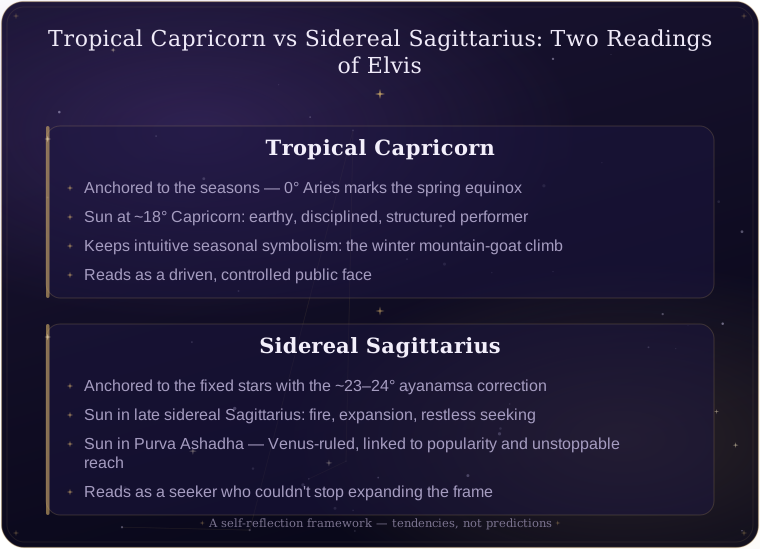
The Elvis birth chart is where the two zodiacs part ways most visibly. Tropical astrology, the standard in the West, anchors the zodiac to the seasons — 0° Aries is the spring equinox, full stop. Jyotish anchors it to the actual constellations, then subtracts the slow drift between the two with the ayanamsa. Because those constellations have crept away from the seasonal markers over the centuries, a Sun that reads as roughly 18° Capricorn tropically lands near the end of sidereal Sagittarius. Same sky, different starting line.
Here is how the trade-off actually works. To get the fixed-star fidelity that Jyotish prizes, you sacrifice the seasonal poetry that makes tropical Capricorn feel so intuitive — the depths of winter, the mountain-goat climb. To get that intuitive seasonal symbolism back, you give up the constellations lining up with their names. Neither version is hiding the real chart; each keeps one thing by letting go of another. According to NASA, Earth's axis wobbles through a full precession cycle of roughly 25,800 years, drifting about one degree every 72 years — and that drift is exactly what the sidereal zodiac tracks and the tropical zodiac sets aside. So the tropical Capricorn Elvis reads as a driven, structured performer, while the sidereal Sagittarius Elvis reads as a seeker who couldn't stop expanding the frame. Both can be true descriptions of the same man; they simply weigh his birth sky on different scales.
How to Read Elvis's Sidereal Chart in Your Own Study
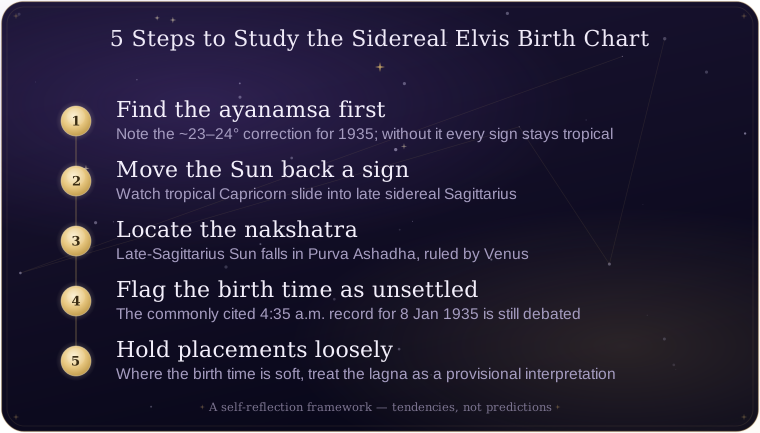
You don't need software fluency to work through the sidereal Elvis birth chart yourself — you need a few observable checkpoints. Treat these as things to notice rather than facts to prove:
- Find the ayanamsa first. Note the roughly 23–24° correction for 1935; without it, every downstream sign is a tropical reading in disguise.
- Move the Sun back a sign. Watch his tropical Capricorn Sun slide into late sidereal Sagittarius, and feel how the story tilts from builder to seeker.
- Locate the nakshatra. That late-Sagittarius Sun sits in Purva Ashadha, ruled by Venus — a lunar mansion traditionally linked to popularity and unstoppable reach.
- Flag the birth time as unsettled. The commonly cited 4:35 a.m. record for January 8, 1935 is debated, so treat any ascendant you calculate as provisional.
- Hold placements loosely. Where the birth time is soft, a specific house or lagna is a considered interpretation, not a settled record.
If the ascendant question interests you most, it helps to first understand ascendant and rising sign meaning in plain terms before deciding how much weight to give any single reading.
Common Misreadings
The confusion around the Elvis birth chart tends to cluster into a few predictable errors, and each one is easy to correct once you name it.
- **"He's really a Capricorn."** Neither zodiac is more real than the other. Tropical keeps the season; sidereal keeps the stars — the Sun sits in Capricorn on one map and Sagittarius on the other, and both are valid within their own system.
- "The Vedic chart reveals hidden facts." It doesn't uncover secrets. This is a symbolic reframing of the same birth moment, offering a different interpretive lens rather than a factual reveal about his life.
- "The nakshatra fixes his fate." Purva Ashadha describes themes and tendencies traditionally associated with reach and influence, not an outcome that was locked in. With his birth time unresolved, even the placement itself stays a thoughtful interpretation.
Elvis Presley's Jyotish Natal Chart at a Glance
| Property | How It Works | Energy Center | How to Observe |
|---|---|---|---|
| Sidereal Sun sign | Ayanamsa shifts the tropical Sun back into the prior sign | Fire (Sagittarius) | Note the Sun near the end of sidereal Sagittarius |
| Sun nakshatra | The Sun's degree falls inside a 13°20′ lunar mansion | Venus-ruled (Purva Ashadha) | Read themes of popularity and reach as a cultural lens |
| Ascendant (lagna) | Rising sign changes fast and depends on exact birth time | Varies with time of birth | Treat any specific lagna as provisional |
| Ayanamsa correction | Subtracts the star-vs-season drift for 1935 | ~23–24° offset | Confirm it was applied before trusting any sign |
Common Questions About Elvis's Vedic Chart
Was Elvis a Capricorn or a Sagittarius?
Both, depending on the zodiac. He's a Capricorn Sun in the Western tropical system and a Sagittarius Sun in the Vedic sidereal one, because the two systems measure the sky from different starting points.
Does the Vedic reading need his exact birth time?
The Sun sign and its nakshatra stay stable regardless, since the Sun barely moves in a day. The ascendant and house placements do need a confirmed time, and his is still debated, so those pieces remain interpretive.
What is the Purva Ashadha nakshatra associated with?
It's a Venus-ruled lunar mansion traditionally linked to themes of popularity, influence, and a reach that's hard to contain. Used as a reflective lens, it maps neatly onto how widely Elvis's presence traveled.
Is a sidereal chart more accurate than a tropical one?
Neither is objectively more accurate; they answer different questions. Sidereal tracks the constellations, tropical tracks the seasons, and each keeps one kind of meaning by setting the other aside.
Reflection Prompts
- Think of a moment when people read you as the "steady one" while something restless ran underneath — what were you actually seeking?
- Recall a time your life quietly reinvented itself; what did you reach toward that surprised you?
- Name a recent situation where your presence landed harder on others than you meant it to.
Related Reading
- how the twelve houses work in a birth chart — helps explain why a confirmed birth time changes so much of a Vedic reading.
- meaning of the lunar nodes in a natal chart — another placement that reframes an archetype once you know where it sits.
- Hindu astrology (Wikipedia)
- Sidereal and tropical astrology (Wikipedia)
Take Action
Run your own birth data through the calculator to see your tropical and sidereal placements together, the same way we split Elvis's Capricorn and Sagittarius Sun. You'll get a side-by-side chart that shows exactly which of your signs shift under the Vedic ayanamsa and which hold steady. Sitting with that gap often tells you something honest about the difference between the self you present and the one quietly steering the wheel — Generate Your Free Birth Chart and read both versions of your story.
Sources
- Traditional Jyotish teachings — the anonymous sidereal chart-reading lineage this interpretation draws on for the nakshatra and ayanamsa framing
- NASA — the axial precession figure used to explain why the sidereal and tropical zodiacs diverge