
What Is Moon in Cancer?
Moon in Cancer is the Moon positioned in Cancer, the cardinal water sign the Moon naturally rules. Because the Moon governs this sign, its instincts sit close to the surface and rarely get filtered. In everyday terms, the placement describes how a person seeks comfort, protects the people they love, and returns to familiar routines when life turns uncertain. Within the wider pillar guide to reading a birth chart, the Moon is one of three core points, alongside the Sun and the Ascendant. Traditional Jyotish readings often emphasize the Moon as the seat of `manas` — the mind's capacity for habit, receptivity, and psychological steadiness — which overlaps with, but is not identical to, the modern Western idea of the Moon as the "emotional core." In short, it reads as an emotional nature wired for security, memory, and belonging.
- Leads with felt safety and emotional memory over logic or bravado
- Rooted in the water element and a cardinal, initiating drive
- Easily mistaken for moodiness when it is really deep responsiveness
Why It Matters for Self-Awareness
Understanding moon in cancer matters because it names something people often feel long before they can put words to it: the quiet pull toward safety, the ache when home feels unstable, the reflex to take care of everyone else first. Knowing this changes how you read your own reactions instead of judging them. It also gives shape to how you bond, which is why the fourth house of home and family meaning often deepens the picture. The value shows up in a few concrete ways:
- Naming the reflex, not the flaw. When you go quiet under stress, you can read it as a need for retreat rather than proof that something is wrong with you.
- Seeing your attachment pattern. You tend to bond quickly and hold on tightly, so noticing that helps you tell secure closeness from anxious clinging.
- Reading your own timing. Because the Moon moves fast, your moods rise and fall with what is happening at home, so a low day reads as a passing tide rather than a crisis.
None of this is a verdict. It is a way to notice patterns you already live, so the next time your mood turns without warning, you have language for what your emotional self is actually asking for.
Cancer Moon vs Cancer Sun: What Actually Differs
Moon in Cancer differs from Sun in Cancer in a way that is easy to blur, yet telling them apart sharpens any reading. The Sun in Cancer describes the identity a person is consciously growing toward — a self built around nurturing, home, and emotional loyalty. The Cancer Moon describes the reflex that is already there before any conscious choice: the automatic "what do I need to feel safe" running quietly under the surface. One is the destination; the other is the starting instinct.
Here is how it works in practice. The Sun is the will a person develops over a lifetime, so a Cancer Sun tends to build warmth and care into their public purpose and long-term goals. The Moon is the instinct a person falls back on when tired or stressed, so a Cancer Moon shows up fastest in private, unguarded moments — the late-night worry, the urge to comfort a friend who is upset, the pull toward a familiar room. Someone can have one without the other, which is why two people who both "have Cancer energy" can feel completely different up close.
The trade-off runs both ways. A Cancer Sun gains a steady, care-centered identity but may over-identify with the caretaker role and lose sight of its own needs. A Cancer Moon gains deep emotional attunement but may need more emotional recovery time after conflict or change. How strongly any of this shows up depends heavily on the Moon's house, its aspects to other planets, and the Moon's phase at birth — a Cancer Moon squared by Saturn reads very differently from one supported by Venus.
How to Read Your Cancer Moon in the Chart
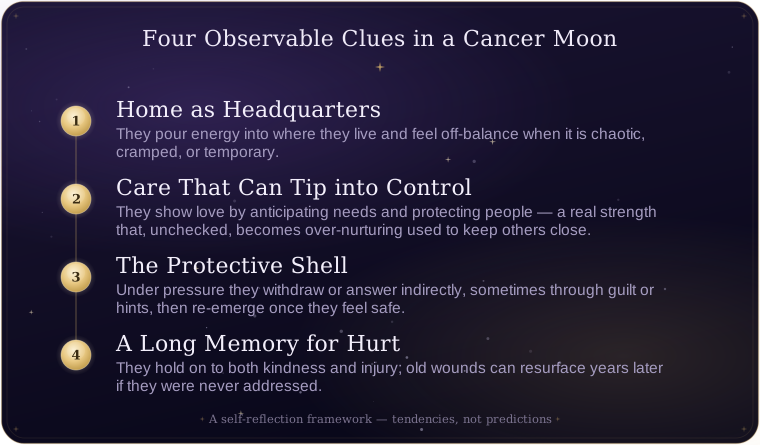
To read moon in cancer in a birth chart, look past the label and watch how a person handles closeness, comfort, and retreat. The Moon moves through a full sign in only about two and a half days, so this is a fast, fluctuating placement — the traits show up as recurring patterns, not a single fixed mood. A few observable clues make it easier to spot:
- Home as headquarters. They pour energy into where they live and feel off-balance when it is chaotic, cramped, or temporary.
- Care that can tip into control. They show love by anticipating needs and protecting people — a real strength that, unchecked, becomes over-nurturing used to keep others close.
- The protective shell. Under pressure they withdraw or answer indirectly, sometimes through guilt or hints rather than a plain request, then re-emerge once they feel safe.
- A long memory for hurt. They hold on to both kindness and injury; old wounds can resurface years later if they were never addressed.
To work with the placement rather than against it, three habits help: build restorative rituals that reliably refill you — a standing meal, a walk, a call home — instead of waiting until you are depleted; check your own capacity before you take on someone else's feelings; and when a mood spikes, write it down to separate real intuition from emotional projection.
In Vedic astrology, sidereal Cancer spans the fourth pada of Punarvasu, all of Pushya, and all of Ashlesha — nakshatras, or lunar mansions, each shading how the Moon expresses itself. These are best treated as an interpretive framework for nuance, not a fixed verdict about the future. Pairing the Moon's sign with its house shows where these needs play out most in daily life.
Common Misreadings
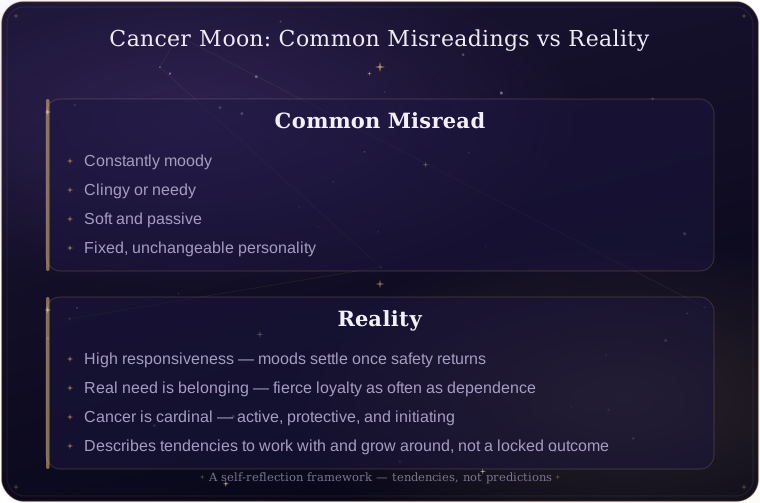
The most common misreadings of moon in cancer come from mistaking sensitivity for weakness, and clearing them up changes how the placement reads:
- Misread: it means someone is constantly moody. Actual: it means high responsiveness — moods move fast but often settle once safety returns. The honest caveat is that a hurt Cancer Moon can also let a mood linger and curdle into sulking.
- Misread: it makes a person clingy or needy. Actual: the real need is belonging, which shows up as fierce loyalty as often as dependence — though reassurance-seeking is a genuine growth edge here.
- Misread: it is "just" a soft, passive placement. Actual: Cancer is cardinal, an initiating sign, so the caretaking is active and protective; it moves toward people rather than only waiting for them.
- Misread: it predicts a fixed, unchangeable personality. Actual: it describes tendencies you can work with and grow around, not an outcome you are locked into.
Cancer Moon at a Glance
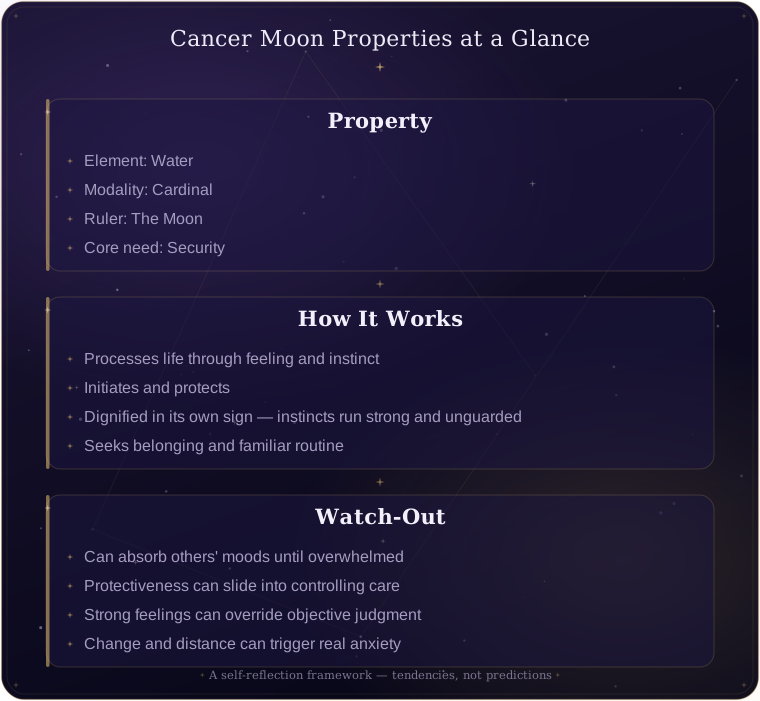
| Property | How It Works | Watch-Out | How to Observe |
|---|---|---|---|
| Element | Water — processes life through feeling and instinct | Can absorb others' moods until overwhelmed | Reads emotional undercurrents before words are spoken |
| Modality | Cardinal — initiates and protects | Protectiveness can slide into controlling care | Takes the lead in caring for and defending loved ones |
| Ruler | The Moon, dignified in its own sign | Strong feelings can override objective judgment | Shows strong, unfiltered emotional instincts |
| Core need | Security, belonging, familiar routine | Change and distance can trigger real anxiety | Circles back to comfort and known spaces when stressed |
Common Questions About the Cancer Moon
What does a Cancer Moon mean in a birth chart?
It marks the Moon in the sign it rules, so emotional instincts run strong and unguarded. It points to someone who seeks security, bonds through care, and treats home as an emotional anchor.
What is a Cancer Moon like in love and relationships?
The attachment style leans devoted and protective. They feel loved through consistency, remembered details, and physical closeness, and feel smothered when a partner is cold, unpredictable, or dismissive of feelings. The growth edge is asking for reassurance directly instead of testing a partner or withdrawing to see who follows.
Which Moon signs are most compatible with a Cancer Moon?
Water and earth Moons — Scorpio, Pisces, Taurus, Virgo — usually match its need for depth and steadiness. Fire and air Moons such as Aries, Sagittarius, Gemini, and Aquarius can feel exciting but may read as emotionally distant, so those pairings work best when both people name their needs out loud.
Is a Cancer Moon the same in Vedic and Western astrology?
Not always. The two systems use different zodiac boundaries, so your Western Moon sign can shift in the Vedic sidereal chart. Always confirm which system a reading uses before comparing.
Reflection Prompts
- Think of a recent moment when you felt truly safe — where were you, and who or what made it feel that way?
- Recall the last time home felt unstable. How did your mood and energy shift in response?
- Name one hurt you are still holding on to — what would it take to set it down?
This is not a clinical interpretation or mental health advice.
Related Reading
- how the square aspect works between planets — useful if your Moon forms a tense angle to Saturn or another planet.
- meaning of the Ascendant in a birth chart — shows how your outward style can differ from this inner emotional layer.
- guide to the lunar nodes north and south — adds context on the Moon's karmic axis in both Vedic and Western charts.
- Cancer (astrology) (Wikipedia)
Take Action
Ready to see where your Moon actually sits? Use Explore Astrology Tools to map your full birth chart and view your Moon's exact sign, house, and aspects together in one place. Seeing the placement in context often makes your emotional patterns feel less like moods to manage and more like needs to understand.
Sources
- Parashara, Brihat Parashara Hora Shastra — foundational classical text whose framework shapes traditional Moon-sign reading.
- B. V. Raman, Hindu Predictive Astrology — twentieth-century work that helped standardize modern Vedic chart interpretation.