
What Is First Saturn Return?
First Saturn Return is the first time the planet Saturn comes back to the exact degree it held in your birth chart. Saturn takes about 29.5 years to circle the Sun, so this return arrives only once in the late twenties, and astrology reads it as a chapter of honest, structural review. According to NASA, Saturn takes roughly 29.5 years to complete one orbit, which is why the first return lands in this age band and later repeats near age 58. The phrase saturn return age 27 points to the earliest edge of that window — not a fixed opening — because your natal Saturn position decides whether yours begins at 27, 28, 29, or 30, a timing you can trace in a full guide to reading a birth chart. Put in plain terms, the first Saturn Return is Saturn coming back to its birth position, roughly between ages 27 and 30.
- Marks a real transit window that lasts two to three years, not a single birthday
- Opens at its earliest edge near 27 and usually settles by age 30
- Timed by your natal Saturn's exact degree, so the start is unique to your chart
Why It Matters for Self-Awareness
Understanding saturn return age 27 matters because it hands late-twenties readers plain language for pressures they already feel — around career, commitment, and identity — instead of leaving those pressures unnamed. In my years applying pattern-recognition frameworks to chart structure, I have found that most people at this stage do not want a forecast; they want a name for the chapter they are already living. The first Saturn Return works as a reflection prompt, not a prediction, and knowing which house of your guide to the astrological houses holds natal Saturn shows where the questions are likely to land first.
That distinction changes how the whole stretch feels. Picture two readers turning 27. The first treats the age as a hard deadline, so an ordinary choice — leaving a stable job, ending or deepening a relationship, moving cities — starts to feel like a test they are already failing. The second treats the return as the opening edge of a two-to-three-year review, so the same choices read as a chapter they get to shape at their own pace. The pressure is genuine in both cases, and it often shows up as restlessness about work, commitment, or who you are becoming. The difference is that naming it as a review, rather than a verdict, tends to move you toward clarity about what you actually want to build.
There is also a practical payoff to getting the timing right. When you know your window may not open until 29, you stop measuring your life against a friend's schedule and start reading your own. That alone can ease the sense of being behind, because the return is orbital and symbolic, not a race everyone runs on the same day.
How First Saturn Return Differs From a Saturn Square
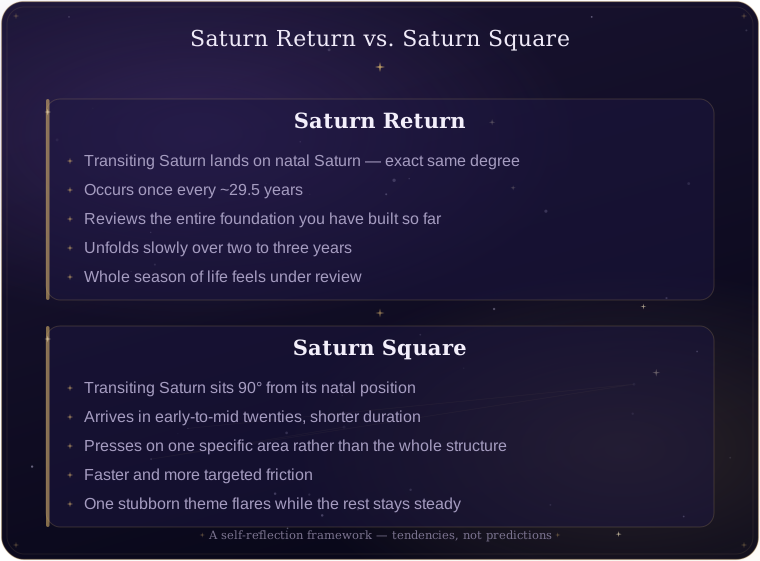
saturn return age 27 is easy to confuse with a Saturn square, because both are Saturn transits that raise hard questions about structure and commitment. The way they work sets them apart. A Saturn return happens when transiting Saturn lands back on your natal Saturn — a once-in-29.5-years alignment that reviews the entire foundation you have built so far. A Saturn square, including the closing (waning) square many people feel in their early-to-mid twenties, happens when Saturn sits at a 90-degree angle to its birth spot — a shorter friction point that presses on one area rather than the whole structure. This tradition of reading Saturn as a builder rather than a punisher descends from astrologers such as Dane Rudhyar and Liz Greene, who framed these passages as chapters of maturing instead of sentences handed down by fate.
The trade-off is worth naming plainly. To get the deep, foundation-wide review of a return, you sacrifice speed: it unfolds slowly across two to three years and resists any quick fix. To get the sharper, faster prompt of a square, you sacrifice scope: it leans on a single theme and then passes. So if a whole season of your life feels under review, you are likely in the return; if one stubborn area keeps flaring while the rest holds steady, a square is the better fit. Neither is a punishment; both are invitations to build something you can actually stand on. To check which, compare the explainer on the Saturn square aspect against your current age and natal degree.
How to Read This Transit in Your Timing
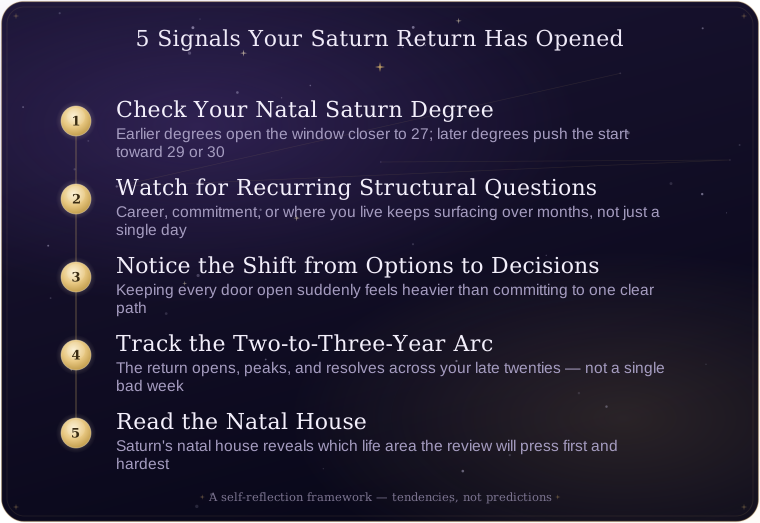
You can spot the opening of saturn return age 27 by watching for a few concrete signals rather than waiting for one dramatic event. Read the timing against your own chart with these clues:
- Check your natal Saturn degree. The earlier the degree, the closer to 27 your window tends to open; later degrees push the start toward 29 or 30.
- Watch for recurring structural questions. Career direction, a commitment, or where you live keeps pushing to the front of your mind over months rather than passing in a day.
- Notice a shift from options to decisions. You may find that keeping every door open suddenly feels heavier than committing to one clear path.
- Track the two-to-three-year arc. The return is not a single bad week; it opens, peaks, and resolves across a stretch of your late twenties.
- Read the natal house. The life area ruled by Saturn's house is usually where the review presses first and hardest.
Taken together, these signals help you locate where you actually are in the window instead of assuming the clock started the day you turned 27.
Common Misreadings
Most quick write-ups get saturn return age 27 wrong in a few predictable ways, and those errors are exactly what send readers searching for a clearer answer. Here is what the popular framing tends to miss:
- Misreading: 27 is the fixed start. In reality, 27 is only the earliest edge; many charts open the return at 28, 29, or 30, depending on natal Saturn's degree.
- Misreading: the return is a single dramatic event. In reality, it is a slow window of two to three years, not a birthday that flips your life overnight.
- Misreading: it predicts specific outcomes. In reality, it describes a theme of structural review, so it prompts reflection about career or commitment rather than forecasting what will happen.
- Misreading: everyone feels it at the same age. In reality, the exact timing is set by your chart, which is why two friends born a year apart can reach it on different schedules.
First Saturn Return at a Glance
| Property | How It Works | Natal Anchor | How to Observe |
|---|---|---|---|
| Timing window | Saturn returns to its natal degree over about two to three years | Set by your natal Saturn's exact degree | Notice recurring pressure building near ages 27 to 30 |
| Earliest edge | Age 27 is the opening boundary, not the true start | Earlier natal degrees can open the window sooner | Track when structural questions first surface |
| Typical close | Usually resolves by age 30 | Later natal degrees push the close toward 30 | Look for decisions finally settling into place |
| Core theme | A structural review of commitments and identity | The natal house holding Saturn colors the focus | See which life area asks for the most honesty |
Common Questions About First Saturn Return
Does the first Saturn Return always start at age 27?
No — 27 is the earliest edge of the window, not a fixed start. Your natal Saturn degree determines whether it opens at 27, 28, 29, or 30.
How long does the first Saturn Return last?
It typically runs two to three years and usually resolves by age 30. The influence builds, peaks, and eases rather than arriving all at once.
Why do different sites list the age as 27, 27-30, or 27-31?
Each source rounds the roughly 29.5-year orbital cycle differently, which is why the titles vary. The steady fact is that Saturn returns to its birth degree in the late twenties, so the range is symbolic, not exact.
Is the Saturn return the same for everyone born the same year?
Not exactly. The window is set by each chart's natal Saturn position, so both the timing and the focus shift from person to person.
Reflection Prompts
- Think of a recent decision about your career that felt heavier than it should have — what was it really asking you to commit to?
- Recall a moment this year when keeping every option open left you more anxious, not freer.
- Name one part of your identity you have quietly outgrown but keep performing out of habit.
Related Reading
- guide to the ascendant and rising sign — your rising sign shapes how the Saturn return chapter shows up in daily life
- explainer on the lunar nodes and life direction — pairs well with the return's focus on identity and long-term direction
- Saturn return (Wikipedia) — a neutral overview of where the idea comes from
- Saturn (Wikipedia) — the astronomy behind the timing
Take Action
Run your birth date, time, and place through the calculator to see the exact years your first Saturn Return opens and closes. You'll get your personal window instead of a generic 27-to-30 guess, which turns a vague dread of turning 27 into a timeline you can actually plan around and reflect on. This is not a clinical interpretation or mental health advice. Explore Your Saturn Return
Sources
- Dane Rudhyar — pioneered the psychological, person-centered reading of astrological cycles like the Saturn return
- Liz Greene — developed the depth-psychology approach that frames Saturn transits as chapters of maturing rather than fate