
What Is Saturn Return in Cancer?
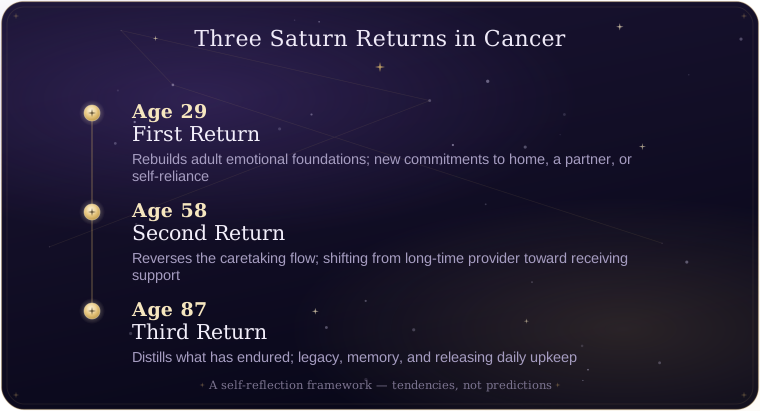
Saturn return in Cancer is the stretch of time when transiting Saturn circles back to the exact degree it held in Cancer on your birth chart, asking you to rebuild the emotional and domestic parts of life on steadier ground. It is not a single day but a window of about two to three years. Because Cancer governs roots, caretaking, and belonging, this passage tends to test how well you provide safety for yourself and the people who depend on you. The first pass arrives near age 29, the second near 58, and a third, for those who reach it, near 87. Learning to guide to reading a birth chart makes it easier to see where Saturn has been working slowly all along. In short, this passage reads as a maturity checkpoint for home, family, and emotional security.
- Concentrates on emotional foundations, family roles, and the meaning of home
- Runs on a fixed astronomical clock rather than a mood or a decision
- Feels heaviest when caretaking has quietly outgrown its old limits
Why It Matters for Self-Awareness
Understanding saturn return in cancer matters because it marks the point where your private support system — the home you keep, the people you tend, and the version of safety you absorbed growing up — stops running on autopilot and asks to be chosen on purpose. In my years applying pattern-recognition frameworks to chart structures, the clearest signal here is not sudden drama but a slow audit of who you take care of, and why. This passage tends to show up in ordinary, concrete places rather than in abstract feelings, which is exactly what makes it easy to overlook until the pressure builds.
The value tends to surface in a few recognizable situations:
- The caretaker's reckoning. You may notice that a family role you accepted at twenty no longer fits the life you have built, and that quiet mismatch finally becomes too loud to ignore.
- The home question. Choices about where you live, whether to put down roots, or how to support aging parents often arrive with unusual weight and refuse to be postponed.
- The security rewrite. Many people with this placement describe rebuilding their sense of safety from the inside out, trusting stability they have earned over habits they inherited.
- The identity check. You might find yourself asking whether the life you built reflects your own needs or the expectations you absorbed early, and the honest answer often reshapes the decade that follows.
Building on the framework Dane Rudhyar established for reading cycles as stages of growth, the point of all this is reflection, not prediction. Liz Greene treats the Saturn return as a threshold rather than a catastrophe — a test of whether the life you built is genuinely yours or merely a response to old pressure. Read that way, it offers a framework for thinking about maturity, not a verdict about your future. The practical payoff is timing: knowing which season is asking for this review lets you meet it deliberately instead of scrambling once the pressure is already high.
How a Saturn Return Differs From a Saturn Square
saturn return in cancer differs from a Saturn square mainly in scope: a return completes the full circle, while a square marks only a quarter-turn of tension partway through the cycle. Here is how each one works. A Saturn square — which you can read more about in how the square aspect works in a birth chart — arrives around ages 7, 21, and 36, applying friction that pushes you to adjust course without demanding a full rebuild. A Saturn return, by contrast, closes the entire 29-year loop and asks for a complete account of what you have actually constructed.
The trade-off is worth naming directly. To get the deeper, structural reset of a return, you sacrifice the quick relief a square tends to offer — a square usually resolves within months, while a return reshapes commitments that can take years to settle. Choosing to treat this passage as a genuine return, rather than just another rough patch, gets you foundations that last, but you give up the option of a fast fix.
Scope is also why the first and second returns feel so unalike. The first return in Cancer often lands while you are still assembling a home and deciding who counts as family, so the rebuild points forward. The second, decades later, reviews those same structures after they have been lived in, which is why it reads less like construction and more like an honest inventory of what held up. One boundary matters throughout: this transit should not be blended with the outer-planet transits of Uranus, Neptune, or Pluto — those describe slow, generational pressure shared by a whole age group, while Saturn's return is a personal ledger of the emotional structures you built yourself.
How to Read This Transit in Your Timing
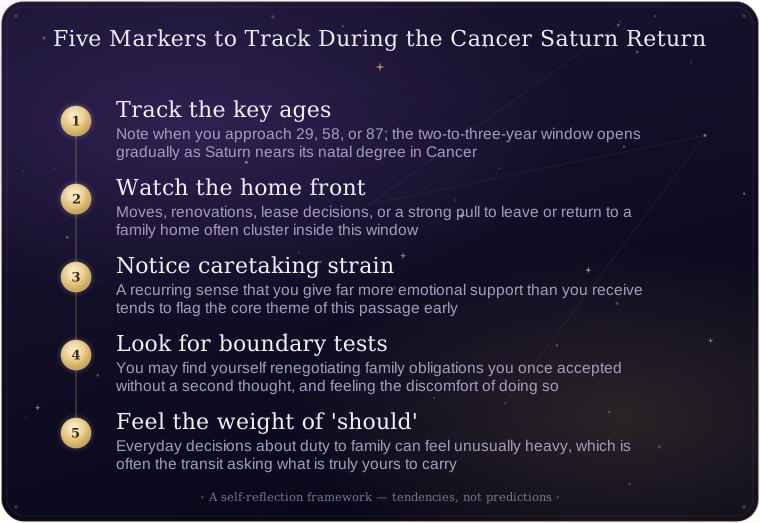
You can spot saturn return in cancer by watching for concrete shifts in daily life rather than waiting for one dramatic sign to announce itself. A handful of markers are worth tracking as the window opens:
- Track the key ages. Note when you approach 29, 58, or 87; the two-to-three-year window opens gradually as Saturn nears its natal degree in Cancer.
- Watch the home front. Moves, renovations, lease decisions, or a strong pull to leave or return to a family home often cluster tightly inside this window.
- Notice caretaking strain. A recurring sense that you give far more emotional support than you receive tends to flag the core theme of this passage early.
- Look for boundary tests. You might find yourself renegotiating family obligations you once accepted without a second thought, and feeling the discomfort of doing so.
- Feel the weight of "should." Everyday decisions about duty to family can feel unusually heavy, which is often the transit asking what is truly yours to carry.
Common Misreadings
Popular write-ups tend to blur what this transit actually asks, which leaves readers stuck on the wrong worry and bracing for the wrong thing. Sorting the myth from the pattern usually loosens most of that dread. Four misreadings come up most often:
- "It plays out the same at 29 and 58." The first return builds your adult foundations, while the second, near 58, often reverses the caretaking flow so the long-time provider begins to need support. Treating the two as identical erases the generational context that gives each pass its distinct meaning.
- "Cancer means it is only about your mother." Family of origin is one important thread, but this passage covers home, chosen family, and your own capacity to nurture. Reducing it to a single relationship misses most of what is being restructured.
- "Saturn here simply means loss." The pressure tends to strip away what was never truly yours to carry, which many people experience as relief rather than pure hardship. What remains is usually what you actually value.
- "The changes are all external." Much of the real work is internal — how you define safety, whom you allow close, and what you stop apologizing for — even when the outer signs look quiet. The visible moves are often just the surface of a deeper repositioning.
The Cancer Saturn Return at a Glance
| Property | How It Works | Natal Placement | How to Observe |
|---|---|---|---|
| First return | Rebuilds adult emotional foundations | Natal Saturn in Cancer, near age 29 | New commitments to home, a partner, or self-reliance |
| Second return | Reverses the caretaking flow | Same natal degree, near age 58 | Shifting from provider to needing support |
| Third return | Distills what has endured | Same natal degree, near age 87 | Legacy, memory, and releasing daily upkeep |
| Core theme | Tests emotional security | Cancer's house in your chart | Where home and belonging feel most weighted |
Common Questions About the Cancer Saturn Return
What does saturn return in cancer mean in simple terms?
It means Saturn has circled back to its birth position in Cancer, prompting a rebuild of your emotional foundations, family roles, and sense of home. The effect tends to unfold across a two-to-three-year window rather than in a single moment, which is why it often feels like a slow season instead of an event.
At what age does the Cancer Saturn return happen?
According to NASA, Saturn takes about 29.5 years to complete one orbit, so the return recurs near ages 29, 58, and 87. Each pass revisits the same Cancer themes of home and security, but at a very different stage of life.
Is the second Saturn return different from the first?
Yes. The first, near 29, builds your adult structures, while the second, near 58, often flips the caretaking dynamic so that support begins to flow back toward you rather than only away from you.
Does this transit only affect people with a Cancer Sun?
No. It applies to anyone with natal Saturn in Cancer, whatever their Sun sign, and it activates the house where Cancer sits in the chart, which localizes where the pressure lands.
Reflection Prompts
- Think of a recent moment when a family role felt heavier than it should — which part of it is genuinely yours to carry?
- Recall the last time you chose where to live; did that choice reflect earned security or inherited habit?
- Name one caretaking task you took on years ago that no longer fits the life you have built now.
Related Reading
- rising sign meaning and how it shapes a chart — the ascendant shapes how this transit's changes show up to other people.
- how the trine aspect works in a birth chart — supportive Saturn contacts can soften the pressure of the return.
- Saturn return (Wikipedia) — background on how the return is defined across every sign.
Take Action
Run your birth data through the Explore Your Saturn Return tool to pinpoint the exact degree and window of your Cancer return. It returns the dates for each pass and the natal house the transit activates, so the timing stops being guesswork. Seeing when your emotional foundations come up for review makes it easier to meet the moment on purpose instead of only recognizing it in hindsight.
Sources
- Dane Rudhyar — pioneered the psychological, person-centered reading of astrological cycles and life stages
- Liz Greene — developed the depth-psychology approach to Saturn as a symbol of maturation and threshold