
What Is Saturn Return in Taurus?
Saturn Return in Taurus is the roughly two-year window when transiting Saturn circles back to the exact degree it held in Taurus at your birth. In plain terms, it is a scheduled re-audit of your material security and self-worth. This differs from simply having Saturn sitting in Taurus permanently in your chart: the return is a moving event with a start and an end, not a fixed birth-chart trait you carry for life. Reading it well starts with knowing your pillar guide on how to read a birth chart, because the house Saturn occupies decides which part of your life feels the pressure. Knowing which version you are dealing with — a passing return or a lifelong placement — keeps you from over-reading an ordinary season as a permanent verdict. According to NASA, Saturn takes about 29.5 years to complete one orbit, which is why this passage recurs near ages 29 and 58.
- Marks a values-audit tied to earned resources, the body, and slow-built commitments
- Recurs near ages 29 and 58 as Saturn completes its orbital return to the birth degree
- Filters that review through the natal house where Saturn sits, not a generic age timeline
Why It Matters for Self-Awareness
Saturn Return in Taurus matters because it hands you a concrete window to examine how you build stability, instead of a vague sense that life has gotten heavier. In my years applying data-driven pattern recognition to how charts are structured, the clearest split I keep seeing is between people describing a lifelong Taurus caution and people describing a specific two-year squeeze around 29 — and only the second one is the return. Because the effect is routed through the guide to the astrological houses in a birth chart, two people born the same year can live the window very differently. Naming the return as a bounded event, rather than a mood, gives you something you can plan around and measure. That framing turns a diffuse sense of pressure into a short list of what stability you are actually building and why.
This passage tends to bring three things about yourself into sharper focus:
- How you earn and hold resources. You may notice old habits around money, saving, and comfort getting stress-tested until only the sturdy ones survive.
- Where your self-worth is borrowed. The window often reveals which parts of your value you tied to income, status, or possessions rather than to yourself.
- Which slow commitments are worth keeping. Long-running arrangements — jobs, leases, relationships built on routine — ask to be renewed on purpose or released.
How the Transit Differs From Natal Saturn in Taurus
People most often confuse Saturn Return in Taurus with natal Saturn in Taurus, and getting the difference right changes how you read everything else. Natal Saturn in Taurus is a permanent value-lens you were born with; it colors how you treat money, comfort, and patience your whole life. The return is a timed event: that same planet circling back to your exact birth degree for about two years. Here is how it works in practice — the natal placement sets the theme, and the return turns up the volume on that theme around ages 29 and 58. This reading follows the psychological tradition Liz Greene helped shape and the person-centered cycle work Dane Rudhyar established, both of which treat the return as a review rather than a punishment. Both frames matter here because they keep the focus on growth you can direct rather than fate you simply endure.
The trade-off is real and worth naming plainly. To get the steadying, long-term rebuild the return offers, you sacrifice speed and easy comfort in the short run; the window tends to slow things down before it stabilizes them. Put another way, choosing to rebuild a foundation now over patching it later gets you durability, but you lose the quick fix. The practical upshot is that patience pays here in a way that shortcuts do not, because the structures you set now are the ones you live inside for the next cycle. This also differs from a passing page on the Saturn square aspect, which applies pressure for a few months rather than restructuring an entire value system over two years.
How to Read This Transit in Your Timing
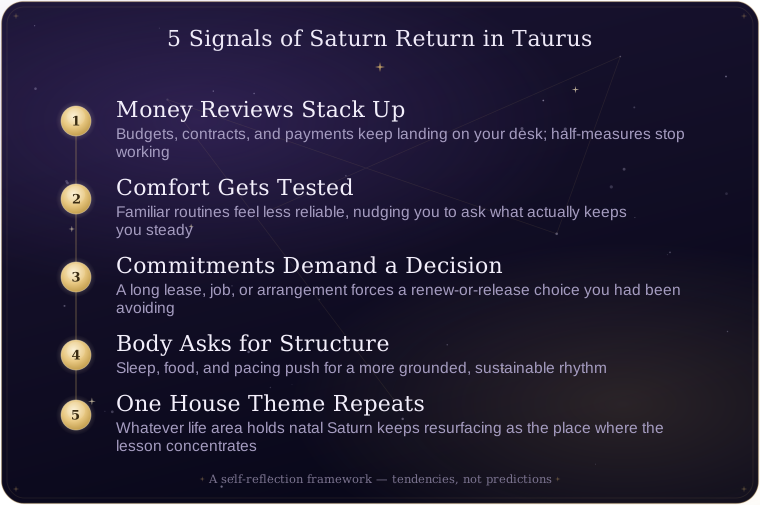
You can spot Saturn Return in Taurus by watching for concrete, repeating signals rather than one dramatic day:
- Money reviews stack up. Budgets, contracts, and payments keep landing on your desk, and half-measures stop working.
- Comfort gets tested. Familiar routines feel less reliable, nudging you to ask what actually keeps you steady.
- Slow commitments demand a decision. A long lease, job, or arrangement forces a renew-or-release choice you had been avoiding.
- Your body asks for structure. Sleep, food, and pacing often push for a more grounded, sustainable rhythm.
- One house theme repeats. Whatever life area holds natal Saturn keeps resurfacing as the place where the lesson concentrates.
Common Misreadings
- "It is the same as my natal Saturn." Natal Saturn is a lifelong placement; the return is a two-year transit that briefly activates it. Treating them as one thing is the single most common mix-up.
- "It only strikes at exactly 29." The window opens and closes over roughly two years around 29 and again near 58, not on a single birthday.
- "Taurus means it is only about money." Money is part of it, but the deeper subject is self-worth, the body, and what you are willing to build slowly.
- "The return decides my future." Astrology describes patterns, not outcomes; your house context, choices, and circumstances shape how the window actually goes.
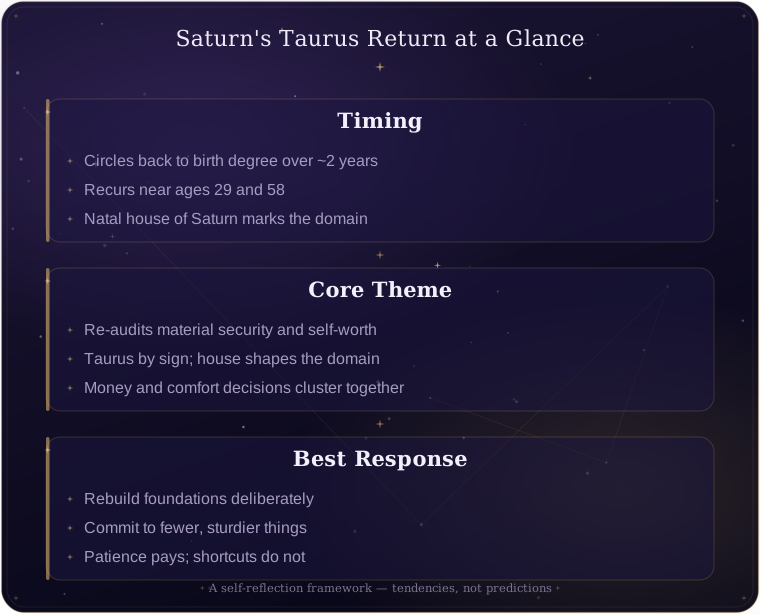
Saturn's Taurus Return at a Glance
| Property | How It Works | Natal Anchor | How to Observe |
|---|---|---|---|
| Timing | Saturn circles back to its birth degree over about two years | Natal house of Saturn | Recurs near ages 29 and 58 |
| Core theme | Re-audits material security and self-worth | Taurus by sign, house by domain | Money and comfort decisions cluster together |
| Pace | Slow, incremental restructuring | Fixed-sign steadiness | Nothing resolves overnight |
| Best response | Rebuild foundations deliberately | Varies with Saturn's house | You commit to fewer, sturdier things |
Common Questions About the Taurus Saturn Return
What is the difference between Saturn Return in Taurus and natal Saturn in Taurus?
Natal Saturn in Taurus is a fixed birth-chart placement you keep for life. The return is a temporary transit, lasting about two years, that briefly reactivates that placement.
At what age does this transit actually happen?
It centers on roughly age 29 for the first return and near 58 for the second. Because Saturn's orbit is about 29.5 years, the exact dates depend on your birth chart, not a flat calendar.
Does the Taurus return only affect money?
No. Money is one expression, but the wider theme is self-worth, the body, and slow-built commitments. The natal house of Saturn shows which of these areas feels it most.
How long does the window last?
Most readers experience it as a two-year passage, with the pressure building, peaking, and easing rather than arriving all at once. As a rough guide, count close to a year of build-up before the exact hit and close to a year of consolidation after it, which is why the passage rarely feels like a single event.
Reflection Prompts
- Think of a recent purchase you defended to yourself — what did it reveal about where you place your worth?
- Recall a moment this year when comfort felt tested; what were you actually trying to protect?
- Name one slow commitment you keep renewing out of habit rather than clear value.
Related Reading
- explainer on the ascendant and rising sign — helps you see how the whole chart frames where Saturn's pressure shows up.
- guide to the lunar nodes in a birth chart — pairs well when the return coincides with a shift in life direction.
- Saturn return (Wikipedia) — background on the transit as an astrological milestone.
- Saturn (Wikipedia) — the astronomical body whose orbit sets the timing.
Take Action
The Taurus return is a pattern to work with, not a verdict. This is not a clinical interpretation or mental health advice. To make it concrete, run your birth details through the Saturn return calculator to see the exact dates your window opens and which natal house it activates. Explore Your Saturn Return and you get a personalized timeline instead of a generic 29-and-58 guess — a clearer sense of when to rebuild what you value most.
Sources
- Liz Greene — shaped the psychological reading of Saturn as a developmental rather than punishing influence
- Dane Rudhyar — established the person-centered, cyclic approach to interpreting astrological returns