
What Is the Swift–Kelce Synastry Chart?
The Swift–Kelce synastry chart is a side-by-side comparison of two birth charts — Taylor Swift's Sagittarius-heavy stack and Travis Kelce's Libra-heavy stack — read together to see how their planets line up. In plain terms, it is a side-by-side map of how two people's planets interact.
- Compares two full birth charts instead of only two Sun signs
- Centers on Moon, Venus, and Mars contacts that set the relationship's tempo
- Often paired with a composite chart, the single blended chart some astrologers nickname a "supercouple" chart
Fans searching Taylor Swift and Travis Kelce usually land on a quick Sun-sign verdict — Sagittarius meets Libra — but the synastry reading goes a layer deeper, weighing the chart aspect by aspect. This sits alongside the broader synastry chart compatibility guide, which explains how chart-to-chart reading works for any pair, not just celebrities.
Why It Matters for Self-Awareness
Most trend-cycle coverage stops at the Sun signs, and that is exactly where readers get stuck. The headline "Sagittarius and Libra are compatible" feels like an answer, but it skips the parts of the chart that describe how two people actually move through a day together. When the takes on Taylor Swift and Travis Kelce conflict — one calls them a destined supercouple, another raises concerns about a rumored wedding date — readers have no framework to tell which read is grounded and which is guesswork. The friction shows up in a few recurring ways:
- The Sun-sign shortcut. People assume two Sun signs settle compatibility, then feel let down when the real relationship looks more complicated than the matchup chart promised.
- The certainty trap. A confident "they're meant to be" reading reads as fact, when synastry only describes tendencies and patterns, not fixed outcomes.
- The missing variables. Without Moon, Venus, and Mars contacts, readers are working with maybe a tenth of the picture and don't realize the rest exists.
Learning to read a synastry chart gives you a way to filter those takes — and the same lens applies to your own relationships, not just a famous couple's.
Full Synastry vs Sun-Sign Compatibility: What Actually Differs
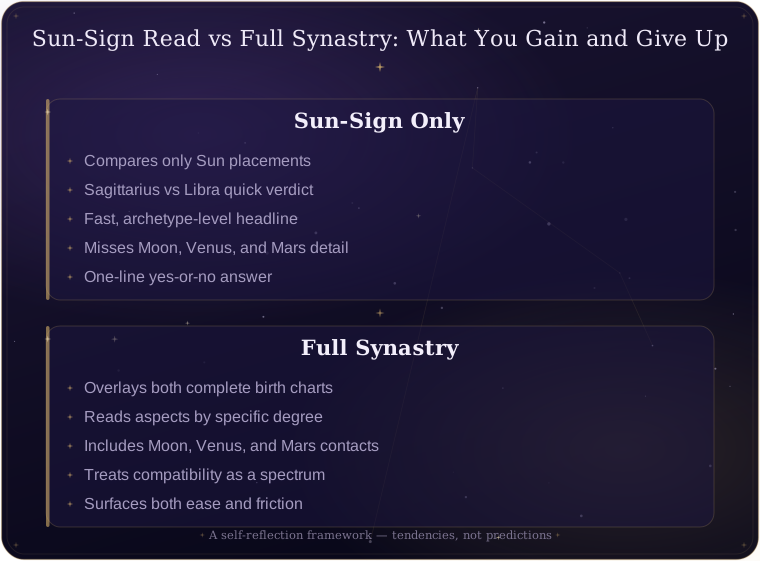
Taylor Swift and Travis Kelce get framed two ways online, and the two methods answer different questions. Sun-sign compatibility looks only at where each person's Sun sits and compares the two — Sagittarius against Libra — to produce a fast, archetype-level verdict. Full synastry overlays both complete charts and reads the specific aspects between them: how Swift's Moon contacts Kelce's Venus, how their Mars placements line up, how close each connection sits in degrees. The way it works is comparative — every planet in one chart is measured against every planet in the other.
The trade-off is real. To read the Swift–Kelce pairing through Sun signs alone gets you a shareable headline in seconds, but you give up the Moon, Venus, and Mars detail that actually sets the relationship's tempo. Choosing full synastry over the Sun-sign take buys you precision and nuance, but you lose the tidy one-line answer — a full reading often surfaces both easy contacts and friction in the same pair. Building on the synastry framework Robert Hand helped formalize, the deeper read treats compatibility as a spectrum of specific contacts rather than a yes-or-no label. If you want a faster sense of one piece of it, a closer focus on Venus contacts covers just the affection layer.
How to Read the Swift–Kelce Synastry Chart in Practice
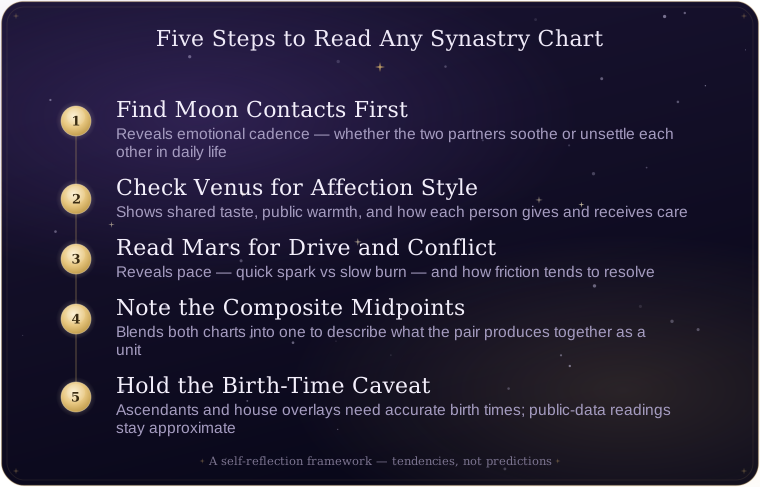
Reading a synastry chart for Swift and Kelce — or any couple — comes down to a handful of observable signals. Work through them in order:
- Find the Moon contacts first. Moon-to-Moon or Moon-to-personal-planet aspects describe emotional cadence — whether the two settle each other or keep each other on edge. According to NASA, the Moon completes one orbit of Earth about every 27.3 days, the same fast rhythm that makes Moon contacts feel like daily-life chemistry.
- Check Venus for affection style. Venus contacts show shared taste, public warmth, and how each person likes to give and receive care.
- Read Mars for drive and conflict. Mars contacts reveal pace — quick spark versus slow burn — and how friction tends to resolve rather than whether it appears.
- Note the composite midpoints. The composite chart, a tradition Dane Rudhyar helped shape, blends both charts into one to describe what the pair produces together as a unit.
- Hold the birth-time caveat. Ascendants and house overlays need accurate birth times, so any public-data reading stays symbolic and reflective.
This is not a clinical interpretation or mental health advice.
Common Misreadings
Popular content gets the Swift–Kelce reading wrong in predictable ways, and most readers arrive already carrying one of them. Here is the correction for each:
- "Matching Sun signs means it works." Misreading: Sagittarius and Libra "click," so the rest is settled. Actual: Sun signs are one data point; the Moon, Venus, and Mars contacts in the Taylor Swift and Travis Kelce charts carry far more of the relationship's day-to-day texture.
- "The composite chart is the same as synastry." Misreading: people use the terms interchangeably. Actual: synastry compares two separate charts, while the composite merges them into a single third chart.
- "A wedding-date number predicts the outcome." Misreading: numerology of a rumored date "confirms" the future. Actual: astrology and numerology describe themes and tendencies, not fixed events.
- "Hard aspects mean doom." Misreading: any square or opposition is a red flag. Actual: friction contacts often describe energy and growth, not a verdict.
The Swift–Kelce Synastry Chart at a Glance
| Property | How It Works | Energy Center | How to Observe |
|---|---|---|---|
| Moon contacts | Sync or strain the couple's emotional rhythm and daily comfort | Moon | Notice whether they seem to soothe or rattle each other in candid moments |
| Venus contacts | Shape affection, shared taste, and public warmth | Venus | Watch for matching style, easy public displays, gift-giving cues |
| Mars contacts | Drive desire and the pace at which conflict moves | Mars | Look at tempo — fast spark versus slow burn, and how friction settles |
| Composite midpoints | Show what the two charts produce together as a unit | Sun–Moon midpoint | Read the "third identity," the public supercouple persona |
Common Questions About the Swift–Kelce Synastry Chart
Are Taylor Swift and Travis Kelce astrologically compatible?
Celebrity astrologers quoted across 2025 coverage of their engagement generally read the pair as compatible. Synastry describes tendencies, though, so a "compatible" label points to supportive contacts rather than a guaranteed result.
What zodiac signs are Taylor Swift and Travis Kelce?
Swift is widely read with a Sagittarius Sun and Kelce with a Libra Sun. Their full charts add Moon, Venus, and Mars placements that a Sun-sign summary leaves out.
What is the difference between a synastry chart and a composite chart?
Synastry compares two separate birth charts and reads the aspects between them. A composite merges both charts into one new chart that describes the partnership as its own entity.
Can you read a synastry chart without exact birth times?
You can read planet-to-planet contacts reasonably well, since the personal planets move on a known schedule. Ascendants and house overlays need accurate birth times, so any public-data read stays approximate.
Reflection Prompts
- Think of a recent moment when a partner's pace matched or clashed with yours — what shifted in how you communicated?
- Recall a bond where shared taste mattered more than you expected. How did it show up day to day?
- Notice when conflict in a close relationship moves fast or slow for you. Which tempo feels more like home?
Related Reading
- composite chart calculator — run any two charts side by side the way this reading does.
- ascendant meaning overview — see why ascendants need accurate birth times before house overlays mean much.
- companion piece on a Sagittarius Sun stack — go deeper on the sign anchoring Swift's chart.
- Synastry (Wikipedia)
Take Action
Open a chart of your own and look for the Moon, Venus, and Mars contacts first — the same three layers that drive every supercouple verdict. You will get a clear, placement-by-placement picture instead of a one-line Sun-sign guess, and once you can read the tempo of a chart, you start to recognize the same patterns shaping your own relationships. Generate your free birth chart to explore Taylor Swift and Travis Kelce.
Sources
- Robert Hand — helped formalize modern synastry as a chart-to-chart comparison method
- Dane Rudhyar — pioneered the person-centered reading of composite charts and astrological cycles
- Liz Greene — shaped the psychological tradition that reads aspects as tendencies rather than fixed fates