What Is a Full Moon Ritual?
A full moon ritual is a structured release and reclamation practice timed to peak lunar light. In practice, it is a short, deliberate ceremony — usually 20 to 40 minutes — performed on or near the night of the full moon, in which you name one thing you are letting go of and one thing you are reclaiming in its place. A typical sequence looks like this: settle into a quiet space, write down what you are releasing, say it out loud, mark the moment with a simple gesture (extinguishing a candle is the most common), then name what fills the cleared space. That is the whole structure. Everything else — crystals, playlists, elaborate altars — is optional decoration around those two acts.
The lineage traces through writers like Dane Rudhyar, who treated the moon's phases as an emotional rhythm rather than a cosmetic calendar event, and modern practice borrows from the subtle-energy frameworks Anodea Judith systematized. But the part most beginners miss is this: the ritual itself is the smaller half of the work. What actually determines whether anything changes is the 48 hours after the flame goes out, when a single concrete choice either confirms the release or quietly dissolves it. Read that way, a full moon ritual is less a magic act than a decision made vivid — a clean way to mark a turning point that the days that follow then make real. (If you want the wider context of why the full moon, specifically, suits this kind of work, start with full moon energy.)
- Centers on the contrast between what you consciously release and what you reclaim in its place
- Treats ceremonial tools (candles, crystals, written intentions) as amplifiers, not sources of power
- Includes a 48-hour integration window after the peak that determines whether intention actually materializes
Why It Matters for Self-Awareness
Understanding what a full moon ritual is matters because most people who try one quit after a single attempt, and the reason isn't lack of belief — it's structural. They invest heavily in the ceremonial layer (the candles, the crystals, the curated playlist) and skip the part that does the actual work. This sits inside the broader rhythm of lunar practice that runs across every phase — the new moon for planting, the full moon for release — but the full moon version carries a specific weight: it asks you to name something out loud, then to live with the silence that follows.
The friction shows up in a predictable shape. Practitioners chase aesthetic completeness and treat the ritual as a sealed event — light the candle, write the intention, blow it out, done. Then nothing materializes, and the practice gets quietly abandoned within a month. The pattern is real, but it is misdiagnosed. It isn't the ritual that failed. It is the 48 hours after the ritual that never happened.
The deeper issue is a category confusion. Practitioners treat the ritual as the cause and behavior change as the effect, when the relationship runs the other way. The decision to release something — articulated cleanly in ritual time — only becomes real when the next two days of choices confirm it. Without that confirmation, the ritual functions as catharsis, which feels good and changes nothing.
Full Moon Ritual vs New Moon Ritual, Manifestation, and Shadow Work
Understanding a full moon ritual against its adjacent practices clarifies how each one functions and what each one costs. The differences are not cosmetic — each comparison comes with a trade-off worth naming.
- Full moon ritual vs new moon ritual. A new moon practice is forward-facing — you plant intention into darkness and wait. The full moon practice is backward-facing — you name what you are releasing because the light has already shown you what no longer fits. To get the clarity of release, you sacrifice the open-ended hope of the new moon's blank-page energy. The two are designed to work as a pair across the cycle; if you set an intention with new moon journal prompts, the full moon ritual two weeks later is where you check what it produced and let go of what it didn't.
- Full moon ritual vs manifestation journaling. Manifestation journaling works through repetition and emotional saturation; it does not require timing. A full moon ritual works through compression — a single high-charge window that forces a decision. To get the intensity of one decisive evening, you sacrifice the steady, low-grade reinforcement that daily journaling provides.
- Full moon ritual vs shadow work. Shadow work, in the lineage Howard Sasportas drew from, is slow excavation across months or years. A full moon ritual is a checkpoint, not an excavation. To get the satisfaction of a clean ritual marker, you sacrifice the depth that only long-form psychological work delivers.
The logic across all three is consistent: the ritual amplifies what is already in motion. It does not generate motion from nothing, and reading it as a power source rather than an amplifier is the most common entry-level mistake.
How to Recognize a Full Moon Ritual That Actually Lands
Knowing what a full moon ritual is on paper is one thing; running one that actually lands is another. The practice has three movements, and the order matters more than any tool you bring to it.
Setting Intention Before the Peak
Before the full moon is exact, get clear on the single thing you are releasing. Not five things — one. Write it in a sentence you can say out loud without a paragraph of qualifiers: "I'm releasing the belief that rest has to be earned," not "I want to feel less stressed and more balanced and also be kinder to myself." Vague intentions do not survive contact with the days that follow. This pre-work is the part most people skip, and it is the part that decides everything else. If you are not sure what to release, a few minutes with full moon journal prompts will usually surface it.
The Release Practice During the Full Moon
On the night itself, the ceremony is short and plain. Speak the release out loud. Mark it with one deliberate gesture — extinguishing a candle, tearing the page, closing the journal. Then, immediately, name what you are reclaiming in the cleared space, and state it as a concrete behavior rather than a feeling: "I'm reclaiming a full night's sleep on weekdays," not "I'm reclaiming my peace." The reclamation half is what keeps a release from becoming an empty subtraction. Close by noticing how you feel — a landed ritual usually produces a quiet drop, not a high.
Integration in the 48 Hours After
This is the half that does the actual work, and it happens after the candle is out. Within two days, make one concrete choice that confirms the release: send the delayed text, decline the invitation, take the rest you said you'd reclaim. Without a single piece of behavioral evidence, the ritual stayed symbolic. Treat the 48-hour window as part of the ritual, not the aftermath — it is where intention either crystallizes into a changed choice or quietly evaporates.
Once you know the three movements, you can read your own practice the morning after. Use these signals before the symbolic warmth has worn off.
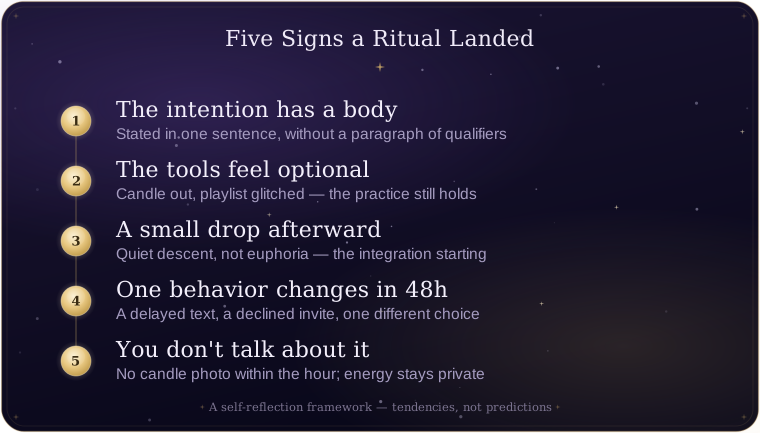
- The intention has a body. You can say out loud what you are releasing in one sentence, without a paragraph of qualifiers. Vague intentions don't survive the 48-hour window.
- The tools feel optional. The candle could go out, the playlist could glitch, the journal page could rip — and the practice would still hold. If the ceremonial layer is load-bearing, the intention layer is hollow.
- You feel a small drop afterward. A landed ritual produces a quiet emotional descent in the hours after, not euphoria. The descent is the integration starting.
- You change one concrete behavior within 48 hours. A delayed text, a declined invitation, a single different choice. Without behavioral evidence, the ritual stayed symbolic.
- You don't talk about it immediately. Posting the candle photo within an hour usually means the energy went into performance instead of integration, and the practice loses most of its private weight.
Common Misreadings
Several misreadings circulate widely and quietly sabotage what is a full moon ritual is supposed to do. Each one looks plausible on the surface and breaks the practice in a different way.
- Misreading: more tools means a stronger ritual. The opposite. The ceremonial layer is decorative — a useful focal point, but not the source. Practitioners who escalate the toolkit (more crystals, longer playlists, more elaborate altars) often dilute the one job the practice actually has: deciding what to release.
- Misreading: the ritual itself is the event. It is the doorway, not the room. The 48 hours after — the integration window where the energetic clearing frameworks Anodea Judith mapped become practical rather than theoretical — is where intention either crystallizes or evaporates.
- Misreading: full moon energy creates the change. The lunar phase is a timing cue, not an external power source. Treating the moon as an agent off-loads responsibility from the practitioner and is the structural reason most rituals don't produce results.
- Misreading: if nothing happens immediately, it didn't work. Release rarely produces same-night clarity. The shape of a working ritual is closer to a slow recession than an instant lift, and judging by the first morning's feeling almost always leads to abandonment.
Full Moon Ritual at a Glance
| Property | How It Works | Lunar Anchor | How to Observe |
|---|---|---|---|
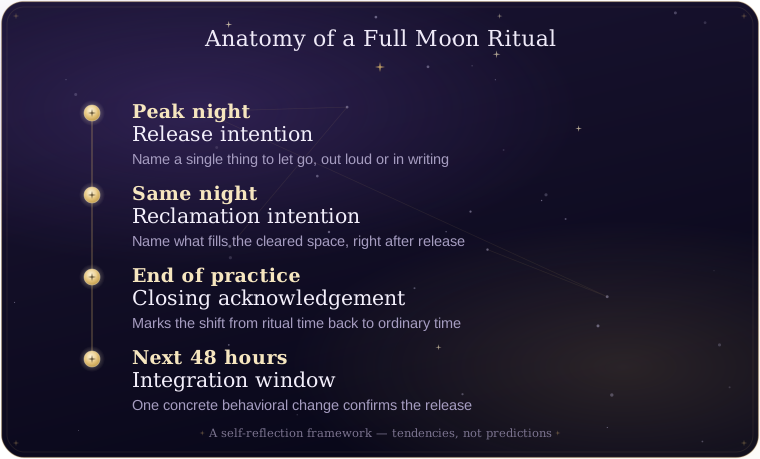
| Release intention | Names a single thing to let go, out loud or in writing | Peak full moon night | Practitioner can state the release in one sentence with no qualifiers |
| Reclamation intention | Names what fills the cleared space | Same night, immediately after release | Practitioner names reclamation as a concrete behavior, not an abstract feeling |
| Ceremonial tools | Sharpen focus on intention; not the source of effect | Optional layer, any time during ritual | Removing the tools would not change the core of the practice |
| 48-hour integration window | Determines whether intention crystallizes into behavior | First 48 hours after peak | At least one concrete behavioral change occurs within the window |
| Closing acknowledgement | Marks transition from ritual time to ordinary time | End of practice | Practitioner notices a quiet emotional drop, not euphoria |
Putting It Into Practice
Simple Full Moon Ritual for Beginners
If you have never done this before, keep it almost embarrassingly plain. You need a few quiet minutes, something to write on, and one optional candle.
- Find the timing. Any of the three nights around the exact full moon works; do not stress about hitting the minute.
- Settle. Sit somewhere undisturbed and take a few slow breaths until the day stops pulling at you.
- Write the release. One sentence: the single thing you are letting go of this cycle.
- Say it out loud, then mark it. Read the sentence aloud. If you lit a candle, blow it out here as the gesture.
- Write the reclamation. One sentence naming the concrete behavior you are reclaiming in its place.
- Close and note how you feel. A quiet drop is a good sign. Then watch the next 48 hours for one choice that proves the release.
That is the entire practice. Everything beyond it is preference, not requirement. The most common beginner mistake is adding more — more crystals, more steps, more candles — when the work is in subtraction, not accumulation. For the broader question of what else to do with the night beyond a single ritual, see what to do on a full moon spiritually.
Full Moon Ritual With Your Birth Chart
A generic full moon ritual works; a chart-informed one is sharper. Each month's full moon falls in a specific sign, and that sign sits in a particular house of your birth chart — the area of life this cycle is asking you to take stock of. A full moon in your fourth house points the release toward home and emotional roots; one in your tenth house points it toward career and public structure. When you know the house, you stop releasing in general and start releasing something situated. The fastest way to find it is to generate your birth chart and note which house the current full moon sign occupies. The two upcoming lunations make good test cases: the June 2026 full moon falls on the Cancer–Capricorn axis, and the July 2026 full moon on the Leo–Aquarius axis, so the house each activates tells you exactly where this cycle's release belongs.
Common Questions About Full Moon Ritual
What is a full moon ritual supposed to feel like?
A working practice produces a quiet emotional descent in the hours after — not a peak experience. The lift, if it comes, arrives gradually across the 48-hour integration window, not in the ritual itself.
Do I need crystals, candles, and a specific altar setup?
No. Tools sharpen focus, but the ritual's structural work is the act of naming a release and a reclamation. Practitioners who strip the ceremonial layer entirely often report stronger results because attention stops migrating to the props.
What does a full moon ritual actually release?
It does not release anything by itself. The ritual creates a deliberate window in which you decide to release something — a story, a pattern, a commitment — and the next 48 hours either reinforce or dissolve that decision through your behavior.
Can I do a full moon ritual the day before or after the actual full moon?
Yes. Lunar energy across the three-day window around peak is functionally similar in most traditions. The structural pieces — the intention and the integration window — matter more than perfect timing to the minute.
Reflection Prompts
- Think back to a recent moment when you almost named something to release, then softened the words — what did the softening protect?
- Recall the last ritual or intention you set; in the 48 hours after, what concrete behavior actually shifted, if any?
- Name one thing you are reclaiming right now that you have not said out loud to another person.
Related Reading
- Full moon energy — why the peak feels amplified and how to read which house and aspects it activates for you.
- What to do on a full moon spiritually — the wider set of practices beyond a single release ritual.
- Full moon journal prompts — questions to surface what you are actually ready to release before the ceremony.
- New moon journal prompts — the forward-facing counterpart you pair with the full moon ritual two weeks later.
- Full moon June 2026 and full moon July 2026 — sign-by-sign context for the next two full moons' specific release themes.
Take Action
Generate your free birth chart to explore full moon ritual. The chart shows where the current full moon is activating points in your natal placements — the specific houses, signs, and planets being asked for release this cycle. Knowing the activation site turns a generic monthly practice into a sharp, situated act of self-awareness, and the integration window that follows becomes much easier to read.
Sources
- Dane Rudhyar — pioneered the person-centered reading of the moon's phases as an emotional rhythm rather than a calendar event.
- Howard Sasportas — established the framework for understanding slow psychological excavation that ritual checkpoints intersect but do not replace.
- Anodea Judith — systematized the modern energetic clearing framework that informs the post-ritual integration window.